The first ISO week of 2026 opens with the JavaScript ecosystem in a reflective, foundations-first mood. The standout essay is Marvin Hagemeister's holiday deep… Compiled for immediate developer deployment.
calendar_todaysummarizeWeek 1-2026bolt1 CRITICAL
article
TAG: LANGUAGE THEORYREAD_TIME: 9_MIN
Signals vs Query-Based Compilers
Marvin Hagemeister draws a structural comparison between Signals (used in UI reactivity) and query-based compiler architectures (used in modern LSPs and tools like rust-analyzer). Both systems share the same core insight — lazy, demand-driven evaluation with cached intermediate results — but differ critically in their change-propagation model. Signals use a push-pull mechanism: a write marks a source dirty and propagates through active subscriptions until an Effect re-pulls, guaranteeing glitch-free, synchronized screen updates within a single frame. Query-based compilers invert this: nothing re-executes automatically; callers must explicitly ask for results, and correctness is enforced instead by a global revision counter with per-node changed_at / verified_at fields. This one-directional dependency tracking trades memory for scalability — a compiler graph can exceed 100k nodes where bidirectional tracking would be prohibitive. The post concludes with an open question about whether a hybrid of both architectures might be the right model for an incremental dev server like Vite.
React Vulnerabilities (Plural), Alpha Navigation, and Apple Finally Kills Your Entry Point
The React Native Rewind newsletter (#25) flags two newly disclosed React vulnerabilities: a high-severity Denial of Service and a medium-severity Code Exposure — separate from the Critical Server Components CVE covered in issue #24. The bulk of the piece covers React Navigation 8.0 (currently alpha), which makes the native bottom navigator the default, requiring an explicit opt-in to the JavaScript-based tabs — a change driven primarily by Liquid Glass on iOS. Type inference for navigation is significantly improved: useNavigation, useRoute, and useNavigationState now infer types automatically from the provided screen name, eliminating the extensive manual TypeScript annotation that previously made navigation types painful to set up. A new pushParams API lets you update a screen's props without triggering a transition or resetting the stack, appending to history so the back action restores previous params — useful for search flows. The NavigationContainer also gains a persistor property for defining custom persist/restore functions to survive app termination.
require(esm) in Node.js: from experiment to stability
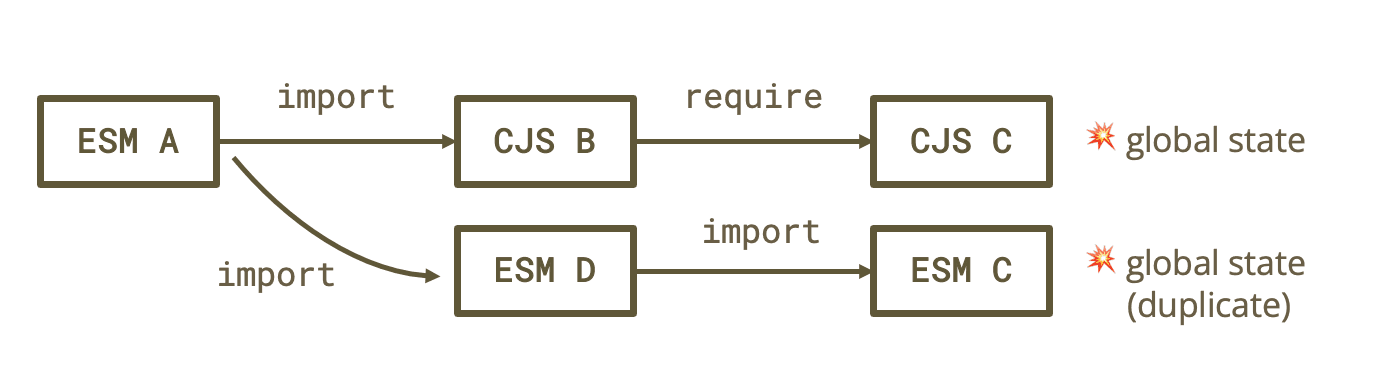
Joyee Cheung, the Node.js contributor who revived require(esm), recounts how the feature progressed from an experimental flag to stable across all supported LTS release lines — available in v20.19.0+ and v22.12.0+ as of end of 2025. The core technical constraint is that require() must stay synchronous, so modules that use top-level await cannot be loaded this way; a September 2024 analysis of the top 5,000 npm packages found only ~0.02% had an irreplaceable use for top-level await in a require-loadable context, while ~20% of ESM-only packages were immediately unblocked. Without this feature, CommonJS remained the path of least resistance as a shipping format because ESM could not be require()-d — pushing package authors toward dual-package distributions (with their hazard of two separate module instances) or faux-ESM (ESM source transpiled to CommonJS in dist/). The backport to v20 required narrowing from 119 to 33 cherry-picked commits to avoid open regressions. Package authors who no longer need to support EOL Node.js versions can now drop CommonJS distributions entirely and simplify their package.jsonexports field.
Rspack 1.7, released December 31 2025, is the final minor release of the 1.x series ahead of Rspack 2.0. The headline improvement is SWC Wasm plugin compatibility: the team replaced version-sensitive rkyv serialization with self-describing cbor, and added an Unknown variant to AST enum types, so most existing plugins built against older SWC versions will survive future SWC upgrades without breakage. Rspack 1.7 also enables lazy compilation by default in the CLI for dynamically imported modules, shrinking the initial module graph and speeding up dev server startup. Three previously experimental features are promoted to stable with their flags deprecated: constant inlining (optimization.inlineExports now controls it), TypeScript enum inlining (collectTypeScriptInfo.exportedEnum), and type re-export checking. On the broader Rstack side, Rsbuild 1.7 adds a runtime error overlay (opt-in via dev.client.overlay.runtime) and per-build asset size diff reporting (performance.printFileSize.diff), while Rslib 0.19 stabilizes ESM library output and introduces a JavaScript API for programmatic builds. Plugin authors must upgrade to swc_core@54 or later to avoid build failures.
Dani Sandoval's monthly Svelte roundup for January 2026 covers ecosystem updates shipped in December 2025. The most developer-impactful change is a new csp option in render's hydratable setting (svelte@5.46.0, PR #17338), which inlines a <script> block into <head> in a Content Security Policy-compatible way — previously a friction point for CSP-strict deployments. The Svelte CLI (sv@0.11.0) can now fully scaffold a SvelteKit project for Cloudflare Workers and Pages without manual configuration. The Vercel adapter (adapter-vercel@6.2.0 / adapter-auto@7.0.0) adds Node 24 runtime support, and the Svelte MCP server now exposes its tools as both a JavaScript API and a CLI (mcp@0.1.16). The language-tools package received substantial performance improvements this cycle — developers should update their editor extensions. Community highlights include Rspress-like static-site generators, terminal emulator and ASCII art Svelte 5 components, and a runtime Svelte component compiler for dynamic user-provided code.
TkDodo's post (part 3 of a design-systems series) argues that the compound component pattern is often misapplied: it excels when children need flexible, user-controlled layout with mostly static elements (e.g., <ButtonGroup>, <TabBar>, <RadioGroup>), but is a poor fit for <Select> (dynamic option sets are better served by a props-based API) or <ModalDialog> (where fixed order and completeness of slots matters more than layout freedom). The key TypeScript challenge is that JSX children don't inherit type parameters from their parent — so even a perfectly typed RadioGroup<ThemeValue> cannot propagate that type literal to its RadioGroupItem children without explicit per-child annotations, which are easily forgotten. The solution introduced is a createRadioGroup<T>() factory function that returns a pre-typed { RadioGroup, RadioGroupItem } object, defaulting the generic to never so callers are forced to provide the type argument. This adds zero runtime overhead but binds the parent and child types together at the call site, reducing annotation burden. The trade-off: consumers must call the factory rather than importing components directly.
Fabian (Coding2GO) covers seven JavaScript patterns that React developers encounter constantly but that can trip up newcomers learning React before mastering the language itself. Destructuring — both object (curly braces, property-name matching) and array (square brackets, used for the useState hook return value) — lets you unpack values in a single declaration. The spread operator (...) creates a new array or object without mutating the original, which is essential when updating state immutably. The map, filter, find, and includes array methods handle data-to-UI transformation, filtering, and lookups. The ternary operator and the logical && operator enable inline conditional rendering. Optional chaining (?.) prevents crashes when accessing properties on potentially null values, while nullish coalescing (??) provides fallbacks only for null/undefined — not falsy values like 0 or ''. ESM import/export wires multi-file component architectures together, and Promises with then/catch (or async/await) handle asynchronous data fetching.
Marvin Hagemeister draws a structural comparison between Signals (used in UI reactivity) and query-based compiler architectures (used in modern LSPs and tools like rust-analyzer). Both systems share the same core insight — lazy, demand-driven evaluation with cached intermediate results — but differ critically in their change-propagation model. Signals use a push-pull mechanism: a write marks a source dirty and propagates through active subscriptions until an Effect re-pulls, guaranteeing glitch-free, synchronized screen updates within a single frame. Query-based compilers invert this: nothing re-executes automatically; callers must explicitly ask for results, and correctness is enforced instead by a global revision counter with per-node changed_at / verified_at fields. This one-directional dependency tracking trades memory for scalability — a compiler graph can exceed 100k nodes where bidirectional tracking would be prohibitive. The post concludes with an open question about whether a hybrid of both architectures might be the right model for an incremental dev server like Vite.
Fabian (Coding2GO) covers seven JavaScript patterns that React developers encounter constantly but that can trip up newcomers learning React before mastering the language itself. Destructuring — both object (curly braces, property-name matching) and array (square brackets, used for the useState hook return value) — lets you unpack values in a single declaration. The spread operator (...) creates a new array or object without mutating the original, which is essential when updating state immutably. The map, filter, find, and includes array methods handle data-to-UI transformation, filtering, and lookups. The ternary operator and the logical && operator enable inline conditional rendering. Optional chaining (?.) prevents crashes when accessing properties on potentially null values, while nullish coalescing (??) provides fallbacks only for null/undefined — not falsy values like 0 or ''. ESM import/export wires multi-file component architectures together, and Promises with then/catch (or async/await) handle asynchronous data fetching.
React Vulnerabilities (Plural), Alpha Navigation, and Apple Finally Kills Your Entry Point
The React Native Rewind newsletter (#25) flags two newly disclosed React vulnerabilities: a high-severity Denial of Service and a medium-severity Code Exposure — separate from the Critical Server Components CVE covered in issue #24. The bulk of the piece covers React Navigation 8.0 (currently alpha), which makes the native bottom navigator the default, requiring an explicit opt-in to the JavaScript-based tabs — a change driven primarily by Liquid Glass on iOS. Type inference for navigation is significantly improved: useNavigation, useRoute, and useNavigationState now infer types automatically from the provided screen name, eliminating the extensive manual TypeScript annotation that previously made navigation types painful to set up. A new pushParams API lets you update a screen's props without triggering a transition or resetting the stack, appending to history so the back action restores previous params — useful for search flows. The NavigationContainer also gains a persistor property for defining custom persist/restore functions to survive app termination.
require(esm) in Node.js: from experiment to stability
Joyee Cheung, the Node.js contributor who revived require(esm), recounts how the feature progressed from an experimental flag to stable across all supported LTS release lines — available in v20.19.0+ and v22.12.0+ as of end of 2025. The core technical constraint is that require() must stay synchronous, so modules that use top-level await cannot be loaded this way; a September 2024 analysis of the top 5,000 npm packages found only ~0.02% had an irreplaceable use for top-level await in a require-loadable context, while ~20% of ESM-only packages were immediately unblocked. Without this feature, CommonJS remained the path of least resistance as a shipping format because ESM could not be require()-d — pushing package authors toward dual-package distributions (with their hazard of two separate module instances) or faux-ESM (ESM source transpiled to CommonJS in dist/). The backport to v20 required narrowing from 119 to 33 cherry-picked commits to avoid open regressions. Package authors who no longer need to support EOL Node.js versions can now drop CommonJS distributions entirely and simplify their package.jsonexports field.
Rspack 1.7, released December 31 2025, is the final minor release of the 1.x series ahead of Rspack 2.0. The headline improvement is SWC Wasm plugin compatibility: the team replaced version-sensitive rkyv serialization with self-describing cbor, and added an Unknown variant to AST enum types, so most existing plugins built against older SWC versions will survive future SWC upgrades without breakage. Rspack 1.7 also enables lazy compilation by default in the CLI for dynamically imported modules, shrinking the initial module graph and speeding up dev server startup. Three previously experimental features are promoted to stable with their flags deprecated: constant inlining (optimization.inlineExports now controls it), TypeScript enum inlining (collectTypeScriptInfo.exportedEnum), and type re-export checking. On the broader Rstack side, Rsbuild 1.7 adds a runtime error overlay (opt-in via dev.client.overlay.runtime) and per-build asset size diff reporting (performance.printFileSize.diff), while Rslib 0.19 stabilizes ESM library output and introduces a JavaScript API for programmatic builds. Plugin authors must upgrade to swc_core@54 or later to avoid build failures.
Dani Sandoval's monthly Svelte roundup for January 2026 covers ecosystem updates shipped in December 2025. The most developer-impactful change is a new csp option in render's hydratable setting (svelte@5.46.0, PR #17338), which inlines a <script> block into <head> in a Content Security Policy-compatible way — previously a friction point for CSP-strict deployments. The Svelte CLI (sv@0.11.0) can now fully scaffold a SvelteKit project for Cloudflare Workers and Pages without manual configuration. The Vercel adapter (adapter-vercel@6.2.0 / adapter-auto@7.0.0) adds Node 24 runtime support, and the Svelte MCP server now exposes its tools as both a JavaScript API and a CLI (mcp@0.1.16). The language-tools package received substantial performance improvements this cycle — developers should update their editor extensions. Community highlights include Rspress-like static-site generators, terminal emulator and ASCII art Svelte 5 components, and a runtime Svelte component compiler for dynamic user-provided code.
TkDodo's post (part 3 of a design-systems series) argues that the compound component pattern is often misapplied: it excels when children need flexible, user-controlled layout with mostly static elements (e.g., <ButtonGroup>, <TabBar>, <RadioGroup>), but is a poor fit for <Select> (dynamic option sets are better served by a props-based API) or <ModalDialog> (where fixed order and completeness of slots matters more than layout freedom). The key TypeScript challenge is that JSX children don't inherit type parameters from their parent — so even a perfectly typed RadioGroup<ThemeValue> cannot propagate that type literal to its RadioGroupItem children without explicit per-child annotations, which are easily forgotten. The solution introduced is a createRadioGroup<T>() factory function that returns a pre-typed { RadioGroup, RadioGroupItem } object, defaulting the generic to never so callers are forced to provide the type argument. This adds zero runtime overhead but binds the parent and child types together at the call site, reducing annotation burden. The trade-off: consumers must call the factory rather than importing components directly.
The first ISO week of 2026 opens with the JavaScript ecosystem in a reflective, foundations-first mood. The standout essay is Marvin Hagemeister's holiday deep dive connecting Signals to the query-based compiler architectures behind modern LSPs — two communities independently converging on demand-driven reactivity, with instructive differences in how they invalidate and memoize.
The platform milestone of the week belongs to Node.js: Joyee Cheung marked require(esm) stable and unflagged across all supported LTS lines, closing a decade of ESM/CJS interop pain, and published the implementer's story behind it. Tooling follows suit — Rspack 1.7 ships as the final 1.x minor, stabilizing SWC Wasm plugin compatibility ahead of 2.0.
Not everything is celebration: the React Native Rewind flags two fresh React vulnerabilities (a high-severity DoS and a medium-severity code exposure) on the heels of December's RSC advisory — the week's must-check item for React teams. Svelte's January update, TkDodo's type-safe compound components, and a pre-React JavaScript refresher round out a quiet but substantive week.
Key Takeaways
require(esm) is now stable across all supported Node.js LTS lines — plan your dual-package strategy retirement.
Audit React and React Native apps against the two newly disclosed vulnerabilities before returning from the holidays.
Signals and query-based compilers share one reactive core — understanding either makes you better at the other.