A year-boundary week made for career and craft. The featured read is Addy Osmani's "21 Lessons From 14 Years at Google" — the thriving engineers, he argues, are… Compiled for immediate developer deployment.
calendar_todaysummarizeWeek 1-2026
article
TAG: DXREAD_TIME: 10_MIN
21 Lessons From 14 Years at Google
Addy Osmani distills 14 years at Google into 21 career principles centered on navigating people, alignment, and ambiguity rather than technical excellence alone. He argues that engineers who thrive work backwards from user problems — spending time in support tickets and watching users struggle — rather than engineering solutions looking for justifications. Several lessons carry concrete operational weight: novelty should be treated like a limited "innovation token" budget spent only where a team is uniquely paid to innovate, since boring technology has known failure modes; and performance wins almost always come from removing work rather than adding cleverness (the fastest code is code that never runs). Osmani warns that glue work — documentation, cross-team coordination, onboarding — is career-dangerous when done invisibly, and that winning every technical argument tends to accumulate silent resistance that surfaces as execution failures, not meeting dissent. The throughline is that learning compounds when it creates new options, not just new trivia, and treating a career like compound interest rather than lottery tickets determines long-term trajectory.
GitHub Security Lab researcher Antonio Morales demonstrates that long-running OSS-Fuzz enrollment is no guarantee of security through three concrete case studies. GStreamer, fuzzed continuously for seven years, had only 2 active fuzzers and 19% code coverage — versus OpenSSL's 139 fuzzers and bzip2's 93% coverage — allowing Morales to find 29 new vulnerabilities in December 2024. Poppler at 60% coverage still missed a 1-click RCE because its dependency DjVuLibre was never instrumented by libFuzzer and was absent from the OSS-Fuzz build entirely, despite being shipped by default with Evince and Papers on millions of Ubuntu systems. Exiv2 missed CVEs including CVE-2025-26623 because researchers fuzz decoders heavily but neglect encoding paths, where vulnerabilities surface in background workflows like thumbnail generation. Morales proposes a five-step workflow — code preparation, edge coverage (target >90%), context-sensitive coverage (target >60% using AFL++ CmpLog or N-Gram branch coverage), value coverage (tracking variable value ranges, not just control-flow paths), and triaging — noting that bugs requiring inputs over 2 GB or execution times exceeding 10 ms still evade all current fuzzers and require static analysis or manual review.
Chrome DevTools features I use all the time — and why you should too
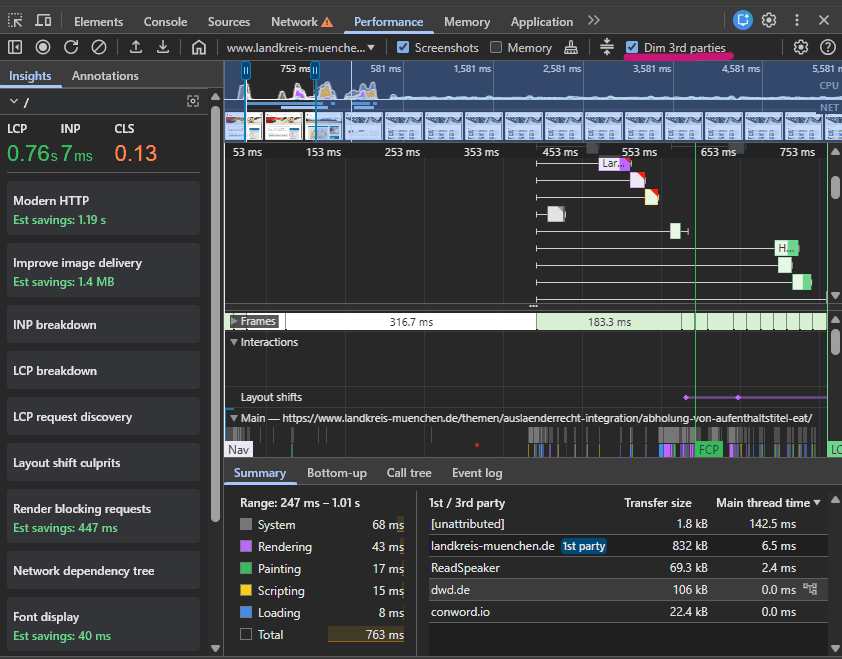
Software architect Keerthana Krishnan (9+ years frontend, speaker at JS Conf Asia 2019 and Performance.now() 2023) profiles seven Chrome DevTools features that shift debugging from reactive to diagnostic. The Accessibility Tree view, reached via the "person" icon in the Elements panel, surfaces missing accessible names, incorrect ARIA roles, and misapplied ARIA attributes that the DOM tree hides entirely. Lighthouse timespans extend auditing beyond initial page load to cover authenticated interactions like form submission and dashboard navigation — exactly where performance regressions hide. Network request blocking, configurable via wildcards, reveals whether third-party script failures, missing image format fallbacks, or dropped "non-critical" resources break real user flows. The Performance panel's flame chart exposes LCP bottlenecks, INP delays, and CLS-causing layout shifts, while the "Dim 3rd parties" toggle removes analytics and ad noise from profiles. The Recorder panel captures reproducible user flows exportable as Puppeteer scripts or as performance profile seeds. Finally, remote debugging via chrome://inspect on Android surfaces CPU and memory constraints absent from desktop testing entirely.
How To Write Good Frontend Tests: 37 Tips and Tricks
This comprehensive guide covers 37 frontend testing principles organized around the thesis that tests should exercise user-facing behavior, not implementation details. Key structural rules include splitting unrelated assertions into separate test() calls, using React Testing Library's query priority order (getByRole > getByLabelText > getByText > getByTestId as last resort), and preferring vi.spyOn() over full vi.mock() to avoid breakage when modules gain new exports. The author argues strongly against over-mocking components — AI is specifically cited as prone to over-mocking because it is uncertain how child components work — and recommends mocking only data-fetching and truly external dependencies while rendering real implementations. Several concrete anti-patterns carry specific consequences: expect(x).toBeDefined() passes even when null is returned; toMatchSnapshot() on large serialized DOMs causes developers to reflexively hit u to update, letting bugs through; and if/else statements inside tests can silently skip expect() calls entirely. Practical recommendations include using vitest --watch filtered to a single file for near-instant feedback, vi.useFakeTimers() for anything date- or timeout-related, and createUser(overrides) fixture helpers to make only the property relevant to each test visible.
Opening and Closing Dialogs Without JavaScript Using HTML Invoker Commands
The HTML Invoker Commands API eliminates the last remaining JavaScript requirement for native <dialog> elements — opening them — by introducing two declarative button attributes. A button annotated with commandFor="dialog-id" and command="show-modal" opens the target dialog as a modal in the browser's top layer, with backdrop, focus management, Esc-key closing, and accessibility tree updates all handled natively. The command="close" attribute on a button inside the dialog replaces the previous <form method="dialog"> workaround. The author notes the API is now supported across all modern browsers, though production use requires evaluating readiness independently; a polyfill by Keith Cirkel is available for environments that need it. The practical consequences of removing even this small script are meaningful: less JavaScript to parse and execute speeds initial load, and declarative markup remains functional even if script delivery fails. The article frames HTML invoker commands as part of a broader platform trend toward native declarative handling of common interactive patterns.
OLTP vs OLAP and the row / column storage tradeoff
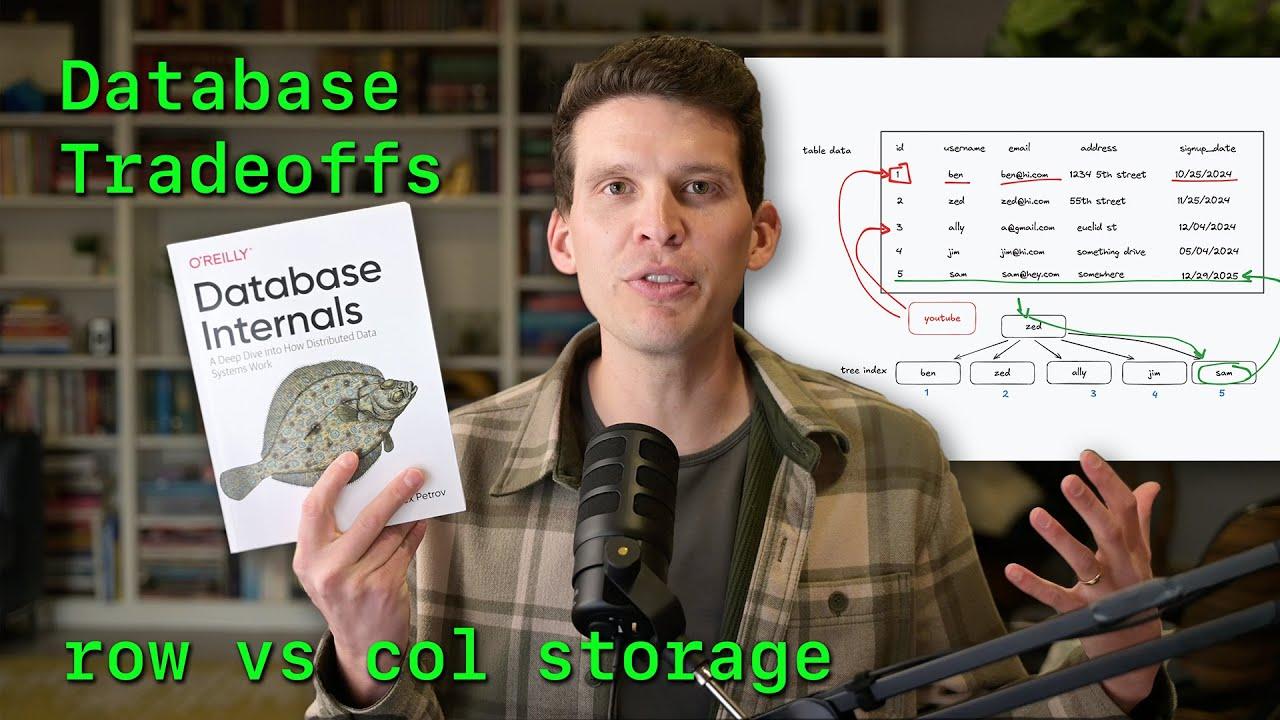
Ben Dicken walks through the three broad database categories — OLTP (online transaction processing), OLAP (analytics), and HTAP (hybrid) — explaining the physical storage tradeoff that drives the split. OLTP systems such as MySQL, PostgreSQL, and SQLite store data row-by-row because application queries typically fetch many columns from a single row at once, and disk reads return 4–16 KB pages that make co-locating a full row efficient. OLAP systems such as ClickHouse, DuckDB, Google BigQuery, and Amazon Redshift store data column-by-column so that analytics queries scanning a single column — like finding sign-up date distributions across billions of rows — skip I/O for every unneeded column entirely. Column storage gains a second advantage through compression: a billion sign-up dates drawn from only ~7,000 distinct day values compress aggressively with run-length encoding, enabling pre-aggregation that accelerates query execution. Dicken notes that HTAP databases like SingleStore attempt both but introduce compute contention and data-duplication challenges at scale; at large enough scale, separate OLTP and OLAP pipelines remain the more reliable architecture.
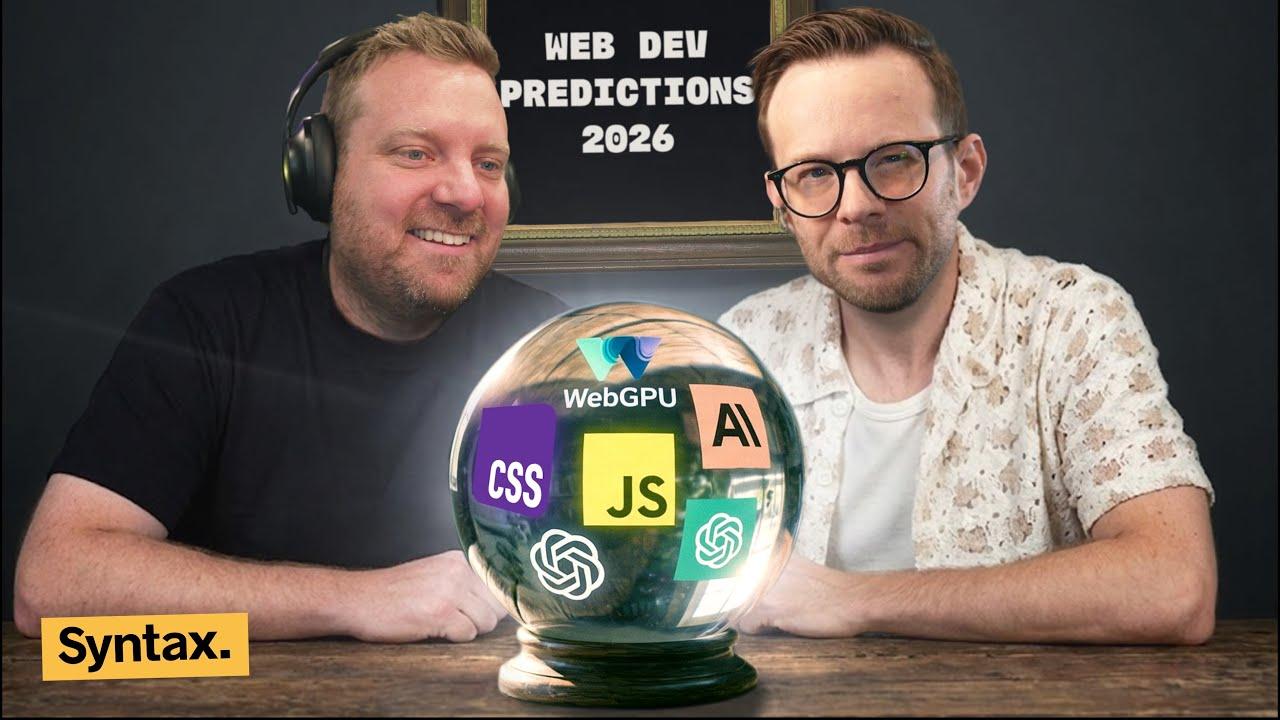
Syntax hosts Wes Bos and Scott Tolinski lay out concrete 2026 predictions in this ~48-minute episode, arguing that the Temporal API will finally ship cross-browser (Chrome stable in January 2026, Safari still pending), and that Oxlint will displace Biome as the dominant non-Prettier linter because Biome requires GritQL for plugins while Oxlint is Rust-based but accepts JavaScript plugins and targets full ESLint spec compatibility. They predict WebGPU-driven 3D experiences will mainstream following the wave sparked by the Lando Norris website, and that modern CSS features — scroll animations, scroll markers, CSS anchor positioning, popover, if statements, and custom CSS functions — will reach widespread practical use, potentially allowing UI frameworks to drop JavaScript polyfills entirely. On the AI tooling side, they forecast end-to-end agent integration (planning, coding, Playwright-driven browser testing) will significantly accelerate shipping, while also warning that developers who delegate entirely to AI risk skill atrophy. They also predict durable-compute platforms like Temporal.io and Ingest will become mainstream alternatives to queues, enabling pausable/resumable workflows with await semantics inside long-running functions.
Addy Osmani distills 14 years at Google into 21 career principles centered on navigating people, alignment, and ambiguity rather than technical excellence alone. He argues that engineers who thrive work backwards from user problems — spending time in support tickets and watching users struggle — rather than engineering solutions looking for justifications. Several lessons carry concrete operational weight: novelty should be treated like a limited "innovation token" budget spent only where a team is uniquely paid to innovate, since boring technology has known failure modes; and performance wins almost always come from removing work rather than adding cleverness (the fastest code is code that never runs). Osmani warns that glue work — documentation, cross-team coordination, onboarding — is career-dangerous when done invisibly, and that winning every technical argument tends to accumulate silent resistance that surfaces as execution failures, not meeting dissent. The throughline is that learning compounds when it creates new options, not just new trivia, and treating a career like compound interest rather than lottery tickets determines long-term trajectory.
OLTP vs OLAP and the row / column storage tradeoff
Ben Dicken walks through the three broad database categories — OLTP (online transaction processing), OLAP (analytics), and HTAP (hybrid) — explaining the physical storage tradeoff that drives the split. OLTP systems such as MySQL, PostgreSQL, and SQLite store data row-by-row because application queries typically fetch many columns from a single row at once, and disk reads return 4–16 KB pages that make co-locating a full row efficient. OLAP systems such as ClickHouse, DuckDB, Google BigQuery, and Amazon Redshift store data column-by-column so that analytics queries scanning a single column — like finding sign-up date distributions across billions of rows — skip I/O for every unneeded column entirely. Column storage gains a second advantage through compression: a billion sign-up dates drawn from only ~7,000 distinct day values compress aggressively with run-length encoding, enabling pre-aggregation that accelerates query execution. Dicken notes that HTAP databases like SingleStore attempt both but introduce compute contention and data-duplication challenges at scale; at large enough scale, separate OLTP and OLAP pipelines remain the more reliable architecture.
Syntax hosts Wes Bos and Scott Tolinski lay out concrete 2026 predictions in this ~48-minute episode, arguing that the Temporal API will finally ship cross-browser (Chrome stable in January 2026, Safari still pending), and that Oxlint will displace Biome as the dominant non-Prettier linter because Biome requires GritQL for plugins while Oxlint is Rust-based but accepts JavaScript plugins and targets full ESLint spec compatibility. They predict WebGPU-driven 3D experiences will mainstream following the wave sparked by the Lando Norris website, and that modern CSS features — scroll animations, scroll markers, CSS anchor positioning, popover, if statements, and custom CSS functions — will reach widespread practical use, potentially allowing UI frameworks to drop JavaScript polyfills entirely. On the AI tooling side, they forecast end-to-end agent integration (planning, coding, Playwright-driven browser testing) will significantly accelerate shipping, while also warning that developers who delegate entirely to AI risk skill atrophy. They also predict durable-compute platforms like Temporal.io and Ingest will become mainstream alternatives to queues, enabling pausable/resumable workflows with await semantics inside long-running functions.
GitHub Security Lab researcher Antonio Morales demonstrates that long-running OSS-Fuzz enrollment is no guarantee of security through three concrete case studies. GStreamer, fuzzed continuously for seven years, had only 2 active fuzzers and 19% code coverage — versus OpenSSL's 139 fuzzers and bzip2's 93% coverage — allowing Morales to find 29 new vulnerabilities in December 2024. Poppler at 60% coverage still missed a 1-click RCE because its dependency DjVuLibre was never instrumented by libFuzzer and was absent from the OSS-Fuzz build entirely, despite being shipped by default with Evince and Papers on millions of Ubuntu systems. Exiv2 missed CVEs including CVE-2025-26623 because researchers fuzz decoders heavily but neglect encoding paths, where vulnerabilities surface in background workflows like thumbnail generation. Morales proposes a five-step workflow — code preparation, edge coverage (target >90%), context-sensitive coverage (target >60% using AFL++ CmpLog or N-Gram branch coverage), value coverage (tracking variable value ranges, not just control-flow paths), and triaging — noting that bugs requiring inputs over 2 GB or execution times exceeding 10 ms still evade all current fuzzers and require static analysis or manual review.
Chrome DevTools features I use all the time — and why you should too
Software architect Keerthana Krishnan (9+ years frontend, speaker at JS Conf Asia 2019 and Performance.now() 2023) profiles seven Chrome DevTools features that shift debugging from reactive to diagnostic. The Accessibility Tree view, reached via the "person" icon in the Elements panel, surfaces missing accessible names, incorrect ARIA roles, and misapplied ARIA attributes that the DOM tree hides entirely. Lighthouse timespans extend auditing beyond initial page load to cover authenticated interactions like form submission and dashboard navigation — exactly where performance regressions hide. Network request blocking, configurable via wildcards, reveals whether third-party script failures, missing image format fallbacks, or dropped "non-critical" resources break real user flows. The Performance panel's flame chart exposes LCP bottlenecks, INP delays, and CLS-causing layout shifts, while the "Dim 3rd parties" toggle removes analytics and ad noise from profiles. The Recorder panel captures reproducible user flows exportable as Puppeteer scripts or as performance profile seeds. Finally, remote debugging via chrome://inspect on Android surfaces CPU and memory constraints absent from desktop testing entirely.
How To Write Good Frontend Tests: 37 Tips and Tricks
This comprehensive guide covers 37 frontend testing principles organized around the thesis that tests should exercise user-facing behavior, not implementation details. Key structural rules include splitting unrelated assertions into separate test() calls, using React Testing Library's query priority order (getByRole > getByLabelText > getByText > getByTestId as last resort), and preferring vi.spyOn() over full vi.mock() to avoid breakage when modules gain new exports. The author argues strongly against over-mocking components — AI is specifically cited as prone to over-mocking because it is uncertain how child components work — and recommends mocking only data-fetching and truly external dependencies while rendering real implementations. Several concrete anti-patterns carry specific consequences: expect(x).toBeDefined() passes even when null is returned; toMatchSnapshot() on large serialized DOMs causes developers to reflexively hit u to update, letting bugs through; and if/else statements inside tests can silently skip expect() calls entirely. Practical recommendations include using vitest --watch filtered to a single file for near-instant feedback, vi.useFakeTimers() for anything date- or timeout-related, and createUser(overrides) fixture helpers to make only the property relevant to each test visible.
Opening and Closing Dialogs Without JavaScript Using HTML Invoker Commands
The HTML Invoker Commands API eliminates the last remaining JavaScript requirement for native <dialog> elements — opening them — by introducing two declarative button attributes. A button annotated with commandFor="dialog-id" and command="show-modal" opens the target dialog as a modal in the browser's top layer, with backdrop, focus management, Esc-key closing, and accessibility tree updates all handled natively. The command="close" attribute on a button inside the dialog replaces the previous <form method="dialog"> workaround. The author notes the API is now supported across all modern browsers, though production use requires evaluating readiness independently; a polyfill by Keith Cirkel is available for environments that need it. The practical consequences of removing even this small script are meaningful: less JavaScript to parse and execute speeds initial load, and declarative markup remains functional even if script delivery fails. The article frames HTML invoker commands as part of a broader platform trend toward native declarative handling of common interactive patterns.
A year-boundary week made for career and craft. The featured read is Addy Osmani's "21 Lessons From 14 Years at Google" — the thriving engineers, he argues, are the ones who learned to navigate people, politics, alignment, and ambiguity, not just the compiler. Syntax's 2026 predictions episode supplies the ecosystem-level counterpart, and Ben Dicken's OLTP-vs-OLAP explainer keeps the fundamentals honest with a visual tour of the row/column storage trade-off.
The testing and tooling thread is unusually strong: GitHub Security Lab dissects why bugs survive years of continuous fuzzing across OSS-Fuzz's1,300+ projects; How To Test Frontend collects 37 field-tested tips for tests you can still read six months later; and the Performance Calendar closes its season with the Chrome DevTools features worth building into daily habit. A two-minute gem — HTML invoker commands opening and closing <dialog> without JavaScript — is the week's quickest win.
Key Takeaways
Career leverage comes from navigating ambiguity and alignment, not only from code quality.
Continuous fuzzing is not a guarantee — treat long-fuzzed dependencies as still worth auditing.
Adopt HTML invoker commands for dialogs — one less JavaScript wiring task in every project.