The AI-in-development theme dominated this week's general web development discussion. Addy Osmani coined the "orchestration tax" — the hidden cognitive cost when… Compiled for immediate developer deployment.
calendar_todaysummarizeWeek 21-2026
article
TAG: AI-WORKFLOWSREAD_TIME: 7_MIN
The Orchestration Tax
Addy Osmani introduces the concept of the 'orchestration tax' — the hidden cognitive cost engineers pay when running many AI agents in parallel. Drawing on Amdahl's Law and the analogy of the GIL (Global Interpreter Lock), he argues that human judgment is the single serial bottleneck: agents can parallelize freely, but code review, conflict resolution, and architectural decisions still route through one person. Practical strategies include scaling your agent fleet to match your actual review rate, batching agent reviews to minimize context-switch costs, sorting tasks into isolated-delegatable versus judgment-required piles, and reserving your best hours for the bottleneck, not for orchestration overhead. Feeling busy running 20 agents is not the same as shipping good code.
Building the Playground: How to Prep Your Codebase for AI Coders
Nadia Makarevich documents how she turned a 300k-line TypeScript codebase into an AI-friendly environment over six months. The foundation is a strict CI/CD pipeline with TypeScript, ESLint (including a no-explicit-any rule that eliminated over 1,000 violations), Prettier, and automated pre-merge checks. On top of that she layered four guardrails: comprehensive skills and architecture docs with reference implementations, an AI-powered PR review skill that checks compliance against those docs, a PR checklist bot that triggers automatically on every pull request, and custom ESLint rules with AI-targeted error messages that link directly to relevant docs. The result is that non-engineers — designers, product managers — are now shipping compliant, quality PRs without engineering having a breakdown.
This essay by Mauro Bieg draws a direct parallel between the deskilling of frontend development by JavaScript frameworks over the past decade and the broader deskilling of programming by agentic AI today. Both reduce barriers to entry, shift labor toward generalists, and weaken worker bargaining power. The author frames agentic coding as an inherently non-deterministic, leaky abstraction — unlike a compiler — and likens prompt engineering to the lost art of Google-fu. Drawing on the Bauhaus movement's response to industrialization, he argues the answer is not historicism but deep material knowledge: just as industrial designers must know their materials, web developers must be intimate with HTML and CSS. Craft will become a smaller slice of a larger pie, but it will not disappear.
How Node.js and V8 Keep Each Other Working: Workflows, Challenges, and Tips
Node.js core contributor Joyee Cheung maps the full cross-project maintenance relationship between Node.js and V8. Key topics include how Node.js maintains a fork of V8 under deps/v8 with floated patches and monthly upstream sync PRs, the build system mismatch (Node.js uses GYP; V8 uses GN), the platform support gap between V8's pinned Clang/libc++ and Node.js's GCC/libstdc++ on Linux and ClangCL on Windows, and V8's pointer-compression trade-off that Node.js opts out of for backward compatibility. She also explains the ABI freeze per major release line, why even-numbered releases were delayed into May in both 2025 and 2026, and practical workflows for testing, floating, and upstreaming patches between the two projects usinggit-node-v8 and node-core-utils.
AI-Assisted Engineers Are Burning Out — Is This Fine?
Evil Martians examines the emerging burnout crisis among developers using AI-assisted workflows, backed by a Harvard Business Review study confirming that AI tools increase perceived workload. The article models the cognitive asymmetry: an engineer using AI may finish a task twice as fast but at higher cognitive intensity, then takes on more tasks and accumulates an energy deficit. Three root causes are identified — reduced fulfillment from skipping the crafting phase, higher work intensity during review and steering, and a growing quantity of tasks. Contributing daily factors include loss of codebase context to agents, elimination of passive thinking time, false pace expectations set by early AI euphoria, and senior-engineer review bottlenecks. Practical countermeasures cover craft-hour protection, work-life discipline, plan-before-generate workflows, and finding new satisfaction areas in the evolved role.
The Express.js project has launched a fully redesigned website and a new brand identity after more than a year of community-driven work. The site was migrated from Jekyll to Astro, chosen for its flexibility with content-heavy pages, strong i18n support, and a framework-agnostic component model. Documentation improvements include side-by-side versioning for Express 4 and Express 5, an AI-powered natural-language search built on Orama, and an llms.txt endpoint for LLM tooling. The new logo was developed through a public community workshop with the Orama team and the Express Technical Committee. Future roadmap items include filling API documentation gaps, improving translations, and aligning releases with documentation.
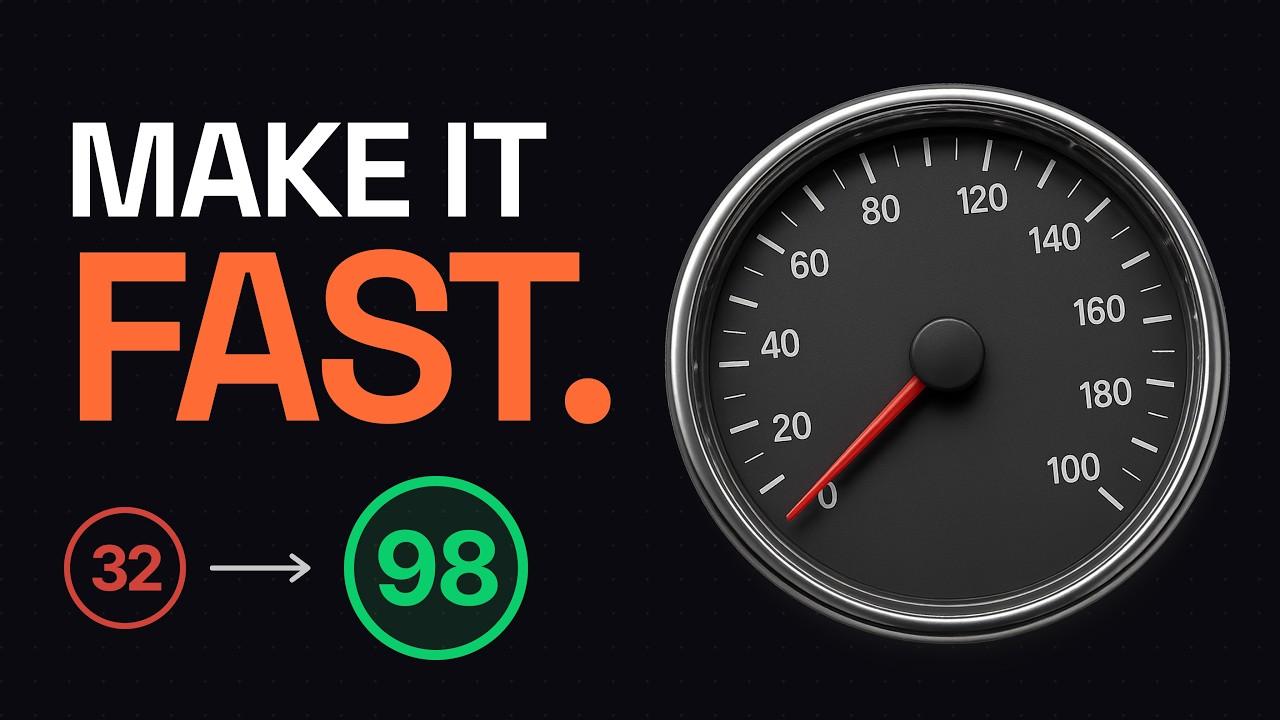
LearnThatStack walks through a systematic web performance audit covering the four main Lighthouse warning categories: CSS, images, JavaScript, and fonts. CSS fixes include inlining critical styles with Beasties, shipping only used utility classes via Tailwind or PurgeCSS, and applying content-visibility: auto to below-the-fold sections. For images, the video demonstrates cutting a 4MB hero image to 100KB using ImageKit's URL-based transformations with f-auto format negotiation. JavaScript strategies cover code splitting with dynamic imports, switching script tags from synchronous to defer, and running a bundle analyzer to eliminate dead weight like Moment.js. Font best practices include font-display: swap, self-hosting WOFF2 files, variable fonts for multi-weight typefaces, and subsetting with Glyphhanger. Delivery optimizations round out the video: CDN deployment, cache-control immutable headers for hashed assets, Brotli compression, and preconnect hints.
Addy Osmani introduces the concept of the 'orchestration tax' — the hidden cognitive cost engineers pay when running many AI agents in parallel. Drawing on Amdahl's Law and the analogy of the GIL (Global Interpreter Lock), he argues that human judgment is the single serial bottleneck: agents can parallelize freely, but code review, conflict resolution, and architectural decisions still route through one person. Practical strategies include scaling your agent fleet to match your actual review rate, batching agent reviews to minimize context-switch costs, sorting tasks into isolated-delegatable versus judgment-required piles, and reserving your best hours for the bottleneck, not for orchestration overhead. Feeling busy running 20 agents is not the same as shipping good code.
LearnThatStack walks through a systematic web performance audit covering the four main Lighthouse warning categories: CSS, images, JavaScript, and fonts. CSS fixes include inlining critical styles with Beasties, shipping only used utility classes via Tailwind or PurgeCSS, and applying content-visibility: auto to below-the-fold sections. For images, the video demonstrates cutting a 4MB hero image to 100KB using ImageKit's URL-based transformations with f-auto format negotiation. JavaScript strategies cover code splitting with dynamic imports, switching script tags from synchronous to defer, and running a bundle analyzer to eliminate dead weight like Moment.js. Font best practices include font-display: swap, self-hosting WOFF2 files, variable fonts for multi-weight typefaces, and subsetting with Glyphhanger. Delivery optimizations round out the video: CDN deployment, cache-control immutable headers for hashed assets, Brotli compression, and preconnect hints.
Building the Playground: How to Prep Your Codebase for AI Coders
Nadia Makarevich documents how she turned a 300k-line TypeScript codebase into an AI-friendly environment over six months. The foundation is a strict CI/CD pipeline with TypeScript, ESLint (including a no-explicit-any rule that eliminated over 1,000 violations), Prettier, and automated pre-merge checks. On top of that she layered four guardrails: comprehensive skills and architecture docs with reference implementations, an AI-powered PR review skill that checks compliance against those docs, a PR checklist bot that triggers automatically on every pull request, and custom ESLint rules with AI-targeted error messages that link directly to relevant docs. The result is that non-engineers — designers, product managers — are now shipping compliant, quality PRs without engineering having a breakdown.
This essay by Mauro Bieg draws a direct parallel between the deskilling of frontend development by JavaScript frameworks over the past decade and the broader deskilling of programming by agentic AI today. Both reduce barriers to entry, shift labor toward generalists, and weaken worker bargaining power. The author frames agentic coding as an inherently non-deterministic, leaky abstraction — unlike a compiler — and likens prompt engineering to the lost art of Google-fu. Drawing on the Bauhaus movement's response to industrialization, he argues the answer is not historicism but deep material knowledge: just as industrial designers must know their materials, web developers must be intimate with HTML and CSS. Craft will become a smaller slice of a larger pie, but it will not disappear.
How Node.js and V8 Keep Each Other Working: Workflows, Challenges, and Tips
Node.js core contributor Joyee Cheung maps the full cross-project maintenance relationship between Node.js and V8. Key topics include how Node.js maintains a fork of V8 under deps/v8 with floated patches and monthly upstream sync PRs, the build system mismatch (Node.js uses GYP; V8 uses GN), the platform support gap between V8's pinned Clang/libc++ and Node.js's GCC/libstdc++ on Linux and ClangCL on Windows, and V8's pointer-compression trade-off that Node.js opts out of for backward compatibility. She also explains the ABI freeze per major release line, why even-numbered releases were delayed into May in both 2025 and 2026, and practical workflows for testing, floating, and upstreaming patches between the two projects usinggit-node-v8 and node-core-utils.
AI-Assisted Engineers Are Burning Out — Is This Fine?
Evil Martians examines the emerging burnout crisis among developers using AI-assisted workflows, backed by a Harvard Business Review study confirming that AI tools increase perceived workload. The article models the cognitive asymmetry: an engineer using AI may finish a task twice as fast but at higher cognitive intensity, then takes on more tasks and accumulates an energy deficit. Three root causes are identified — reduced fulfillment from skipping the crafting phase, higher work intensity during review and steering, and a growing quantity of tasks. Contributing daily factors include loss of codebase context to agents, elimination of passive thinking time, false pace expectations set by early AI euphoria, and senior-engineer review bottlenecks. Practical countermeasures cover craft-hour protection, work-life discipline, plan-before-generate workflows, and finding new satisfaction areas in the evolved role.
The Express.js project has launched a fully redesigned website and a new brand identity after more than a year of community-driven work. The site was migrated from Jekyll to Astro, chosen for its flexibility with content-heavy pages, strong i18n support, and a framework-agnostic component model. Documentation improvements include side-by-side versioning for Express 4 and Express 5, an AI-powered natural-language search built on Orama, and an llms.txt endpoint for LLM tooling. The new logo was developed through a public community workshop with the Orama team and the Express Technical Committee. Future roadmap items include filling API documentation gaps, improving translations, and aligning releases with documentation.
The AI-in-development theme dominated this week's general web development discussion. Addy Osmani coined the "orchestration tax" — the hidden cognitive cost when human judgment becomes the single serial bottleneck across a fleet of parallel AI agents — and recommended matching agent count to actual review capacity, batching reviews to reduce context-switch overhead, and protecting peak hours for bottleneck work rather than orchestration. Nadia Makarevich documented a concrete six-month process for making a 300k-line TypeScript codebase AI-ready: strict ESLint (including no-explicit-any, eliminating 1,000+ violations), automated pre-merge CI, architecture docs with reference implementations, an AI-powered PR review skill, a PR checklist bot, and custom ESLint rules with AI-targeted error messages linking to documentation.
Evil Martians connected AI-assisted workflows to developer burnout, citing a Harvard Business Review study: engineers finish tasks twice as fast but at higher cognitive intensity, take on more tasks, and accumulate an energy deficit. Root causes include reduced fulfillment from skipping the crafting phase, elevated review intensity, and increased task volume. Practical countermeasures cover protecting craft hours, plan-before-generate workflows, and finding new satisfaction in the evolved role. Mauro Bieg drew a structural parallel between JavaScript frameworks deskilling frontend development over the past decade and agentic AI deskilling programming broadly today, arguing that deep material knowledge of HTML and CSS remains indispensable.
On infrastructure and ecosystem news, Joyee Cheung mapped the full Node.js/V8 maintenance relationship including floated patches, build system mismatches (GYP vs. GN), and platform compatibility gaps. Express.js relaunched its website on Astro with Orama-powered AI search and an llms.txt endpoint. A web performance audit video walked through Lighthouse-based CSS, image, JavaScript, and font optimization techniques including Beasties for critical CSS inlining, ImageKit URL transforms, dynamic imports, and Glyphhanger for font subsetting.
Key Takeaways
The "orchestration tax" is real: human review is the serial bottleneck in AI-agent workflows, so match your agent fleet size to your actual review throughput rather than running as many agents as possible.
A Harvard Business Review study confirms AI-assisted engineers accumulate an energy deficit — protect dedicated craft hours and adopt plan-before-generate workflows to prevent AI-assisted burnout.
Making a codebase AI-ready requires systemic guardrails: strict ESLint with AI-targeted error messages, architecture docs with reference implementations, and an automated PR checklist bot — not just adding an AI tool.