Styling Week 41: native tooltips, scroll scenes and formula inputs
Explore native popovers and their accessibility limits, CSS scroll-scene composition, formula-aware inputs, and responsive grids that handle narrow containers. Compiled for immediate developer deployment.
calendar_todaysummarizeWeek 41-2026
article
TAG: DXREAD_TIME: 4_MIN
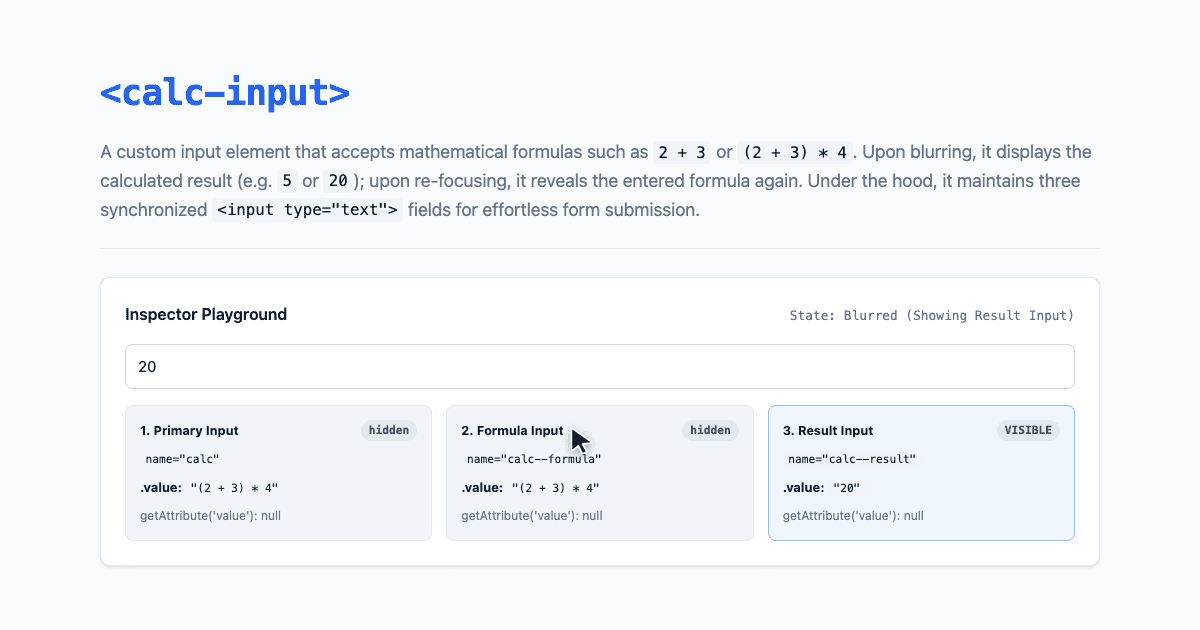
<calc-input>, a custom input element that accepts mathematical formulas
Bramus introduces calc-input, a custom element for forms where users need to calculate a value and later inspect how they obtained it. Focusing the control shows the formula, while blur shows the calculated result, using three ordinary text inputs in the Light DOM. The author describes a recursive-descent expression parser without eval(), and invalid formulas remain editable while native constraint validation blocks submission. Submission modes determine whether the primary field contains the formula or result and whether companion fields are sent. The default sends all three fields, so payload shape deserves explicit agreement with the backend. This is a reusable numeric-entry pattern, not an independent security audit; validate submitted values on the server and test the control's focus and labeling behavior.
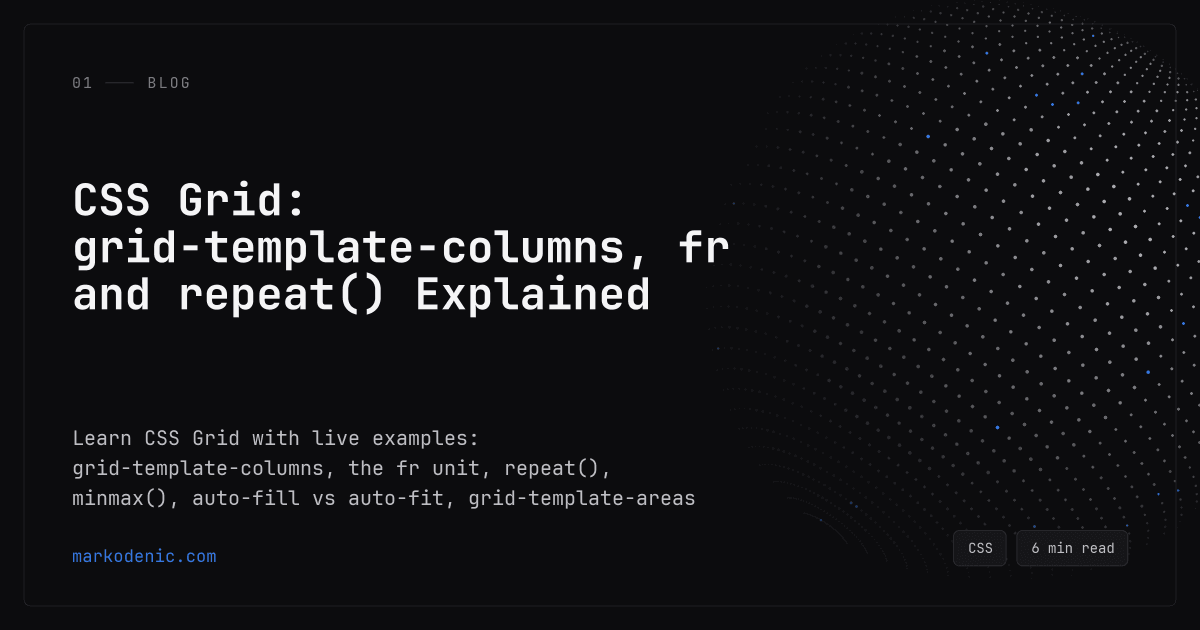
CSS Grid: grid-template-columns, fr and repeat() Explained
Marko Denic's CSS Grid guide explains how fixed tracks, gaps, and fractional space interact before moving to responsive card patterns. Fractional tracks divide remaining space, but their content-based minimum can still force a layout wider than its container. minmax(0, 1fr) allows a track to shrink, while oversized content may still need its own overflow treatment. For automatic card columns, auto-fill preserves empty tracks and auto-fit collapses them so populated tracks expand. The guide also bounds a nominal card minimum by 100% of the container, preventing that minimum from exceeding a very narrow viewport. Treat these as established layout techniques and choose the empty-track behavior deliberately, then test long URLs, code, and small containers rather than assuming equal fractions guarantee a fit.
Rethinking Tooltips with Interest Invokers and Popover API - Martine Dowden - NDC Oslo 2026
Martine Dowden demonstrates how native popovers can replace parts of tooltip positioning and interaction code, then shows where responsibility remains with the developer. The top layer avoids ordinary stacking constraints, while CSS anchor positioning and fallback positions address screen-edge placement where supported. Auto, hint, and manual popovers have different dismissal behavior; manual controls require particular care with focus and keyboard escape paths. Interest invokers add hover and focus triggers, but their support is more limited than the base Popover API. Screen-reader demonstrations expose announcement and focus differences, rather than proving universal accessibility. Test the chosen browser and assistive-technology combinations, keep essential information reachable, and treat evolving features as progressive enhancements with fallbacks.
Kevin Powell recreates a GTA 6-style sequence of overlapping scenes using CSSview timelines rather than scripting the scroll progress. Viewport-height wrappers stay in document flow while fixed inner layers overlap, and named timelines connect each wrapper's progress to its scene. Separate entry and exit opacity animations create crossfades, with a scale change from 1.1 to 1 adding a subtle zoom. The walkthrough also fixes a stacking-context problem and animates a text gradient through registered custom properties. This is a visual recreation, with limited browser support and unresolved accessibility questions around hidden decorative layers; it does not provide a reduced-motion solution. Adapt the composition after checking support, motion preferences, and the accessibility of overlapping content in your own interface.
<calc-input>, a custom input element that accepts mathematical formulas
Bramus introduces calc-input, a custom element for forms where users need to calculate a value and later inspect how they obtained it. Focusing the control shows the formula, while blur shows the calculated result, using three ordinary text inputs in the Light DOM. The author describes a recursive-descent expression parser without eval(), and invalid formulas remain editable while native constraint validation blocks submission. Submission modes determine whether the primary field contains the formula or result and whether companion fields are sent. The default sends all three fields, so payload shape deserves explicit agreement with the backend. This is a reusable numeric-entry pattern, not an independent security audit; validate submitted values on the server and test the control's focus and labeling behavior.
CSS Grid: grid-template-columns, fr and repeat() Explained
Marko Denic's CSS Grid guide explains how fixed tracks, gaps, and fractional space interact before moving to responsive card patterns. Fractional tracks divide remaining space, but their content-based minimum can still force a layout wider than its container. minmax(0, 1fr) allows a track to shrink, while oversized content may still need its own overflow treatment. For automatic card columns, auto-fill preserves empty tracks and auto-fit collapses them so populated tracks expand. The guide also bounds a nominal card minimum by 100% of the container, preventing that minimum from exceeding a very narrow viewport. Treat these as established layout techniques and choose the empty-track behavior deliberately, then test long URLs, code, and small containers rather than assuming equal fractions guarantee a fit.
Martine Dowden's tooltip talk separates the Popover API's native interaction from CSS anchor positioning and more limitedinterest invokers. The top layer simplifies stacking, but manual dismissal, focus return, announcements, and essential information still need deliberate design. Browser and screen-reader testing remain part of the implementation.
Kevin Powell's CSS scroll scenes connect in-flow wrappers to fixed layers with view timelines, then split entry and exit animations for crossfades. The recreation explains composition and stacking, while leaving browser support, overlapping-layer accessibility, and reduced-motion handling for further work. Treat visual effects as enhancements after the interaction remains usable.
Bramus's calc-input preserves a formula alongside its result, using native text inputs and constraint validation while making submission modes explicit. Marko Denic's grid guide addresses another boundary: track minimums and empty columns can change whether content fits. Test the form payload and narrow-container behavior as carefully as the polished visual state.
Key Takeaways
Test popover focus, dismissal, and announcements with target browsers and screen readers.
Add your own support and reduced-motion checks before adapting the CSS scroll-scene recreation.
Agree calc-input submission modes with the backend and test grid minimums with long content.