articleTAG: ECOSYSTEMREAD_TIME: 5_MIN
Git security vulnerabilities announced
Elijah Newren details six Git vulnerabilities fixed in Git 2.56.1 and patched maintenance releases. One recursive-clone issue can redirect submodule metadata through path truncation and lead to hook execution, while other flaws involve protocol paths, signature processing, binary patches, and large merges. The attack conditions differ, making automation that clones or processes untrusted repositories a particularly relevant review point. GitHub’s cloud service was patched, but the announcement distinguishes that from client and development-environment updates still being rolled out. Check the Git actually bundled into CI images, desktops, and remote workspaces, then apply an appropriate fixed release; a patched hosting service does not establish that every local executable or repository-processing workflow is already protected.
TAG: ECOSYSTEMREAD_TIME: 10_MIN
wfx-loot campaign pushes CI secret stealer to tens of thousands of repositories
Aikido traces a campaign in which stolen GitHub credentials were used to probe write access and introduce CI secret-stealing workflows. A probe pull request demonstrates account access, not that the later payload executed in every repository contacted. The report describes workflow cleanup and attempts to retain cloud access through identity-trust changes, which can outlast the original token. Its execution totals disagree internally, so the exact conflicting counts should not anchor an exposure estimate; affected Go tags also do not by themselves show that package consumers executed malware. Review workflow history and evidence of execution, investigate changes to cloud trust relationships, and scope credential rotation accordingly rather than equating a large probe campaign with the same number of confirmed compromises.
TAG: ECOSYSTEMREAD_TIME: 21_MIN
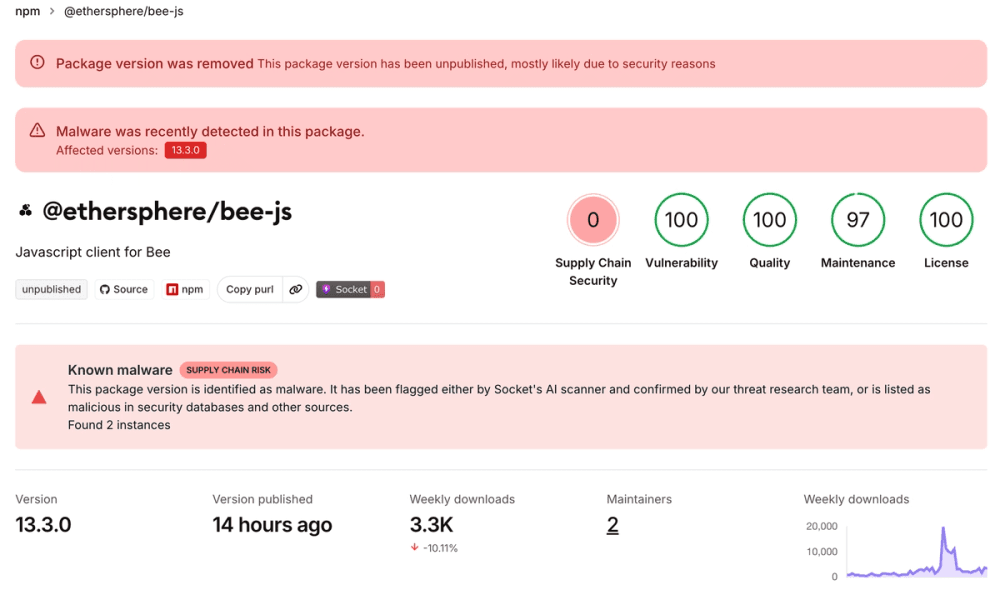
Malicious bee-js npm Release and Swarm Desktop Releases Deliver SleepyDuck Ethereum C2 Backdoor
Socket investigates malicious @ethersphere/bee-js 13.3.0 and Swarm Desktop 0.56.2 releases associated with the SleepyDuck backdoor. Compromised project identities introduced loader code into legitimate release paths, so trusted publishing and build provenance could accurately identify a build that still contained attacker-controlled changes. The npm package used an installation hook, while the desktop release placed its loader in Electron’s main process, creating different exposure paths. The investigation does not establish how the first credentials were stolen, and download counts cannot be treated as confirmed infected machines. Check exact versions and whether code executed, contain affected systems, and assess credentials and persistence; removing a release or uninstalling an application alone does not undo a payload that already ran.
TAG: ECOSYSTEMREAD_TIME: 9_MIN
Introducing Spend Management: Spending limits and alerts for Cloudflare
Cloudflare introduces beta Spend Management for pay-as-you-go Workers and Durable Objects, combining warning thresholds with policies that pause billable activity. Usage is aggregated in stages, priced with account-specific allowances and subscription state, and evaluated before a cap propagates to the runtime. The system reports near-real-time costs under ten minutes, but enforcement and runtime refresh are asynchronous, so the announcement should not be read as an instantaneous, cent-exact ceiling. Paused Workers reject new billable invocations, including scheduled and queue-consumer work, while static assets continue to be served. Plan for both the service interruption caused by a cap and the delay before it takes effect, and distinguish today’s product-level beta from future application-wide or agent-specific budgets.
TAG: ECOSYSTEMREAD_TIME: 4_MIN
Retiring the contributor pool
Nicholas C. Zakas announces the end of ESLint’s contributor pool, which compensated meaningful work by people outside the core team. The program began with a monthly allocation and later used a share of monthly income, with more than $51,000 in reported payouts. The stated reason is the growing difficulty of identifying and policing AI-generated contributions while keeping the pool focused on human work, rather than a claim that all paid maintenance has ended. This is a maintainer’s account of one project’s governance burden, not a measurement of AI contribution rates across open source. Read it alongside the same week’s AI-assisted ESLint performance improvements: useful assistance and a sustainable compensation policy are separate questions, with review and attribution costs that automation does not remove.
TAG: ECOSYSTEMREAD_TIME: 3_MIN
Sovereign Tech Fund and Servo
Igalia reports concrete Servo work commissioned by the Sovereign Tech Fund, focusing on the infrastructure embedders need rather than a new browser branding exercise. An accessibility system emits tree updates that tests can inspect through AccessKit, alongside documented guidance for accessible embedding. The work also unifies controls such as dialogs and file pickers, improves input handling and pinch zoom, and adds reliable screenshot capture that helped enable WebDriver by default. Rendering was reworked for multiple targets, while CI and dependency maintenance support continued development across platforms. These are implementer-reported milestones, not proof of full browser interoperability or universal accessibility conformance; they show how sustained funding can address integration and testing prerequisites that headline feature lists often conceal.
summarizeDigest_Summary
Three security reports require different responses. Git’s fixed releases address vulnerable repository processing; Socket’s investigation shows why genuine build provenance cannot establish that source changes were benign; Aikido separates broad write-access probes from evidence that a secret-stealing workflow ran.
Operational controls also have boundaries. Cloudflare’s beta spends time aggregating usage and propagating caps, so a pause policy is neither an instantaneous ceiling nor a substitute for planning service interruption.
The maintenance stories broaden the week beyond incident response: Igalia describes funded Servo integration and testing work, while ESLint closes a compensation program whose attribution policy became costly to enforce. Match the action to the proven condition, whether that condition is an affected executable, a compromised workflow, a delayed cap, or a maintenance constraint.
Key Takeaways- Inventory affected Git and package versions, and distinguish download or probe counts from confirmed code execution.
- Investigate workflow and identity-trust changes when assessing persistence after credential theft.
- Plan for asynchronous spend enforcement and treat sustainable browser and maintainer work as operational infrastructure.