Week 5's most urgent story was a security one: CVE-2026-23864 (CVSS 7.5) disclosed multiple denial-of-service vulnerabilities in React Server Components, affecting… Compiled for immediate developer deployment.
calendar_todaysummarizeWeek 5-2026bolt1 CRITICAL
article
TAG: SECURITYREAD_TIME: 2_MIN
Summary of CVE-2026-23864 - Vercel
CVE-2026-23864 (CVSS 7.5) exposes multiple denial-of-service vulnerabilities in React Server Components, affecting packages react-server-dom-parcel, react-server-dom-webpack, and react-server-dom-turbopack across React versions 19.0.x, 19.1.x, and 19.2.x. Attackers can trigger server crashes, out-of-memory exceptions, or excessive CPU usage by sending specially crafted HTTP requests to Server Function endpoints. Affected downstream frameworks include Next.js 13.x through 16.x, as well as Vite, Parcel, React Router, RedwoodSDK, and Waku. Vercel deployed WAF mitigations across its global platform at no cost, but explicitly warns against relying on WAF alone. Fixed versions are React 19.0.4, 19.1.5, 19.2.4, and Next.js 15.0.8 through 16.2.0-canary.9. Immediate upgrades to patched releases are required.
Anthropic released MCP Apps, a major open extension to the Model Context Protocol that enables MCP servers to render interactive, app-like UI experiences directly inside chat interfaces. Built on tools that supply HTML and JavaScript UI resources, the framework already has support in Goose, VS Code Insiders, and will soon be available in ChatGPT. Launch partners include Amplitude, Asana, Box, Canva, Clay, Figma, Hex, monday.com, and Slack, with Salesforce planning to bring Agentforce, Data 360, and Customer 360 apps to Claude. Security guardrails include sandboxed iframes, host-level HTML review, auditable UI-to-host messages, and explicit user approval for UI-initiated tool calls. The framework builds on the open-source MCP-UI project and OpenAI's Apps SDK, both of which it acknowledges as pioneers.
Run untrusted code with Vercel Sandbox, now generally available
Vercel Sandbox is now generally available, providing on-demand Linux microVMs powered by Firecracker (internally code-named Hive) — the same compute platform already processing over 2.7 million deployments per day. Each sandbox gets its own filesystem, network, and process space with sudo access, supports sub-second cold starts, and bills only for active CPU time. A snapshot feature lets agents restore complex environments instantly, enabling use cases like resuming a task days later or branching from a known working state. Roo Code uses snapshots to skip dependency installs on subsequent runs, while Blackbox AI standardized on Vercel Sandbox for its Agents HQ orchestration platform, citing sub-second initialization as critical to production-grade latency. The Vercel Sandbox CLI and SDK are open-sourced; you can get started with npx sandbox create --connect.
Node.js — OpenSSL Security Advisory Assessment, January 2026
The Node.js project assessed OpenSSL's January 2026 advisory covering 12 CVEs, identifying three that affect Node.js at Low to Moderate severity: CVE-2025-11187 (stack buffer overflow in PBMAC1 MAC verification, Moderate — affects v22.x, v24.x, v25.x but not v20.x since OpenSSL 3.0 lacks PBMAC1 support), CVE-2025-69421 (NULL pointer dereference in PKCS12_item_decrypt_d2i_ex(), Low — all branches affected), and CVE-2026-22795 (type confusion during PKCS#12 parsing, Low — all branches affected). All three require an attacker to supply a specially crafted PFX file via the pfx TLS option, limiting the practical attack surface. Because the attack surface is constrained, fixes will ship in upcoming regular Node.js releases rather than emergency security releases.
Security researcher Graham Helton disclosed that the Kubernetes nodes/proxy GET resource — used by 69 monitoring tools found in public Helm charts — allows an account with read-only permissions to execute arbitrary and privileged commands on any pod in a cluster, including stealing service account tokens and running code in control plane pods. The attack, which exploits a mismatch between WebSockets and Kubelet authorization logic via port 10250, leaves no trace in the Kubernetes AuditPolicy. Kubernetes marked it as intended behavior, not a CVE, and the official long-term fix is KEP-2862 (Fine-Grained Kubelet API Authorization), expected in Kubernetes 1.36 in April. Until then, administrators should audit RBAC policies for nodes/proxy permissions, restrict access to kubelet port 10250 via network policies, and evaluate whether monitoring tools truly require direct kubelet access.
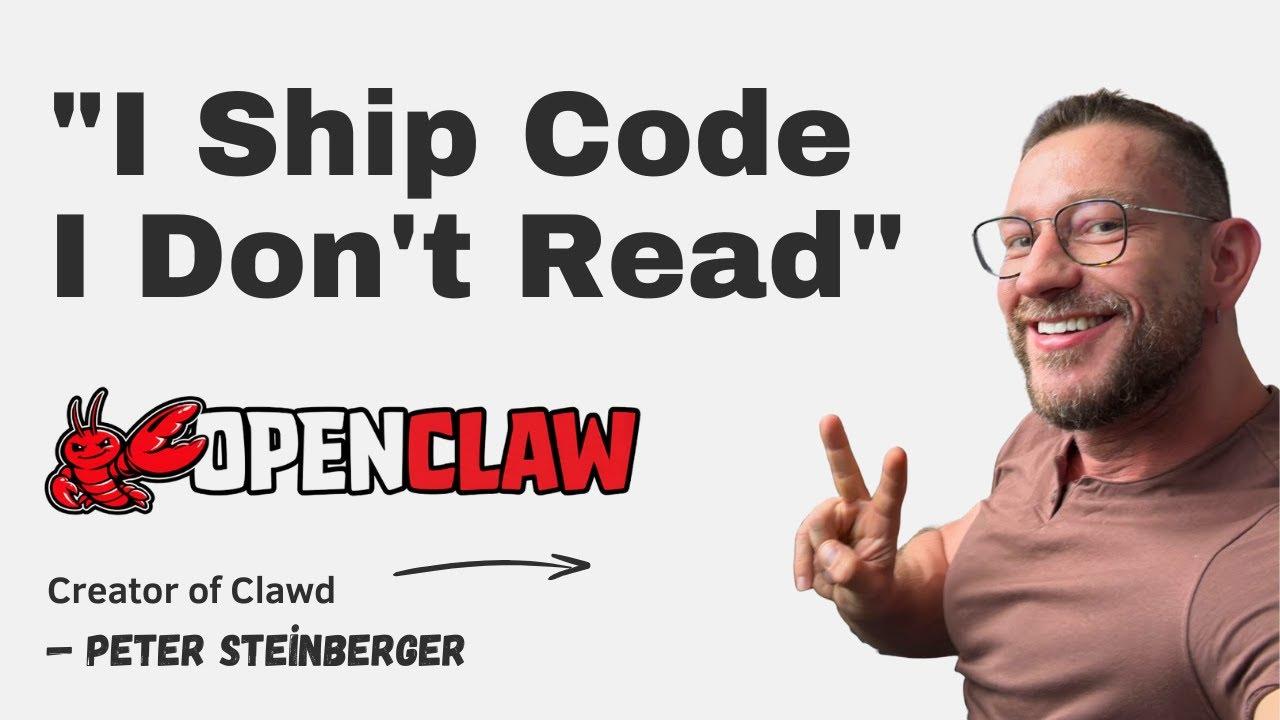
The creator of OpenClaw: "I ship code I don't read"
Peter Steinberger, creator of PSPDFKit (deployed on over 1 billion devices), returns to software after a 3-year burnout hiatus and builds Clawbot — a personal AI assistant — almost entirely through agentic coding, running 5–10 parallel Codex agents simultaneously. He argues the "closing the loop" principle is the key differentiator between effective agent use and frustrating vibe coding: agents must be able to compile, lint, run, and validate their own output before results are trusted. He prefers OpenAI Codex for complex application development because it reads more of the codebase before acting, and describes a workflow of concurrent agent sessions where he architects the system, delegates implementation, then reviews outcomes rather than individual lines of code. He also contends that working this way has made him a better software architect, since verifiable-by-design code structures are now a first-class concern.
The creator of OpenClaw: "I ship code I don't read"
Peter Steinberger, creator of PSPDFKit (deployed on over 1 billion devices), returns to software after a 3-year burnout hiatus and builds Clawbot — a personal AI assistant — almost entirely through agentic coding, running 5–10 parallel Codex agents simultaneously. He argues the "closing the loop" principle is the key differentiator between effective agent use and frustrating vibe coding: agents must be able to compile, lint, run, and validate their own output before results are trusted. He prefers OpenAI Codex for complex application development because it reads more of the codebase before acting, and describes a workflow of concurrent agent sessions where he architects the system, delegates implementation, then reviews outcomes rather than individual lines of code. He also contends that working this way has made him a better software architect, since verifiable-by-design code structures are now a first-class concern.
CVE-2026-23864 (CVSS 7.5) exposes multiple denial-of-service vulnerabilities in React Server Components, affecting packages react-server-dom-parcel, react-server-dom-webpack, and react-server-dom-turbopack across React versions 19.0.x, 19.1.x, and 19.2.x. Attackers can trigger server crashes, out-of-memory exceptions, or excessive CPU usage by sending specially crafted HTTP requests to Server Function endpoints. Affected downstream frameworks include Next.js 13.x through 16.x, as well as Vite, Parcel, React Router, RedwoodSDK, and Waku. Vercel deployed WAF mitigations across its global platform at no cost, but explicitly warns against relying on WAF alone. Fixed versions are React 19.0.4, 19.1.5, 19.2.4, and Next.js 15.0.8 through 16.2.0-canary.9. Immediate upgrades to patched releases are required.
Anthropic released MCP Apps, a major open extension to the Model Context Protocol that enables MCP servers to render interactive, app-like UI experiences directly inside chat interfaces. Built on tools that supply HTML and JavaScript UI resources, the framework already has support in Goose, VS Code Insiders, and will soon be available in ChatGPT. Launch partners include Amplitude, Asana, Box, Canva, Clay, Figma, Hex, monday.com, and Slack, with Salesforce planning to bring Agentforce, Data 360, and Customer 360 apps to Claude. Security guardrails include sandboxed iframes, host-level HTML review, auditable UI-to-host messages, and explicit user approval for UI-initiated tool calls. The framework builds on the open-source MCP-UI project and OpenAI's Apps SDK, both of which it acknowledges as pioneers.
Run untrusted code with Vercel Sandbox, now generally available
Vercel Sandbox is now generally available, providing on-demand Linux microVMs powered by Firecracker (internally code-named Hive) — the same compute platform already processing over 2.7 million deployments per day. Each sandbox gets its own filesystem, network, and process space with sudo access, supports sub-second cold starts, and bills only for active CPU time. A snapshot feature lets agents restore complex environments instantly, enabling use cases like resuming a task days later or branching from a known working state. Roo Code uses snapshots to skip dependency installs on subsequent runs, while Blackbox AI standardized on Vercel Sandbox for its Agents HQ orchestration platform, citing sub-second initialization as critical to production-grade latency. The Vercel Sandbox CLI and SDK are open-sourced; you can get started with npx sandbox create --connect.
Node.js — OpenSSL Security Advisory Assessment, January 2026
The Node.js project assessed OpenSSL's January 2026 advisory covering 12 CVEs, identifying three that affect Node.js at Low to Moderate severity: CVE-2025-11187 (stack buffer overflow in PBMAC1 MAC verification, Moderate — affects v22.x, v24.x, v25.x but not v20.x since OpenSSL 3.0 lacks PBMAC1 support), CVE-2025-69421 (NULL pointer dereference in PKCS12_item_decrypt_d2i_ex(), Low — all branches affected), and CVE-2026-22795 (type confusion during PKCS#12 parsing, Low — all branches affected). All three require an attacker to supply a specially crafted PFX file via the pfx TLS option, limiting the practical attack surface. Because the attack surface is constrained, fixes will ship in upcoming regular Node.js releases rather than emergency security releases.
Security researcher Graham Helton disclosed that the Kubernetes nodes/proxy GET resource — used by 69 monitoring tools found in public Helm charts — allows an account with read-only permissions to execute arbitrary and privileged commands on any pod in a cluster, including stealing service account tokens and running code in control plane pods. The attack, which exploits a mismatch between WebSockets and Kubelet authorization logic via port 10250, leaves no trace in the Kubernetes AuditPolicy. Kubernetes marked it as intended behavior, not a CVE, and the official long-term fix is KEP-2862 (Fine-Grained Kubelet API Authorization), expected in Kubernetes 1.36 in April. Until then, administrators should audit RBAC policies for nodes/proxy permissions, restrict access to kubelet port 10250 via network policies, and evaluate whether monitoring tools truly require direct kubelet access.
Week 5's most urgent story was a security one: CVE-2026-23864 (CVSS 7.5) disclosed multiple denial-of-service vulnerabilities in React Server Components, affecting all three react-server-dom packages across React 19.0.x through 19.2.x and downstream frameworks from Next.js 13 through 16. Vercel deployed WAF mitigations platform-wide but explicitly warned against treating them as sufficient — fixed releases (React 19.0.4/19.1.5/19.2.4, Next.js 15.0.8+) require immediate uptake. A separate OpenSSL advisory covering three Node.js-relevant CVEs was assessed as lower risk, with fixes shipping in regular releases rather than emergency patches.
On the infrastructure side, Vercel Sandbox reached general availability — Firecracker-based Linux microVMs with sub-second cold starts, snapshot support for instant environment restoration, and billing only for active CPU time. Its already-live customer roster (Roo Code, Blackbox AI) underlines that this is production-grade compute, not a preview. Anthropic's MCP Apps framework landed as the other significant platform move: MCP servers can now render sandboxed interactive UI widgets directly inside chat hosts, with Amplitude, Figma, and Slack among the launch partners.
A Kubernetes disclosure rounded out the security picture: a telemetry API used by 69 monitoring tools allows read-only accounts to execute privileged commands on any pod, with no AuditPolicy trace and no CVE designation — the long-term fix is KEP-2862, due in Kubernetes 1.36 this April.
Key Takeaways
CVE-2026-23864 is a CVSS 7.5 DoS in React Server Components — upgrade to React 19.0.4/19.1.5/19.2.4 and Next.js 15.0.8+ immediately; WAF mitigations alone are not sufficient.
Vercel Sandbox GA brings production-grade Firecracker microVMs with sub-second cold starts and snapshot restore — agentic coding workflows now have a first-class execution substrate.
A Kubernetes nodes/proxy privilege-escalation leaves no audit trail and affects 69 monitoring tools — audit RBAC policies and restrict kubelet port 10250 until KEP-2862 ships in April.