The news week belongs to agentic AI growing up. Addy Osmani publishes the definitive pair: a map of the road from coder to conductor to orchestrator of autonomous… Compiled for immediate developer deployment.
calendar_todaysummarizeWeek 1-2026bolt1 CRITICAL
article
TAG: ARCHITECTUREREAD_TIME: 25_MIN
The future of agentic coding: conductors to orchestrators
Addy Osmani argues that the software engineering role is splitting into two distinct modes: the Conductor, who guides a single AI agent interactively in real-time within an IDE or CLI (Claude Code, Cursor, Gemini CLI), and the Orchestrator, who dispatches autonomous agents to work asynchronously on separate git branches and deliver finished pull requests. Orchestrator-mode tools — GitHub Copilot Agent, Google Jules, OpenAI Codex cloud agent, and Cursor 2's Background Agents — each clone the repo into isolated environments, execute multi-step tasks including running tests, and open PRs without continuous human oversight. Community platforms such as Conductor by Melty Labs and Claude Squad let teams run multiple Claude Code instances across parallel worktrees for further throughput gains. Osmani cautions that orchestration demands front-loaded task specification, workspace isolation to prevent merge conflicts, and persistent human review of every PR, since AI agents do not self-correct across sessions. The key trade-off: orchestrators gain breadth and parallelism at the cost of fine-grained control, making clear prompt specs and strong CI/test gates essential prerequisites before delegating work to an autonomous agent fleet.
A high-severity MongoDB Server flaw — CVE-2025-14847, CVSS 8.7, dubbed 'MongoBleed' — is under active exploitation, and CISA added it to its Known Exploited Vulnerabilities catalog on December 29. The bug stems from mismatched length fields in zlib-compressed protocol headers: the message decompressor returned the allocated output length rather than the actual decompressed length, so a single malformed packet lets an unauthenticated remote attacker read uninitialized heap memory — potentially exposing user records, passwords, and API keys. The flaw was identified December 15 and patched shortly after; an Elastic Security researcher published a proof of concept on December 26, and OX Security likens it to 'Heartbleed for MongoDB.' A wide range of MongoDB Server versions are affected; any internet-exposed vulnerable server is attackable, and private servers reachable via lateral movement are also at risk. MongoDB urges immediate upgrades — or disabling zlib compression on the server when upgrading isn't possible.
SAFE-MCP, a Community-Built Framework for AI Agent Security
SAFE-MCP is an open security analysis framework specifically targeting the Model Context Protocol attack surface — the layer where LLMs connect to external tools and APIs. Co-created by Frederick Kautz, Arjun Subedi, and Bishnu Bista and now formally adopted under the Linux Foundation and OpenID Foundation, the framework catalogs over 80 documented techniques across more than a dozen tactic categories, modeled after MITRE ATT&CK. Specific documented threats include prompt manipulation (SAFE-T1102), tool poisoning (SAFE-T1001), OAuth consent abuse (SAFE-T1007), and agent CLI weaponization (SAFE-T1111), each paired with mitigations. The framework covers four security layers — identity and intent verification using OpenID Connect-backed scoped tokens, interaction screening for prompt-based manipulation, context-aware policy enforcement, and observability with audit trails and quarantine patterns. Contributors from Meta, eBay, Okta, Red Hat, Intel, and American Express participate across global time zones; more than 2,000 people have engaged through hackathons and global events. Teams building or auditing MCP-connected AI agents should explore the public GitHub repository and consider mapping their toolchain's permissions against the SAFE-T technique catalog as a baseline security audit.
Addy Osmani details a disciplined seven-step AI-assisted engineering workflow derived from his work at Anthropic, where Claude Code now generates approximately 90% of its own codebase. The core sequence: (1) co-author a spec.md with the LLM before any code is written — iterative questioning until requirements and edge cases are fully documented; (2) decompose the spec into bite-sized tasks or a sequenced prompt plan file for tools like Cursor; (3) pack extensive context using tools like gitingest or repo2txt, or MCP integrations like Context7, so the model never operates on partial information; (4) maintain a CLAUDE.md or GEMINI.md rules file per project that encodes style guides, lint rules, and preferred patterns to reduce off-script output; (5) commit after every small task with a descriptive message — treating commits as game save-points that allow safe rollback of AI missteps; (6) weave test execution into each coding step so agents can self-debug on CI failures before reporting done; (7) run AI-on-AI code review by spawning a second model (e.g., Gemini reviewing Claude's output) to catch what either misses. Osmani flags a key caveat: LLMs are "over-confident and prone to mistakes" — AI-generated code that superficially passes review can still hide architectural flaws invisible without the human reading every diff.
Nvidia paid $20 billion to non-exclusively license Groq's intellectual property — its Language Processing Units (LPUs) and accompanying software — while absorbing CEO Jonathan Ross, president Sunny Madra, and most of Groq's engineering talent into Nvidia, leaving Groq technically independent under new CEO Simon Edwards. The Register's Tobias Mann argues the widely cited SRAM angle is a red herring: Groq's LPUs carry only 230 MB of SRAM each, requiring 574 LPUs stitched via high-speed interconnect just to run Llama 70B, whereas Nvidia already uses SRAM in all its chips. The more credible motive is Groq's 'assembly line' dataflow architecture — a programmable dataflow design that streams data through SIMD function units continuously, eliminating the load-store bottlenecks of Von Neumann architectures and enabling Groq to achieve 350 tok/s on Llama 3.3 70B and 465 tok/s on gpt-oss 120B per Artificial Analysis benchmarks. Mann speculates the LPUs' best fit in Nvidia's 2026 Rubin roadmap could be as speculative decoding accelerators — running small draft models that predict outputs of larger ones, potentially doubling or tripling system throughput. The foundry-diversification theory (Groq uses GlobalFoundries and Samsung 4nm; Nvidia primarily uses TSMC) is dismissed as implausible since Nvidia has no structural barrier to approaching Samsung directly.
Anthropic's New Benchmark Changes Everything—Most People Will Miss Why
This video by Nate B. Jones centers on METR (Model Evaluation and Threat Research), a nonprofit that measures how long AI agents can sustain useful autonomous work with at least 50% success — a metric with no upper ceiling, unlike capped benchmarks like SWEbench. The headline result: Claude Opus 4.5 can complete tasks that would take an experienced human roughly 4 hours 45 minutes, with the 80% success threshold landing at 27–28 minutes for the same model. Jones argues this places AI capability on a super-exponential curve — doubling roughly every 4 to 4.5 months — which means the 50%-success horizon could reach 10 hours by end of Q1, 20 hours by mid-year, and potentially 40 hours by year-end 2026. The practical implication Jones stresses is a compounding power-law: developers who learn today to assign week-length tasks to agents will maintain an expanding skill lead over those who defer, because the skill of scoping and directing agents compounds as agent capability itself compounds. He notes that domain expertise remains irreplaceable — an agent cannot substitute for a lawyer's decades of judgment — but that expertise must now be translated into high-quality agent tasking to retain its value.
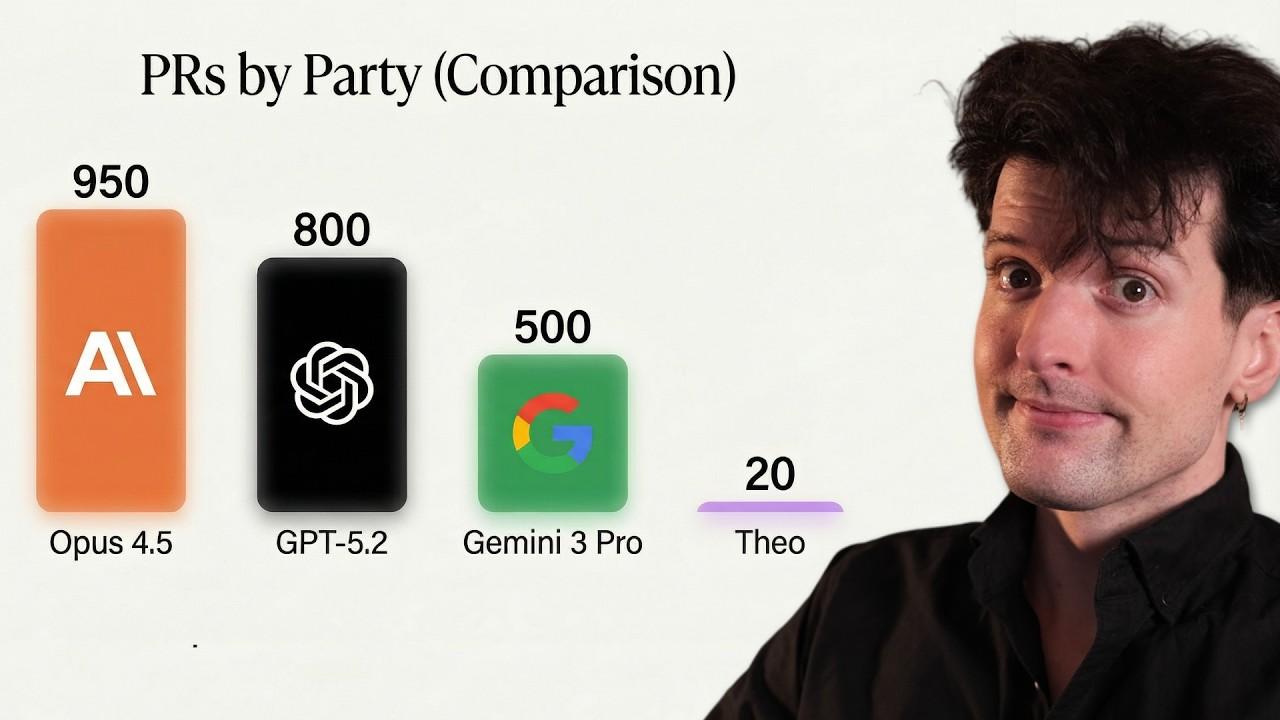
Theo (t3.gg) synthesizes multiple 2025 year-in-review sources — primarily Simon Willison's wrap-up and the Graphtile State of AI Coding report — to argue that AI fundamentally changed how code is written rather than merely accelerating it. Key quantitative shifts: average PR size rose 33% from March to November 2025, lines of code per developer per month grew from 4,450 to 7,800 (76%), and medium-team output jumped 89% (from ~7,000 to ~13,000 lines/dev/month). Claude Code, quietly launched as a second item in the Claude 3.7 Sonnet announcement, reached roughly $1B/year in revenue; its architect Boris built it explicitly for the model 6 months ahead rather than the model of the day. The Anthropic SDK gained 1,547x installs since April 2023 and now sits at 30–31M monthly PyPI installs, narrowing the gap to OpenAI's SDK from 45x to 4.2x. Theo cautions that MCP is likely a one-year-wonder because shell access via agents makes dedicated MCP servers redundant for most tasks, and that YOLO-mode (bypassing agent permission prompts) normalizes security deviance in a pattern analogous to the Challenger disaster. The practical takeaway: developers are now spending more time reviewing PRs in GitHub than writing code in editors, and that shift is accelerating.
The future of agentic coding: conductors to orchestrators
Addy Osmani argues that the software engineering role is splitting into two distinct modes: the Conductor, who guides a single AI agent interactively in real-time within an IDE or CLI (Claude Code, Cursor, Gemini CLI), and the Orchestrator, who dispatches autonomous agents to work asynchronously on separate git branches and deliver finished pull requests. Orchestrator-mode tools — GitHub Copilot Agent, Google Jules, OpenAI Codex cloud agent, and Cursor 2's Background Agents — each clone the repo into isolated environments, execute multi-step tasks including running tests, and open PRs without continuous human oversight. Community platforms such as Conductor by Melty Labs and Claude Squad let teams run multiple Claude Code instances across parallel worktrees for further throughput gains. Osmani cautions that orchestration demands front-loaded task specification, workspace isolation to prevent merge conflicts, and persistent human review of every PR, since AI agents do not self-correct across sessions. The key trade-off: orchestrators gain breadth and parallelism at the cost of fine-grained control, making clear prompt specs and strong CI/test gates essential prerequisites before delegating work to an autonomous agent fleet.
Anthropic's New Benchmark Changes Everything—Most People Will Miss Why
This video by Nate B. Jones centers on METR (Model Evaluation and Threat Research), a nonprofit that measures how long AI agents can sustain useful autonomous work with at least 50% success — a metric with no upper ceiling, unlike capped benchmarks like SWEbench. The headline result: Claude Opus 4.5 can complete tasks that would take an experienced human roughly 4 hours 45 minutes, with the 80% success threshold landing at 27–28 minutes for the same model. Jones argues this places AI capability on a super-exponential curve — doubling roughly every 4 to 4.5 months — which means the 50%-success horizon could reach 10 hours by end of Q1, 20 hours by mid-year, and potentially 40 hours by year-end 2026. The practical implication Jones stresses is a compounding power-law: developers who learn today to assign week-length tasks to agents will maintain an expanding skill lead over those who defer, because the skill of scoping and directing agents compounds as agent capability itself compounds. He notes that domain expertise remains irreplaceable — an agent cannot substitute for a lawyer's decades of judgment — but that expertise must now be translated into high-quality agent tasking to retain its value.
Theo (t3.gg) synthesizes multiple 2025 year-in-review sources — primarily Simon Willison's wrap-up and the Graphtile State of AI Coding report — to argue that AI fundamentally changed how code is written rather than merely accelerating it. Key quantitative shifts: average PR size rose 33% from March to November 2025, lines of code per developer per month grew from 4,450 to 7,800 (76%), and medium-team output jumped 89% (from ~7,000 to ~13,000 lines/dev/month). Claude Code, quietly launched as a second item in the Claude 3.7 Sonnet announcement, reached roughly $1B/year in revenue; its architect Boris built it explicitly for the model 6 months ahead rather than the model of the day. The Anthropic SDK gained 1,547x installs since April 2023 and now sits at 30–31M monthly PyPI installs, narrowing the gap to OpenAI's SDK from 45x to 4.2x. Theo cautions that MCP is likely a one-year-wonder because shell access via agents makes dedicated MCP servers redundant for most tasks, and that YOLO-mode (bypassing agent permission prompts) normalizes security deviance in a pattern analogous to the Challenger disaster. The practical takeaway: developers are now spending more time reviewing PRs in GitHub than writing code in editors, and that shift is accelerating.
A high-severity MongoDB Server flaw — CVE-2025-14847, CVSS 8.7, dubbed 'MongoBleed' — is under active exploitation, and CISA added it to its Known Exploited Vulnerabilities catalog on December 29. The bug stems from mismatched length fields in zlib-compressed protocol headers: the message decompressor returned the allocated output length rather than the actual decompressed length, so a single malformed packet lets an unauthenticated remote attacker read uninitialized heap memory — potentially exposing user records, passwords, and API keys. The flaw was identified December 15 and patched shortly after; an Elastic Security researcher published a proof of concept on December 26, and OX Security likens it to 'Heartbleed for MongoDB.' A wide range of MongoDB Server versions are affected; any internet-exposed vulnerable server is attackable, and private servers reachable via lateral movement are also at risk. MongoDB urges immediate upgrades — or disabling zlib compression on the server when upgrading isn't possible.
SAFE-MCP, a Community-Built Framework for AI Agent Security
SAFE-MCP is an open security analysis framework specifically targeting the Model Context Protocol attack surface — the layer where LLMs connect to external tools and APIs. Co-created by Frederick Kautz, Arjun Subedi, and Bishnu Bista and now formally adopted under the Linux Foundation and OpenID Foundation, the framework catalogs over 80 documented techniques across more than a dozen tactic categories, modeled after MITRE ATT&CK. Specific documented threats include prompt manipulation (SAFE-T1102), tool poisoning (SAFE-T1001), OAuth consent abuse (SAFE-T1007), and agent CLI weaponization (SAFE-T1111), each paired with mitigations. The framework covers four security layers — identity and intent verification using OpenID Connect-backed scoped tokens, interaction screening for prompt-based manipulation, context-aware policy enforcement, and observability with audit trails and quarantine patterns. Contributors from Meta, eBay, Okta, Red Hat, Intel, and American Express participate across global time zones; more than 2,000 people have engaged through hackathons and global events. Teams building or auditing MCP-connected AI agents should explore the public GitHub repository and consider mapping their toolchain's permissions against the SAFE-T technique catalog as a baseline security audit.
Addy Osmani details a disciplined seven-step AI-assisted engineering workflow derived from his work at Anthropic, where Claude Code now generates approximately 90% of its own codebase. The core sequence: (1) co-author a spec.md with the LLM before any code is written — iterative questioning until requirements and edge cases are fully documented; (2) decompose the spec into bite-sized tasks or a sequenced prompt plan file for tools like Cursor; (3) pack extensive context using tools like gitingest or repo2txt, or MCP integrations like Context7, so the model never operates on partial information; (4) maintain a CLAUDE.md or GEMINI.md rules file per project that encodes style guides, lint rules, and preferred patterns to reduce off-script output; (5) commit after every small task with a descriptive message — treating commits as game save-points that allow safe rollback of AI missteps; (6) weave test execution into each coding step so agents can self-debug on CI failures before reporting done; (7) run AI-on-AI code review by spawning a second model (e.g., Gemini reviewing Claude's output) to catch what either misses. Osmani flags a key caveat: LLMs are "over-confident and prone to mistakes" — AI-generated code that superficially passes review can still hide architectural flaws invisible without the human reading every diff.
Nvidia paid $20 billion to non-exclusively license Groq's intellectual property — its Language Processing Units (LPUs) and accompanying software — while absorbing CEO Jonathan Ross, president Sunny Madra, and most of Groq's engineering talent into Nvidia, leaving Groq technically independent under new CEO Simon Edwards. The Register's Tobias Mann argues the widely cited SRAM angle is a red herring: Groq's LPUs carry only 230 MB of SRAM each, requiring 574 LPUs stitched via high-speed interconnect just to run Llama 70B, whereas Nvidia already uses SRAM in all its chips. The more credible motive is Groq's 'assembly line' dataflow architecture — a programmable dataflow design that streams data through SIMD function units continuously, eliminating the load-store bottlenecks of Von Neumann architectures and enabling Groq to achieve 350 tok/s on Llama 3.3 70B and 465 tok/s on gpt-oss 120B per Artificial Analysis benchmarks. Mann speculates the LPUs' best fit in Nvidia's 2026 Rubin roadmap could be as speculative decoding accelerators — running small draft models that predict outputs of larger ones, potentially doubling or tripling system throughput. The foundry-diversification theory (Groq uses GlobalFoundries and Samsung 4nm; Nvidia primarily uses TSMC) is dismissed as implausible since Nvidia has no structural barrier to approaching Samsung directly.
The news week belongs to agentic AI growing up. Addy Osmani publishes the definitive pair: a map of the road from coder to conductor to orchestrator of autonomous agent fleets, and a 2026 LLM workflow guide anchored by a striking datapoint — roughly 90% of Claude Code's own code is now written by Claude Code. Theo's year-in-review lands the same thesis from the practitioner side: 2025 was the year agents went from buzzword to daily driver.
The security counterweight arrived on schedule. A critical MongoDB flaw — already dubbed the "Heartbleed of MongoDB" — is under active exploitation, making it the drop-everything patch item of the window. And SAFE-MCP brings the CVE/ATT&CK playbook to MCP-connected agents, an early sign the industry is building shared security language for agentic systems before the incidents force it to.
On the business side, Nvidia's ~$20B Groq deal drew a week of speculation — SRAM inference bets, foundry capacity, talent — dissected soberly by The Register, while METR's agent-task-length benchmark (via Nate B. Jones) suggests the agentic curve is steeper than most planning assumes.
Key Takeaways
Patch MongoDB now — the 'Heartbleed of MongoDB' is being actively exploited.
Agentic engineering is a management skill: invest in orchestration workflows, not just prompt technique.
MCP security is becoming table stakes — evaluate SAFE-MCP before wiring agents to production tools.