articleTAG: SUPPLY CHAINREAD_TIME: 11_MIN
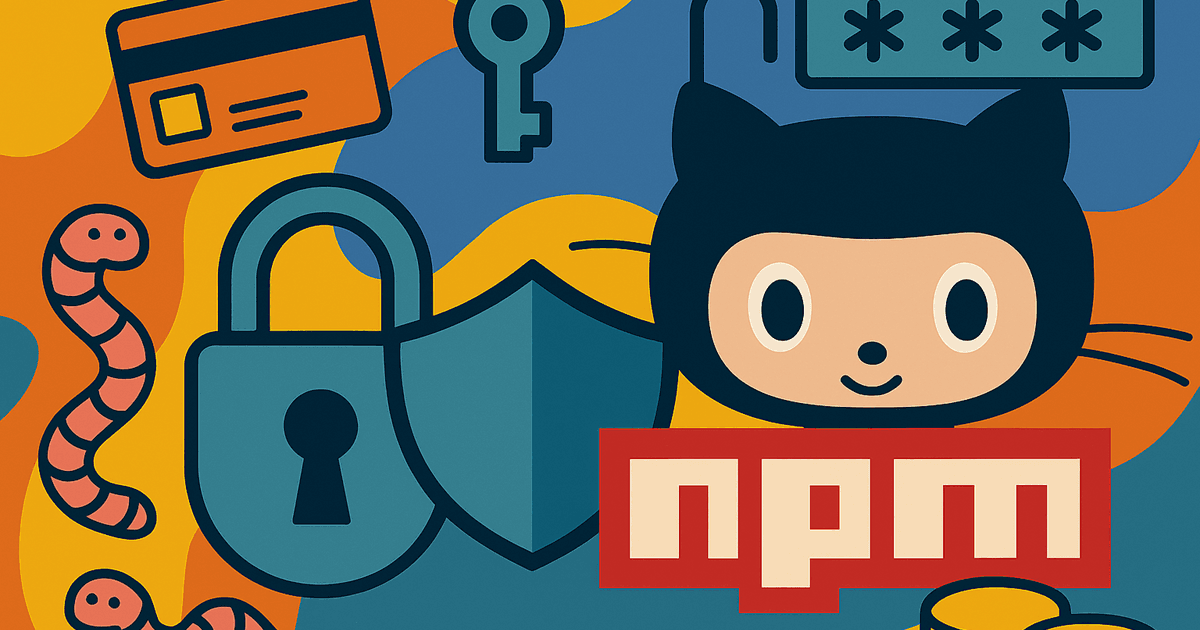
How GitHub Could Secure npm
In September 2025, two coordinated npm supply-chain attack waves compromised over 500 packages — the first wave hit 20 packages with 2 billion weekly downloads and was downloaded 2.5 million times in just 2 hours; the second, dubbed Shai-Hulud, was a self-replicating worm that propagated automatically across 500+ packages. GitHub's response — deprecating legacy tokens, enforcing 90-day granular token rotation, and promoting trusted publishing via OIDC providers GitHub and GitLab — focused narrowly on credential theft, placing disproportionate burden on maintainers while leaving the registry without proactive defenses. Nicholas Zakas argues npm needs anomaly detection analogous to credit-card fraud systems: flagging publishes from unexpected IP locations, requiring semver-major bumps when preinstall/postinstall scripts are first introduced to a release line, and mandating email-based 2FA for lifecycle-script additions. These measures would remain effective even after credentials are stolen, closing the window of opportunity before compromised packages proliferate through CI/CD pipelines that perform fresh installs.
TAG: SECURITYREAD_TIME: 3_MIN
MCP November 2025 Spec Update: CIMD, XAA, and Security
The November 25, 2025 Model Context Protocol specification update introduces four identity and security changes aimed at bringing MCP in line with standard OAuth patterns. Client Identity Metadata Documents (CIMD) replace manual dynamic registration: an MCP client identifies itself via a URL it controls (e.g. https://myapp.com/client.json), and the authorization server verifies identity by fetching that JSON, anchoring trust in DNS and HTTPS. Cross-App Access (XAA), built on the Identity Assertion Authorization Grant OAuth standard, lets IT administrators pre-authorize trusted AI agents to access specific enterprise tools, eliminating user consent fatigue while maintaining full governance visibility. SEP-1024 requires explicit user consent before any local MCP server is installed or run, mandating that the exact command be displayed. Incremental scope consent (SEP-835) allows servers to request additional permissions progressively via WWW-Authenticate headers rather than demanding all scopes upfront, moving MCP toward a Zero Trust enterprise model.
TAG: OPEN SOURCEREAD_TIME: 10_MIN
Owners, Not Renters: Mozilla's Open Source AI Strategy
Mozilla CTO Raffi Krikorian frames AI as "Layer 8" — an agentic intermediary that mediates between users and the entire internet — and warns that the current trajectory leads to a rental economy where a handful of closed platforms control intelligence. He identifies four tipping-point battlegrounds: developer experience, data provenance, model architecture (where small 1–8B parameter models are rapidly closing the capability gap), and compute access. Mozilla.ai is building any-suite, a modular open framework integrating model routing, evaluation, guardrails, memory, and orchestration, with the stated goal of making open AI as easy as a single API call. Simultaneously, the Mozilla Data Collective is constructing a licensed, provenance-based data marketplace, Mozilla Ventures is backing open-source AI companies, and Pinterest is cited as proof that migrating to open-source AI infrastructure can save millions of dollars. TypeScript grew +66% on GitHub in 2025; Krikorian's parallel is that openness wins not by being more principled but by becoming the better deal.
TAG: STANDARDSREAD_TIME: 6_MIN
Building the Universal Commerce Protocol (2026)
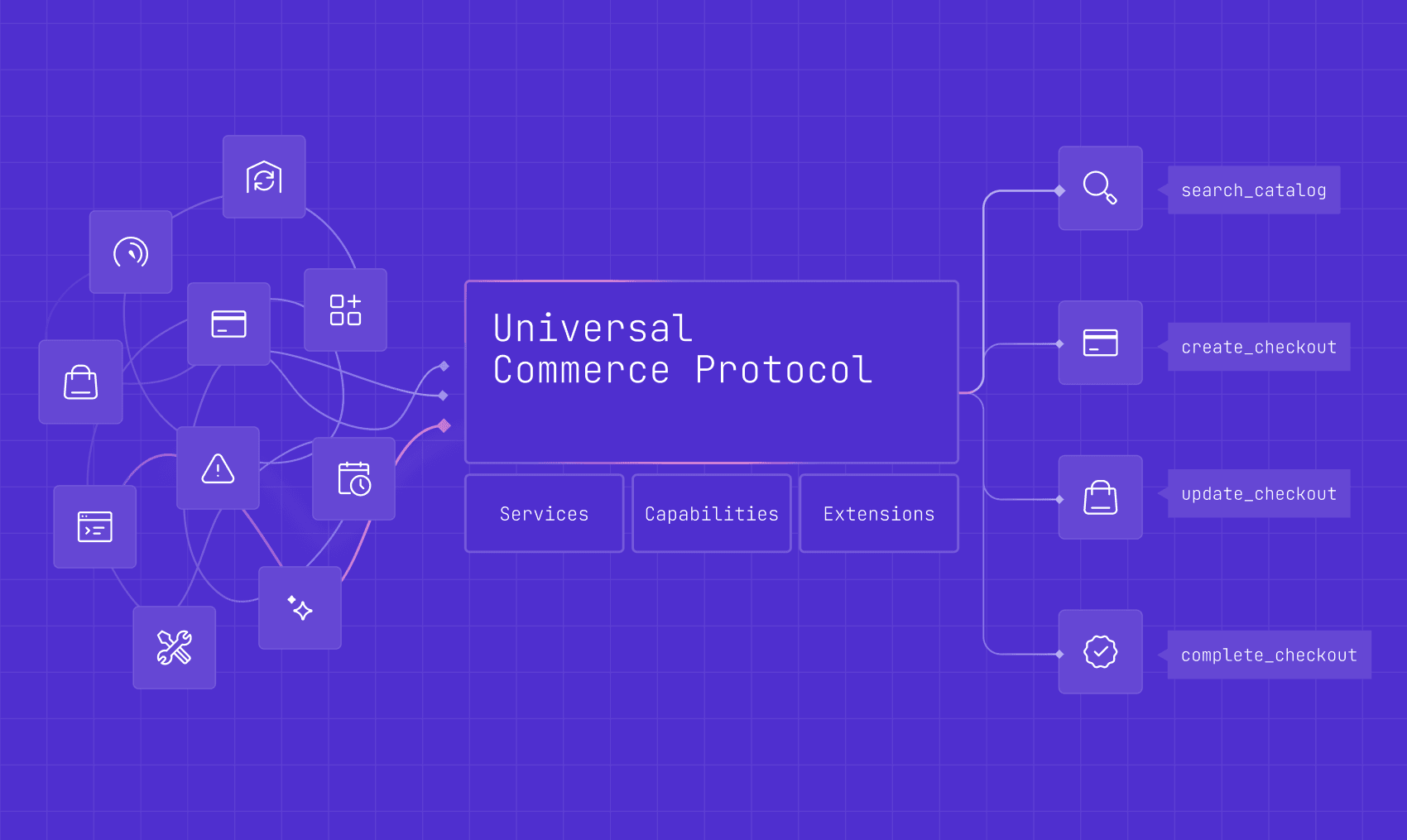
Shopify Distinguished Engineer Ilya Grigorik announces the Universal Commerce Protocol (UCP), co-developed with Google and already backed by Etsy, Target, Walmart, and Wayfair, as an open standard for AI agents to discover and transact with any merchant. UCP separates responsibilities into three layers — a Shopping Service for core primitives, versioned Capabilities (Checkout, Orders, Catalog), and domain-specific Extensions — allowing merchants to publish profiles at /.well-known/ucp that agents negotiate against per-transaction without any central registry approval. Extension namespaces follow reverse-domain ownership (dev.ucp.shopping.* vs. com.loyaltyprovider.*), meaning third parties can add loyalty points, regional PSP handlers, or bespoke fulfillment schemas without committee votes. When a transaction requires human intervention, UCP's Embedded Checkout Protocol (ECP) uses JSON-RPC 2.0 to hand off to an embedded UI that pulls from the agent's wallet and resurfaces native payment sheets (Shop Pay, Google Pay), all compliant with PCIv4 sandboxing. The spec is public and built on Shopify's Checkout Kit.
TAG: SUPPLY CHAINREAD_TIME: 5_MIN
2025 in Review: The Evolution of Supply Chain Security & What's Next
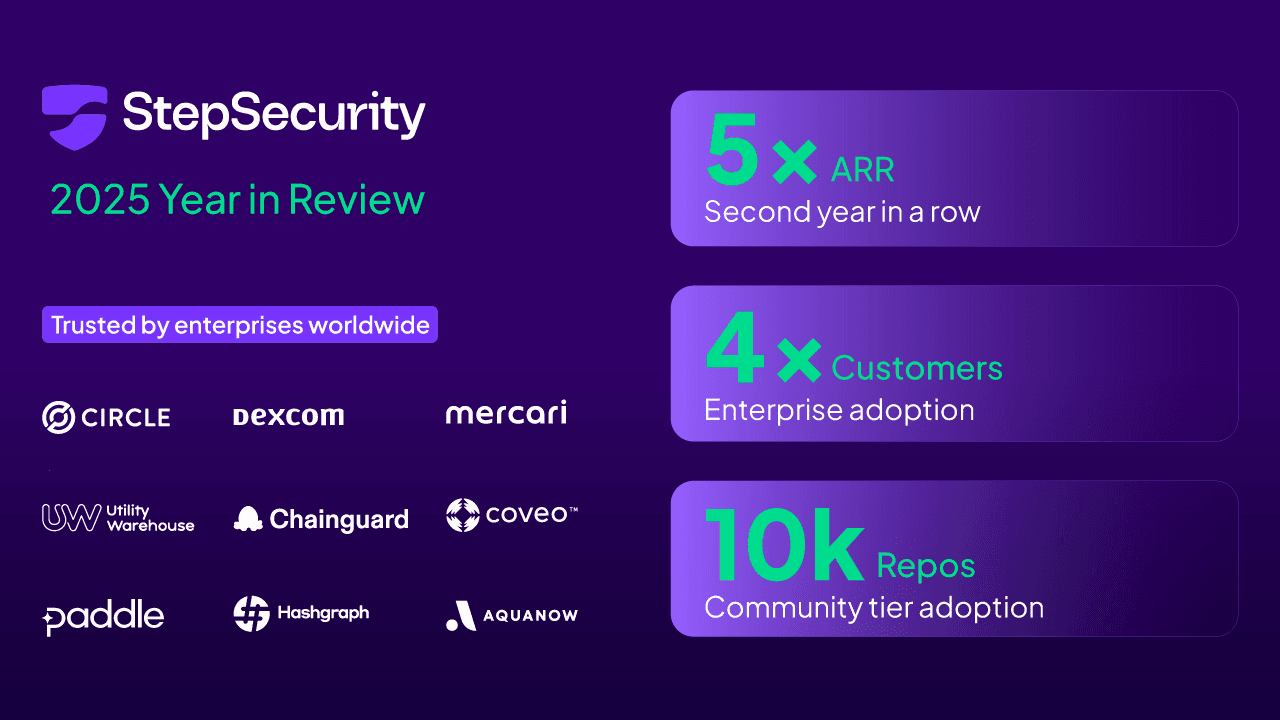
StepSecurity reports 5× ARR growth for the second consecutive year and 4× customer growth in 2025, now securing over 13 million builds per week. The company was first to detect three major incidents: the tj-actions/changed-files compromise (flagged via anomalous outbound network calls from Harden Runner, later presented at Black Hat USA), the Shai-Hulud npm worm (research referenced by CISA), and the Nx / s1ngularity attack (GHSA-cxm3-wv7p-598c), where malicious versions published after a maintainer token theft exfiltrated credentials by creating public GitHub repositories named s1ngularity-repository and abused locally installed AI CLI tools. In response, StepSecurity shipped 200 drop-in secure replacements for vulnerable third-party GitHub Actions, added an npm cool down check to block recently released package versions during the critical post-compromise window, and introduced real-time threat intelligence notifications. For 2026, the roadmap includes developer-workstation protection, Harden Runner support for Windows and macOS, and expansion beyond npm to PyPI and other ecosystems.
TAG: SECURITYREAD_TIME: 8_MIN
Deepfake Job Hires: When Your Next Breach Starts With an Interview
Gartner predicts that by 2028, one in four candidate profiles worldwide could be fake, and in 2025 the U.S. Department of Justice announced coordinated nationwide actions — indictments, arrests, and seizures of laptop farms — targeting North Korean remote IT worker schemes that placed synthetic employees inside companies with legitimate credentials. Generative AI now enables attackers to fabricate polished ATS-optimized resumes, lived-in LinkedIn profiles, voice clones, and real-time video deepfakes at low cost, converting hiring pipelines into an initial access vector that provides legitimate credentials, trusted permissions, and weeks of unsuspected dwell time. The Citi Institute projects up to 8 million deepfakes shared online by end of 2025 (up from ~500,000 in 2023), while Deloitte estimates generative-AI-enabled fraud losses could reach $11.5 billion by 2027. NSA, FBI, and CISA guidance already warns that synthetic media is being used for social engineering and emphasizes layered verification over single-gate detection. Practical countermeasures include adding controlled unpredictability to interviews (spontaneous liveness prompts), requiring in-person identity confirmation before onboarding completes, treating resumes as claims to validate rather than facts, and applying Zero Trust continuous monitoring to new hires during the first 30–90 days.
TAG: ECOSYSTEMREAD_TIME: 4_MIN
Why AI Is Pushing Developers Toward Typed Languages
A 2025 academic study found that 94% of LLM-generated compilation errors were type-check failures, making type systems the most direct lever for reducing AI-introduced bugs. GitHub's Octoverse 2025 report confirms the effect at ecosystem scale: TypeScript is now the most-used language on GitHub, overtaking Python and JavaScript as of August 2025, adding over 1 million contributors in 2025 — a 66% year-over-year increase — bringing its estimated total to 2.6 million developers. Luau (Roblox's gradually typed scripting language) grew >194% YoY and Typst grew >108% YoY; even Java, C++, and C# saw stronger growth than in prior years. The driving mechanism, as Cassidy Williams explains, is that AI-generated code dramatically expands the volume of code developers did not personally write, and type systems act as a shared contract between developers, frameworks, and AI tools — surfacing ambiguous logic and input/output mismatches before they reach runtime. Frameworks like Astro, Next.js, and Angular scaffolding TypeScript by default are also accelerating adoption.
summarizeDigest_Summary
Supply chain security dominates week 2 with a forensic density rarely seen in a single news cycle. Nicholas Zakas makes the structural argument the field has been waiting for: GitHub's response to the September 2025 npm attack waves — two incidents that together compromised 500+ packages, with the Shai-Hulud worm self-replicating across the registry in hours — focused narrowly on credential theft. Revoking legacy tokens and mandating 90-day rotation is necessary but insufficient. What is missing is anomaly detection analogous to credit-card fraud systems: flagging publishes from unexpected IP locations, requiring semver-major bumps when preinstall/postinstall scripts are first added to a release line, and mandating email-based 2FA for lifecycle-script additions. These defenses would remain effective even after a credential is stolen, closing the exploitation window before compromised packages propagate through CI/CD pipelines. StepSecurity's 2025 review confirms the stakes: the firm detected all three major incidents first — including the Nx/s1ngularity attack that abused locally installed AI CLI tools — and now secures over 13 million builds per week. Their npm cool down check, which blocks recently released package versions during the post-compromise window, is an operational implementation of exactly the anomaly-detection logic Zakas advocates.
The AI infrastructure story this week is a two-sided debate about ownership. Mozilla CTO Raffi Krikorian frames AI as "Layer 8" — an agentic intermediary between users and the internet — and warns that the current trajectory produces a rental economy controlled by a handful of closed platforms. Mozilla.ai's any-suite framework, a data marketplace built on licensed provenance, and Mozilla Ventures' open-source AI investments are positioned as countermeasures. The MCP security specification update from November 2025 lands in this context: CIMD replaces manual dynamic registration with DNS-anchored client identity; XAA lets IT admins pre-authorize trusted agents without fatiguing users with consent prompts; and SEP-835 moves permissions to progressive WWW-Authenticate requests — steps toward a Zero Trust enterprise model for agentic systems.
Shopify's Universal Commerce Protocol (UCP), co-developed with Google and backed by Etsy, Target, Walmart, and Wayfair, adds a commerce-native dimension: AI agents can discover and transact with any merchant by negotiating against profiles published at /.well-known/ucp, using reverse-domain extension namespaces so third parties can add loyalty or regional payment logic without committee approval. When human intervention is needed, the Embedded Checkout Protocol (ECP) hands off to a PCIv4-sandboxed embedded UI. The deepfake hiring threat closes the week's security arc: Gartner's prediction that one in four candidate profiles globally could be fake by 2028, combined with U.S. DOJ actions against North Korean laptop farms, makes Zero Trust continuous monitoring of new hires the recommended posture for the first 30–90 days of employment. TypeScript's rise as GitHub's most-used language — a 66% contributor growth driven partly by AI-generated code requiring type contracts to catch 94% of LLM compilation errors — provides the throughline connecting every story: the same complexity pressures that drove the npm attack surface are driving demand for stronger contracts everywhere in the stack.
Key Takeaways- Add anomaly-detection policies to your npm publish workflow today: flag unexpected IP-location publishes and require email-based 2FA for any release that first introduces a
preinstall or postinstall lifecycle script. - Evaluate Shopify's Universal Commerce Protocol spec at
/.well-known/ucp now if you maintain a merchant integration — the open standard is backed by Google, Walmart, and Target, and agent-negotiated checkout is coming faster than most roadmaps assume. - Treat the first 30–90 days of any new hire as a Zero Trust window: require in-person identity confirmation before onboarding completes and apply continuous behavioral monitoring to detect deepfake-placed insider threats before dwell time compounds.