Design systems tooling moved forward on multiple fronts this week. Storybook 10.4 shipped AI-driven automated setup that can configure mocks, write stories, and… Compiled for immediate developer deployment.
calendar_todaysummarizeWeek 21-2026
article
TAG: COMPONENTSREAD_TIME: 5_MIN
Storybook 10.4
Storybook 10.4 brings AI-driven automated setup that can configure mocks, write stories, and run interaction tests for up to 10 components without manual wiring. A new sidebar change-detection filter surfaces stories marked new, modified, or related to a code diff, helping teams review agentic output more reliably. Quick Sharing lets anyone publish a local Storybook to Chromatic with a single click, bypassing the need for a PR or CI run. First-class TanStack React support ships via @storybook/tanstack-react with zero-config type-safe routing and server function integration. An experimental react-component-meta docgen analyzer, built on Volar and the TypeScript Language Server, replaces react-docgen and react-docgen-typescript with faster updates and higher component-detection rates.
Component Architecture for React Server Components
Aurora Scharff traces the evolution from useEffect local fetching through React Query and route-level loaders to React Server Components (RSCs), arguing that RSCs achieve the best of both worlds: server-side data fetching without coupling components to a loader's data shape. Each async server component fetches only what it needs via a minimal identifier, making components portable across pages without prop-drilling or duplicated loader logic. React's cache() deduplicates identical per-request fetches across the component tree. The page then becomes a synchronous compositor that places deliberate Suspense boundaries to design the loading sequence — single boundary for simplicity, granular boundaries for independent streaming — with co-located component and skeleton exports to prevent layout-shift drift. The article also covers useOptimistic for client-side Server Function mutations, feature-folder organization, and how the same architecture maps cleanly to Next.js 16 Partial Prerendering with cacheComponents.
Don't Put aria-label on Generic Elements Like Divs
The ARIA specification's "Name prohibited" section explicitly lists the generic role — the default role of div and span — as an element that cannot be named. Manuel Matuzovic tested aria-label on divs, spans, and custom elements across eight screen reader and browser combinations and found wildly inconsistent behavior: VoiceOver on macOS announces the label plus "group", while JAWS and NVDA on Chrome ignore the label entirely and read only the text content. Two notable exceptions exist: a section element gains a region landmark role when labeled, making labeling appropriate, and a div with the popover attribute takes on a group role, also making labeling technically valid. The practical takeaway is that relying on aria-label for generic elements produces unpredictable AT announcements and should be avoided in design-system markup guidelines.
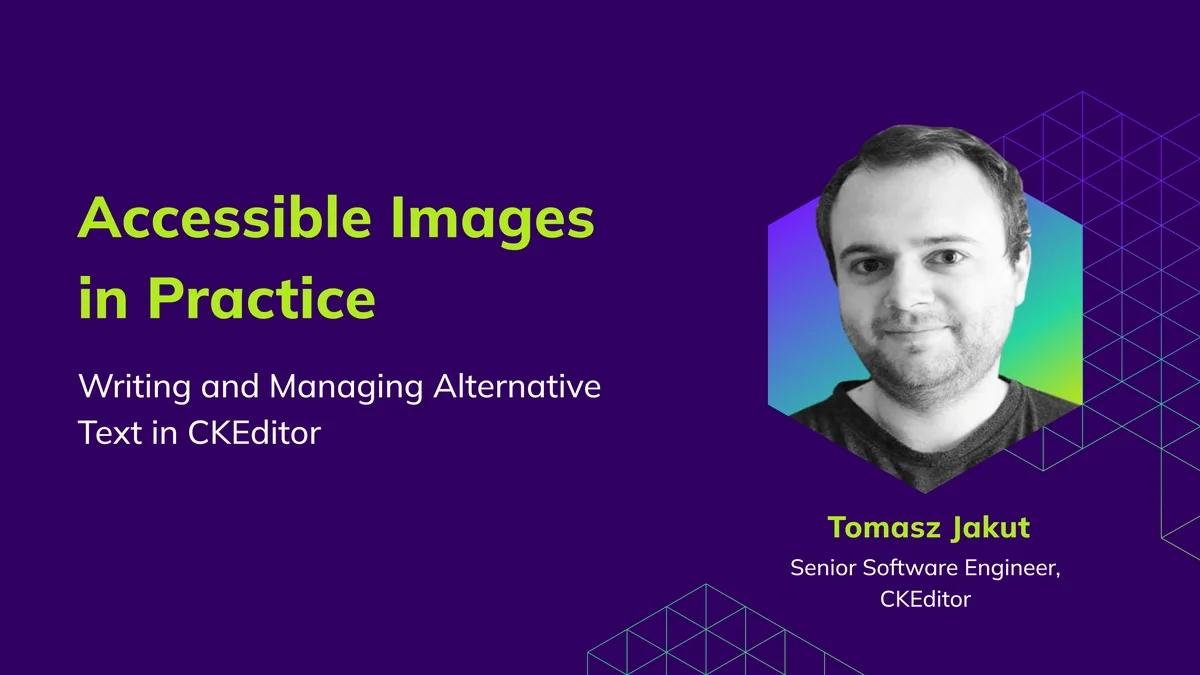
Alt Text Best Practices: Writing and AI-Generating in CKEditor
Effective alt text depends heavily on context: the same image of a painting requires a rich description in an essay but only a functional destination label when used inside a navigation link. The article maps WCAG 2.2's POUR principles to concrete image categories — essential content images, images inside links or buttons, decorative images that need empty alt attributes, images of text, and complex visuals like charts where a companion list or description is more appropriate than a long alt string. The HTML alt attribute remains the conformant standard over aria-label or aria-labelledby, which don't serve as fallback text when images fail to load. CKEditor's AI Quick Actions feature can auto-generate alt text from image content, but the post emphasizes that AI output still requires human review for correctness and contextual fit before publishing.
Global Accessibility Awareness Day: Recapping Deque's Three Free Training Sessions
For the 15th Global Accessibility Awareness Day (GAAD), Deque hosted three free digital accessibility fundamentals sessions spanning APAC, Europe, and North America, drawing thousands of registrants from over 30 countries and more than 30 distinct job roles. Key practical guidance included Patrick Sturdivant's reminder that any alt text is better than none, and Michael Harshbarger's framing of accessibility as an ongoing operational discipline on par with security or performance — not a one-time audit. The AI angle was addressed directly: developers remain responsible for ensuring their AI-generated code meets accessibility standards. The APAC session highlighted that 690 million people in the region live with a disability, underscoring the scale of the problem. Deque's goal was to convert GAAD awareness into sustained action across development and design teams.
Laura Klein distinguishes two categories of design artifacts: deliverables meant for stakeholders, and "design disposables" — rough sketches, draft task flows, quick prototypes, and early research plans created solely to help the designer think. The core argument is that treating every artifact as a reviewable deliverable triggers the sunk-cost fallacy, making exploration feel expensive and discouraging iteration. Disposables are intentionally imperfect and throwaway; their value is in externalizing fuzzy thinking, not in the output itself. AI tools complicate this dynamic: they can generate a first-draft task flow in seconds, eliminating the productive friction of making something yourself, which is where much of the actual problem-solving happens. Klein's recommendation is to use AI to speed up artifact creation but remain rigorous in evaluating and questioning the output — disposables should drive thinking, not substitute for it.
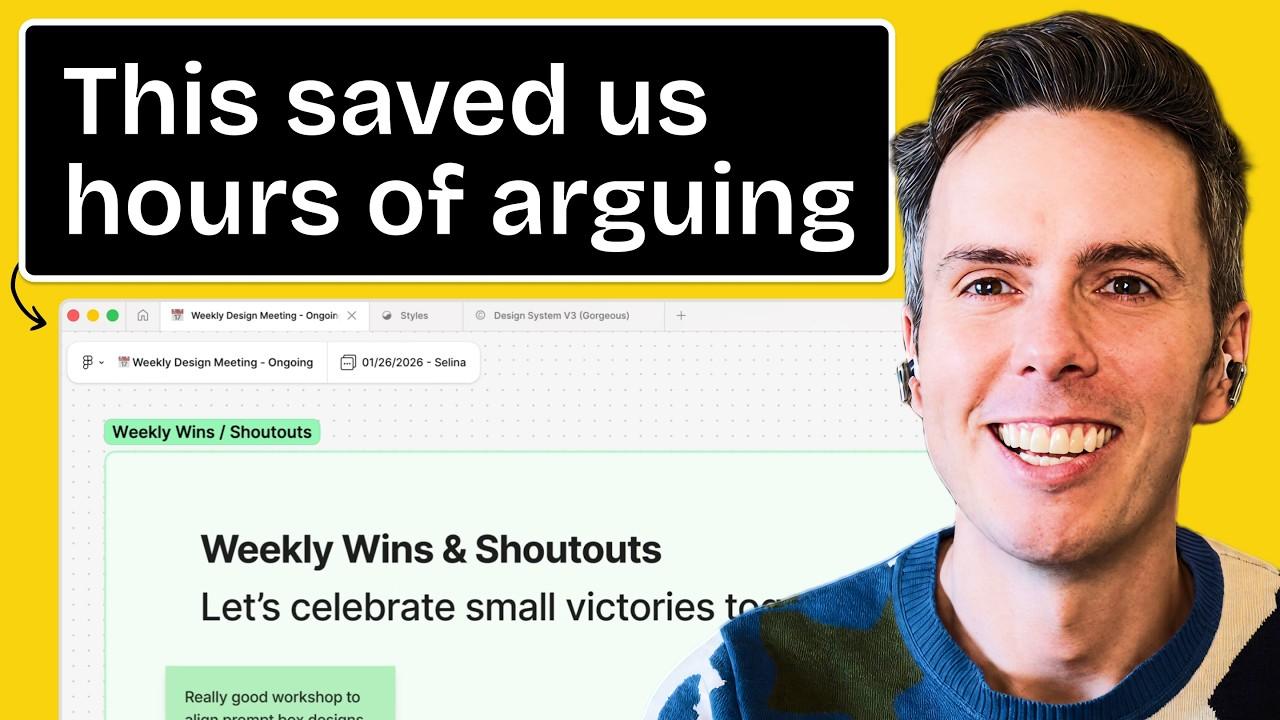
The 2-Question Rule That Makes Design Crits Effective
John, head of design at Descript, walks through the design ceremonies and operating system his nine-person team uses in FigJam and Notion. The centerpiece is the "two-question entry fee" for design crits: before anyone can give feedback, the group must first ask two clarifying questions, forcing participants to confirm they understand the project context before critiquing execution. Three scoped review types — designer-only craft crits, cross-functional work-in-progress reviews, and go/no-go design reviews — keep strategic and quality conversations from bleeding into each other. Descript's Crit Hub documents vibes, responsibilities, and facilitator rules in Notion. Supplementary rituals include the creator challenge (designers use the product under a time constraint to surface real papercuts), a weekly FigJam vibeometer check-in, and the Catalyst async proposal framework for team-level decisions such as design system color palette updates.
Storybook 10.4 brings AI-driven automated setup that can configure mocks, write stories, and run interaction tests for up to 10 components without manual wiring. A new sidebar change-detection filter surfaces stories marked new, modified, or related to a code diff, helping teams review agentic output more reliably. Quick Sharing lets anyone publish a local Storybook to Chromatic with a single click, bypassing the need for a PR or CI run. First-class TanStack React support ships via @storybook/tanstack-react with zero-config type-safe routing and server function integration. An experimental react-component-meta docgen analyzer, built on Volar and the TypeScript Language Server, replaces react-docgen and react-docgen-typescript with faster updates and higher component-detection rates.
The 2-Question Rule That Makes Design Crits Effective
John, head of design at Descript, walks through the design ceremonies and operating system his nine-person team uses in FigJam and Notion. The centerpiece is the "two-question entry fee" for design crits: before anyone can give feedback, the group must first ask two clarifying questions, forcing participants to confirm they understand the project context before critiquing execution. Three scoped review types — designer-only craft crits, cross-functional work-in-progress reviews, and go/no-go design reviews — keep strategic and quality conversations from bleeding into each other. Descript's Crit Hub documents vibes, responsibilities, and facilitator rules in Notion. Supplementary rituals include the creator challenge (designers use the product under a time constraint to surface real papercuts), a weekly FigJam vibeometer check-in, and the Catalyst async proposal framework for team-level decisions such as design system color palette updates.
Component Architecture for React Server Components
Aurora Scharff traces the evolution from useEffect local fetching through React Query and route-level loaders to React Server Components (RSCs), arguing that RSCs achieve the best of both worlds: server-side data fetching without coupling components to a loader's data shape. Each async server component fetches only what it needs via a minimal identifier, making components portable across pages without prop-drilling or duplicated loader logic. React's cache() deduplicates identical per-request fetches across the component tree. The page then becomes a synchronous compositor that places deliberate Suspense boundaries to design the loading sequence — single boundary for simplicity, granular boundaries for independent streaming — with co-located component and skeleton exports to prevent layout-shift drift. The article also covers useOptimistic for client-side Server Function mutations, feature-folder organization, and how the same architecture maps cleanly to Next.js 16 Partial Prerendering with cacheComponents.
Don't Put aria-label on Generic Elements Like Divs
The ARIA specification's "Name prohibited" section explicitly lists the generic role — the default role of div and span — as an element that cannot be named. Manuel Matuzovic tested aria-label on divs, spans, and custom elements across eight screen reader and browser combinations and found wildly inconsistent behavior: VoiceOver on macOS announces the label plus "group", while JAWS and NVDA on Chrome ignore the label entirely and read only the text content. Two notable exceptions exist: a section element gains a region landmark role when labeled, making labeling appropriate, and a div with the popover attribute takes on a group role, also making labeling technically valid. The practical takeaway is that relying on aria-label for generic elements produces unpredictable AT announcements and should be avoided in design-system markup guidelines.
Alt Text Best Practices: Writing and AI-Generating in CKEditor
Effective alt text depends heavily on context: the same image of a painting requires a rich description in an essay but only a functional destination label when used inside a navigation link. The article maps WCAG 2.2's POUR principles to concrete image categories — essential content images, images inside links or buttons, decorative images that need empty alt attributes, images of text, and complex visuals like charts where a companion list or description is more appropriate than a long alt string. The HTML alt attribute remains the conformant standard over aria-label or aria-labelledby, which don't serve as fallback text when images fail to load. CKEditor's AI Quick Actions feature can auto-generate alt text from image content, but the post emphasizes that AI output still requires human review for correctness and contextual fit before publishing.
Global Accessibility Awareness Day: Recapping Deque's Three Free Training Sessions
For the 15th Global Accessibility Awareness Day (GAAD), Deque hosted three free digital accessibility fundamentals sessions spanning APAC, Europe, and North America, drawing thousands of registrants from over 30 countries and more than 30 distinct job roles. Key practical guidance included Patrick Sturdivant's reminder that any alt text is better than none, and Michael Harshbarger's framing of accessibility as an ongoing operational discipline on par with security or performance — not a one-time audit. The AI angle was addressed directly: developers remain responsible for ensuring their AI-generated code meets accessibility standards. The APAC session highlighted that 690 million people in the region live with a disability, underscoring the scale of the problem. Deque's goal was to convert GAAD awareness into sustained action across development and design teams.
Laura Klein distinguishes two categories of design artifacts: deliverables meant for stakeholders, and "design disposables" — rough sketches, draft task flows, quick prototypes, and early research plans created solely to help the designer think. The core argument is that treating every artifact as a reviewable deliverable triggers the sunk-cost fallacy, making exploration feel expensive and discouraging iteration. Disposables are intentionally imperfect and throwaway; their value is in externalizing fuzzy thinking, not in the output itself. AI tools complicate this dynamic: they can generate a first-draft task flow in seconds, eliminating the productive friction of making something yourself, which is where much of the actual problem-solving happens. Klein's recommendation is to use AI to speed up artifact creation but remain rigorous in evaluating and questioning the output — disposables should drive thinking, not substitute for it.
Design systems tooling moved forward on multiple fronts this week. Storybook 10.4 shipped AI-driven automated setup that can configure mocks, write stories, and run interaction tests for up to 10 components in one pass, along with a sidebar change-detection filter that surfaces new, modified, and related stories against a code diff. Quick Sharing enables one-click publishing to Chromatic without a PR or CI run. First-class TanStack React support arrived via @storybook/tanstack-react, and an experimental react-component-meta analyzer built on Volar replaces react-docgen and react-docgen-typescript.
Accessibility in design systems received significant attention. Manuel Matuzovic's research across eight screen reader and browser combinations confirmed that aria-label on generic elements like div and span produces wildly inconsistent AT behavior — VoiceOver announces the label plus "group" while JAWS and NVDA on Chrome ignore it entirely — and should be prohibited in markup guidelines. CKEditor documented alt text best practices aligned with WCAG 2.2's POUR principles, distinguishing context-dependent requirements for content images, link images, decorative images, and complex visuals. The 15th Global Accessibility Awareness Day (GAAD) reinforced that AI-generated code does not exempt developers from accessibility responsibility.
Design process thinking was also in focus. Laura Klein argued for protecting "design disposables" — rough sketches and quick prototypes that externalize fuzzy thinking — warning that AI tools can eliminate the productive friction of making something, where real problem-solving happens. Aurora Scharff detailed a React Server Components architecture using React's cache() for request deduplication, co-located Suspense boundaries and skeletons, and useOptimistic for Server Function mutations, with a clean mapping to Next.js 16 Partial Prerendering.
Key Takeaways
Storybook 10.4's AI-driven setup automates mock configuration, story writing, and interaction tests for up to 10 components at once — directly targeting the agentic code-review bottleneck.
aria-label on div and span is explicitly prohibited by the ARIA spec and produces unpredictable screen reader output across JAWS, NVDA, and VoiceOver — remove it from design system markup guidelines.
React Server Components with React's cache() for per-request deduplication and co-located Suspense boundaries is now the recommended architecture for data-fetching in Next.js 16 Partial Prerendering projects.