articleTAG: SECURITYREAD_TIME: 19_MIN
Your AI Shipped a Backend That Boots. That Is the Whole Problem.
AI-generated Node.js backends routinely pass tests and deploy successfully while shipping serious security defects: unbounded request bodies enabling DoS, wildcard CORS with credentials, SSRF-vulnerable outbound fetch calls, and JWT verifiers susceptible to algorithm-confusion attacks. The author argues the real fix is inverting framework defaults so that the secure path is also the lazy path. DaloyJS, the framework discussed, enforces a 64KB body cap, a prototype-pollution-safe JSON parser, and RFC 9457 error responses out of the box. Critically, it refuses to boot in production when given a wildcard CORS origin, a weak session secret, or an unauthenticated state-changing route. Its fetchGuard utility validates every redirect hop against an SSRF deny-list covering cloud metadata endpoints. The argument is that if safe defaults are baked in, AI agents that only do exactly what they are told still produce secure code.
TAG: ARCHITECTUREREAD_TIME: 12_MIN
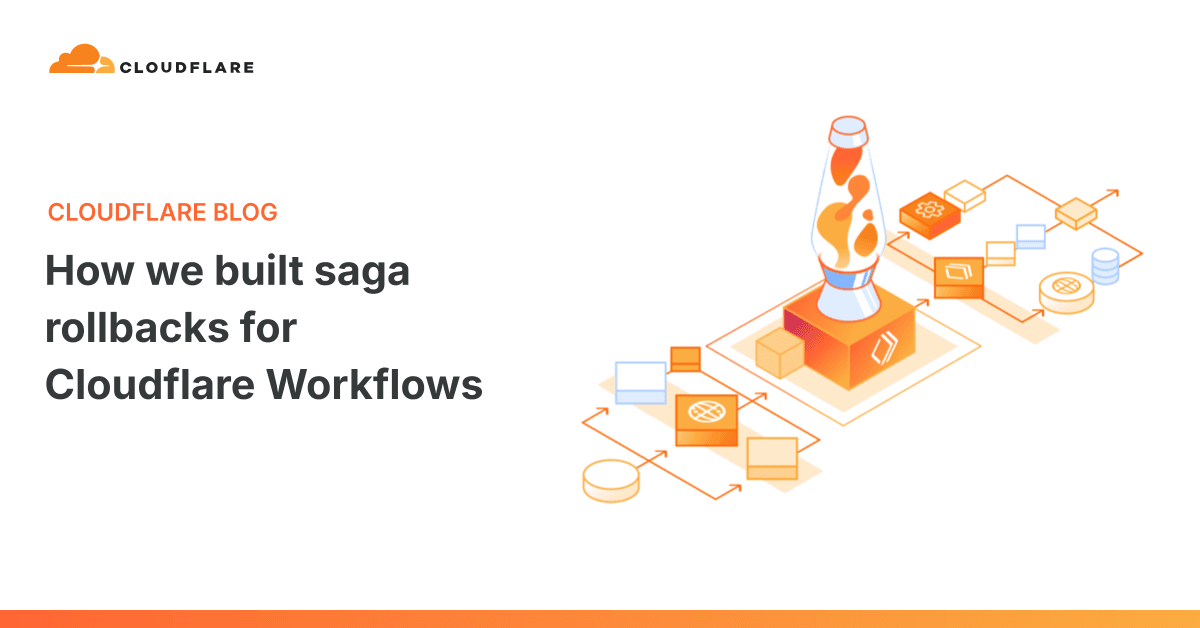
How We Built Saga Rollbacks for Cloudflare Workflows
Cloudflare Workflows now supports the saga pattern natively: each step.do() call can carry an inline rollback handler that runs in reverse start-order when a workflow fails mid-execution. The feature solves the classic distributed-transaction problem where a completed step, such as a bank debit, cannot simply be undone and instead requires a compensating operation. Rollback handlers receive the step output, an error context, and the step context, and are themselves durable steps with configurable retries and timeouts. The team explored a fluent API and a builder pattern before settling on rollback as step metadata, preserving the existing Promise semantics and Workers RPC promise pipelining without introducing timing ambiguity. Under the hood, Cloudflare stores a rollback-eligibility flag in durable step history so that handlers can be rebuilt via replay after an engine restart, without re-executing the original forward steps. Developers are also encouraged to use idempotency keys in rollback handlers to make compensation safe to retry.
TAG: PRIVACYREAD_TIME: 17_MIN
PACT: Anonymous Credentials for the Web
Mozilla proposes PACT (Private Access Control Tokens), a W3C-track system for privacy-preserving rate limiting that avoids the device-attestation approach of Google's abandoned Web Environment Integrity and Apple's Private Access Tokens. The design introduces three roles: Anchors, which are sites that hold scarce signals such as paid subscriptions or verified phone numbers and issue Privacy Pass-style Endorsement tokens; Moderators, which exchange Endorsements for stateful Credentials; and browsers, which present Credentials to access sites. Issuer blinding via zero-knowledge proofs prevents a site from learning which Anchor backed a given Credential. Anonymous Credit Tokens allow a Moderator to update a Credential's internal counter based on observed behavior without revealing the exact value, enabling dynamic rate-limit adjustment without cross-site tracking. Multiparty computation via Prio lets sites compute aggregate quality scores per Anchor without exposing individual user data. AI agents acting on behalf of users can carry their user's Credentials or operate under an operator-run Anchor, letting sites choose how to treat agent traffic without a separate detection mechanism.
TAG: PERFORMANCEREAD_TIME: 25_MIN
Different Hydration and Rendering Strategies
This comprehensive guide maps every major rendering strategy against the hydration cost each imposes. Static Site Generation with ISR solves freshness without per-request server work, while classic SSR reintroduces the full re-render pass that keeps pages non-interactive until hydration completes. Streaming SSR with Suspense boundaries lets React prioritize hydration for the component a user taps first, but ships the same JavaScript volume. Islands architecture, popularized by Astro, eliminates JavaScript entirely for non-interactive regions using client directives like client:visible. React Server Components remove component code from the client bundle by keeping server-only components out of the Flight stream, though a misplaced use client directive can silently pull heavy dependencies into the bundle. TanStack Start treats RSC payloads as ordinary data fetched on the client's terms, reducing migration cost for existing SPAs. Fine-grained reactivity frameworks like SolidJS and Svelte 5 skip virtual DOM diffing entirely, while Qwik's resumability serializes the full execution state into HTML and defers all code loading until interaction.
TAG: BENCHMARKREAD_TIME: 13_MIN
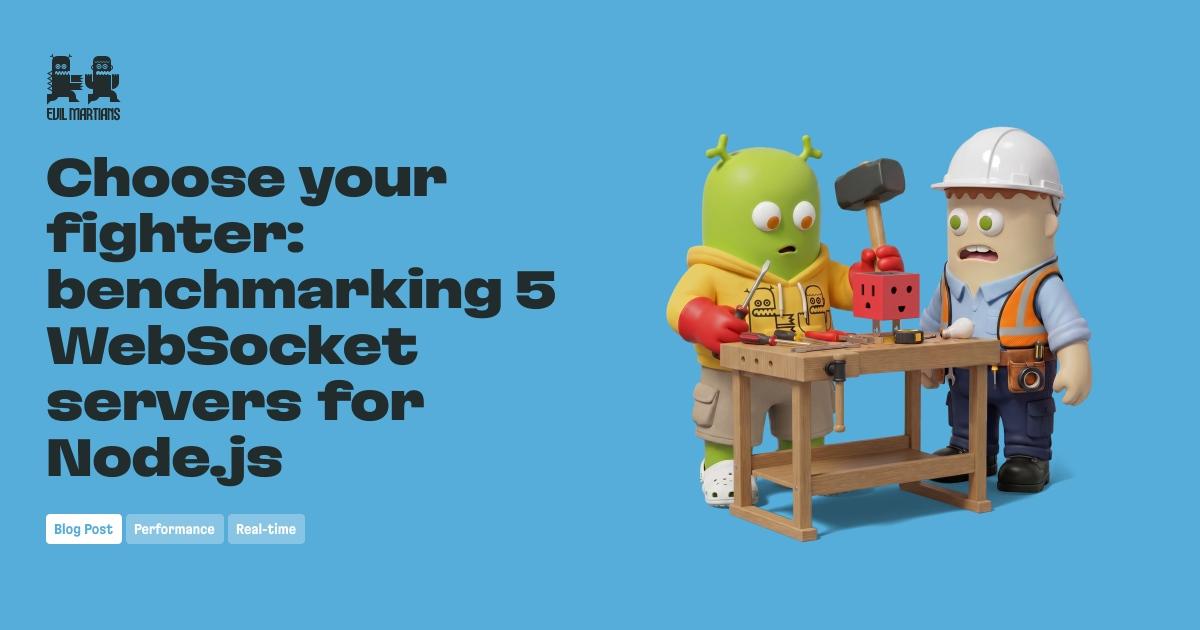
Benchmarking 5 WebSocket Servers for Node.js
Evil Martians compared five Node.js WebSocket stacks, default Socket.io, Socket.io with Connection State Recovery, uWebSockets.js, AnyCable OSS, and AnyCable Pro, across latency, message delivery under network drops, reconnect-storm resilience, and per-connection memory cost. The most instructive finding was methodological: a single-process load generator holding 10,000 subscribers inflated AnyCable's measured p99 latency from 11ms to 234ms because the Node event loop became the bottleneck, not the server. Sharding the harness to 40 processes of 250 clients each collapsed the number back to reality. An independent intra-network OpenTelemetry trace confirmed the 11ms figure. Key results at 10K subscribers show all servers within a few milliseconds of each other for raw latency, but AnyCable delivered 100% of messages under WiFi drops while default Socket.io delivered 85%. AnyCable Pro also held 822K idle connections on 14.8GB RAM versus Socket.io's 120K ceiling, with the distinction that Socket.io hit a single-threaded CPU wall while AnyCable OSS approached a RAM wall.
TAG: PLATFORM-ENGINEERINGREAD_TIME: 14_MIN
Building a State-of-the-Art Development Platform with Backstage
Backstage solves the portal problem, not the platform problem, and most teams hit this wall after deployment. A portal organizes catalogs and templates; a platform owns deployments, environments, policies, and runtime reconciliation. The article proposes a three-layer architecture: a Backstage-powered experience plane, a programmable control plane that compiles developer abstractions such as components, endpoints, and dependencies into Kubernetes resources and continuously reconciles drift, and a data plane that runs the resulting workloads. Developer abstractions map directly to runtime semantics: declaring a project-scoped endpoint generates network policies enforcing isolation, while declaring a dependency automatically injects connection URLs and configures bidirectional egress and ingress policies. The control plane also aggregates observability data back through the same abstraction layer so developers see pod status, deployment history, logs, metrics, and traces scoped to their component without context-switching. OpenChoreo, recently accepted into the CNCF sandbox, is presented as a reference implementation of this architecture. The article also covers how MCP-exposed platform APIs enable AI agents to create components, trigger deployments, and query environment state as first-class platform participants.
TAG: SUPPLY-CHAINREAD_TIME: 8_MIN
Two Places to Stop a Bad Release
Drydock is a free web app that inserts a human review checkpoint between CI and package registry publish, targeting the gap where source review ends and the built artifact begins. The tool supports two complementary mechanisms. Staged publishing leverages npm's native staging flow where maintainers run npm stage publish, Drydock fetches and unpacks the staged tarball in a sandboxed environment for diff review, and final approval stays behind npm's own 2FA. Release gates apply to ecosystems without native staging such as PyPI: CI builds artifacts, uploads them as immutable GitHub Actions artifacts, and the publish job is paused by a GitHub Environment custom protection rule. Drydock receives a signed webhook, fetches the artifacts, recomputes digests, and a maintainer approves or rejects before the publish step runs. The tool deliberately never owns the publish token or approval command, keeping the trust boundary at the registry. Findings cover lifecycle scripts, entrypoint changes, unusual dependency specs, native binaries, and metadata mismatches. AI-assisted review is available but advisory and off by default, with deterministic checks as the authority.
summarizeDigest_Summary
The week surfaced several interconnected themes around security defaults, rendering strategy, and infrastructure primitives. A Stack Overflow blog post made a sharp case that AI-generated Node.js backends routinely ship with critical security defects — unbounded request bodies, wildcard CORS with credentials, SSRF-vulnerable fetch, and JWT algorithm-confusion — because frameworks default to convenience over safety. DaloyJS, the framework discussed, flips this: it refuses to boot in production with a wildcard CORS origin or a weak session secret, and its fetchGuard validates every redirect against an SSRF deny-list. The argument lands as a design principle: if secure defaults are baked in, agents that only do what they're told still produce secure code.
A comprehensive hydration and rendering strategies guide mapped every approach — SSG with ISR, SSR, Streaming SSR, Islands, RSC, TanStack Start, SolidJS, Svelte 5, and Qwik resumability — against their hydration cost and JS bundle implications. Key takeaways: a misplaced use client directive in RSC silently pulls heavy dependencies into the client bundle, and Qwik's resumability trades initial HTML size for deferred code loading. Cloudflare Workflows added native saga-pattern rollbacks via inline rollback handlers on step.do(), storing rollback eligibility in durable step history so handlers survive engine restarts.
Evil Martians' WebSocket benchmark of Socket.io, uWebSockets.js, and AnyCable revealed a methodological trap: a single-process load generator inflated AnyCable's p99 from 11ms to 234ms by bottlenecking the Node event loop, not the server. Sharding to 40 processes restored accuracy. AnyCable delivered 100% message reliability under WiFi drops versus Socket.io's 85%. A Backstage platform-engineering article drew the portal/platform distinction and introduced OpenChoreo (recently accepted to the CNCF sandbox) as a reference implementation of a three-layer architecture — Backstage experience plane, programmable control plane, and data plane — with MCP-exposed APIs for AI agent platform participation. Mozilla's PACT technical proposal also appeared under web_dev_general, detailing Privacy Pass Endorsement tokens, Anonymous Credit Tokens for stateful rate limiting, and Prio multiparty computation for aggregate quality scoring.
Key Takeaways- DaloyJS's secure-by-default approach — refusing to boot in production with wildcard CORS, weak secrets, or unauthenticated state-changing routes — is the correct frame for AI-generated backends: safe defaults mean agents produce secure code without extra instructions.
- Cloudflare Workflows' inline saga rollbacks on step.do() solve the distributed-transaction compensation problem with durable history and replay, without the developer needing to manage a separate orchestration layer.
- Evil Martians' WebSocket benchmark found AnyCable delivers 100% message reliability under WiFi drops vs. Socket.io's 85%, but the headline lesson is methodological: always shard load generators across multiple processes or the Node event loop becomes the bottleneck, not the server.