The web development meta shifted strongly toward agentic infrastructure and MCP this week. Vercel Ship 2026 (London, Berlin, New York) placed agentic… Compiled for immediate developer deployment.
calendar_todaysummarizeWeek 27-2026
article
TAG: PLATFORMREAD_TIME: 18_MIN
Vercel Ship 2026 Recap
Vercel Ship 2026 spanned London, Berlin, and New York, centering on agentic infrastructure as the company's core thesis. Key launches include the Agent Stack (AI SDK, AI Gateway, Workflow SDK, Vercel Sandbox, Chat SDK), Vercel Connect for scoped ephemeral credentials, the open-source eve agent framework, Dockerfile support with a container registry, Vercel Services for microservice-to-microservice communication, and Vercel Agent in public beta — which autonomously monitors production, investigates anomalies, and opens fix PRs. Enterprise additions include Vercel Passport for internal app access control, a Security Dashboard, and BYOC on AWS. Session highlights showed Vercel's internal support agent automating 91% of tickets and Brex cutting tool calls 75% with a bash-only agent shell.
Addy Osmani proposes a two-axis framework — agency and orchestration — that replaces the single-axis Yegge ladder for measuring AI coding autonomy. Six levels range from Level 0 (suggest only, human decides) through Level 2 (scoped task delegation with automated verification) and Level 3 (goal-driven loops with measurable stopping conditions) to Level 5 (managed-by-exception orchestration where a manager agent dispatches worker agents, monitors progress, and escalates only on failure). Data from roughly 400K Claude Code sessions shows humans make around 70% of planning decisions while Claude handles 80% of execution steps. The article identifies four anti-patterns — autonomy as status, permission laundering, summary substitution, and fleet cosplay — and recommends every agent run be preceded by a written contract specifying goal, scope, non-goals, tools, stopping condition, evidence, escalation, and token budget.
Most MCP Servers Don't Need to Exist. Your Case Might Be an Exception.
Evil Martians argues that most MCP servers are premature product interfaces built before teams have stabilized their API or CLI contracts. An analysis of 1,412 MCP servers found roughly half the companies shipping one have no public API at all. The article frames MCP as a third interface layer that has nothing to stand on without a coherent first (API) and second (CLI). The key justification for building is cross-client demand — agents in Claude, Cursor, ChatGPT, or Copilot needing the same operations. Hidden costs are examined: Anthropic reported a five-server setup consuming55K tokens before the first message; Astrix's audit of 5,205 MCP repositories found 88% require credentials but only 8.5% implement OAuth. The piece closes with an eight-question checklist and a use/wrap/build decision framework.
Introducing the Safari MCP Server for Web Developers
Safari Technology Preview 247 ships a built-in MCP server that connects any MCP-compatible AI agent directly to a live Safari browser window. The server exposes 16 tools covering DOM interaction, screenshot capture, JavaScript evaluation, network request inspection, console log retrieval, viewport sizing, and CSS media emulation. Developers can use it to debug cross-browser compatibility issues, surface accessibility problems such as missing ARIA labels and poor contrast, evaluate JavaScript performance metrics like navigation timing, and verify user-flow states — all without switching windows. Setup requires enabling remote automation in Safari Settings and running a single CLI command. The server runs entirely on-device, makes no outbound network calls, and does not access personal Safari data such as AutoFill.
Build Agent Workflows Around State Ownership, Not Timing
This article derives a generalizable agent workflow design principle from a concrete problem: migrating Codex chat threads into Projects by patching local state files. The initial approach of mutating state while the app was running failed because Codex flushed its in-memory copy on quit, overwriting the changes. The fix split the workflow into two halves: an in-app planning phase that produces a declarative JSON move plan, and a detached terminal helper that waits for all Codex processes to exit before applying mutations to the global JSON state, SQLite thread rows, and transcript JSONL metadata. The principle generalizes as: identify which process owns the state, serialize intent into a plan file, back up before editing, mutate only when the owner is stopped, and verify the user-visible postcondition. The workflow was packaged as a reusable Codex skill named codex-chat-organizer, complete with fixture tests that validate invariants against a synthetic Codex home.
Matching AI Modality to User Intent: Designing the Right Interface
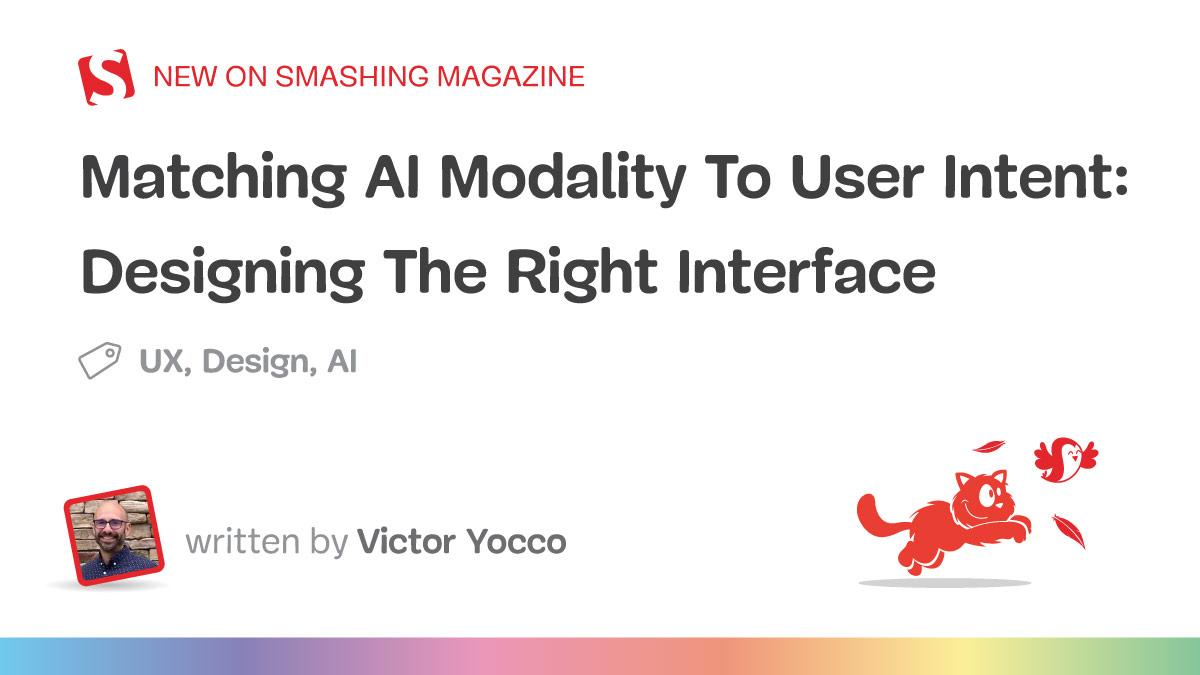
Victor Yocco argues that the industry's default to chat-bubble interfaces for AI capabilities imposes a dual burden: a linguistic barrier for input (users must translate vague intent into precise prompts) and a cognitive tax for output (serial text reading is slower than visual parallel processing). The article introduces two design tools: a Task Audit with four evaluation axes — input constraints, output constraints, social constraints, and cognitive load — and an Input/Output Alignment Matrix mapping six user intent types to optimal modality pairs. A field case study with utility-grid technicians shows how contextual inquiry and focused interviews revealed hands-busy, eyes-busy constraints that made touch interfaces unsafe, leading to a voice-input plus audio-summary solution in the field and a 15-inch dashboard handoff in the truck cab — resulting in a 20% reduction in diagnostic time and increased daily tool adoption.
How Do You Turn AI Coding Chaos into a Repeatable Playbook?
Snowflake SVP of Engineering Vivek Raghunathan describes how the company systematically scaled coding-agent adoption across its 1,000-engineer org. Starting with unrestricted experimentation, Snowflake codified learnings into 14 AI design patterns — including plan-in-English before writing code, using git worktrees to parallelize isolated agents, and an orchestrator-never-holds-context pattern. Focus weeks separate exploiters (who follow paved paths) from fearless explorers (who create them). Results: 97% weekly-active agent usage, release validation time cut from 15 days to one day, test volume up 3.5x, and a three-person team achieved a 40x improvement on the query compiler. On-call toil reduction follows a four-step maturity model, with 7,000 skills encoding tribal knowledge into versioned CI/CD workflows.
Kent Beck's YOW! 2025 talk argues that AI coding tools have thrown all programmers back into an exploration phase, upending the familiar extract mode where trade-offs were well-understood. He revisits his 3X model (explore, expand, extract) to show that AI assistants excel at rapid exploration — collapsing the gap between idea and working prototype — but struggle in expansion and extract phases where maintaining optionality matters. Beck warns that jumping from feature to feature without deliberately rebuilding optionality creates a "feature saw" pattern where teams burn down to zero options and get stuck. He closes with practical guidance: treat augmented development as a learning process rather than a production throughput race, use the AI as a tireless tutor, hire junior developers because they represent compounding learning investment, and focus on the 10% of skills gaining leverage — project selection, sequencing decisions, and maintaining awareness of agent choices.
Vercel Ship 2026 spanned London, Berlin, and New York, centering on agentic infrastructure as the company's core thesis. Key launches include the Agent Stack (AI SDK, AI Gateway, Workflow SDK, Vercel Sandbox, Chat SDK), Vercel Connect for scoped ephemeral credentials, the open-source eve agent framework, Dockerfile support with a container registry, Vercel Services for microservice-to-microservice communication, and Vercel Agent in public beta — which autonomously monitors production, investigates anomalies, and opens fix PRs. Enterprise additions include Vercel Passport for internal app access control, a Security Dashboard, and BYOC on AWS. Session highlights showed Vercel's internal support agent automating 91% of tickets and Brex cutting tool calls 75% with a bash-only agent shell.
Kent Beck's YOW! 2025 talk argues that AI coding tools have thrown all programmers back into an exploration phase, upending the familiar extract mode where trade-offs were well-understood. He revisits his 3X model (explore, expand, extract) to show that AI assistants excel at rapid exploration — collapsing the gap between idea and working prototype — but struggle in expansion and extract phases where maintaining optionality matters. Beck warns that jumping from feature to feature without deliberately rebuilding optionality creates a "feature saw" pattern where teams burn down to zero options and get stuck. He closes with practical guidance: treat augmented development as a learning process rather than a production throughput race, use the AI as a tireless tutor, hire junior developers because they represent compounding learning investment, and focus on the 10% of skills gaining leverage — project selection, sequencing decisions, and maintaining awareness of agent choices.
Addy Osmani proposes a two-axis framework — agency and orchestration — that replaces the single-axis Yegge ladder for measuring AI coding autonomy. Six levels range from Level 0 (suggest only, human decides) through Level 2 (scoped task delegation with automated verification) and Level 3 (goal-driven loops with measurable stopping conditions) to Level 5 (managed-by-exception orchestration where a manager agent dispatches worker agents, monitors progress, and escalates only on failure). Data from roughly 400K Claude Code sessions shows humans make around 70% of planning decisions while Claude handles 80% of execution steps. The article identifies four anti-patterns — autonomy as status, permission laundering, summary substitution, and fleet cosplay — and recommends every agent run be preceded by a written contract specifying goal, scope, non-goals, tools, stopping condition, evidence, escalation, and token budget.
Most MCP Servers Don't Need to Exist. Your Case Might Be an Exception.
Evil Martians argues that most MCP servers are premature product interfaces built before teams have stabilized their API or CLI contracts. An analysis of 1,412 MCP servers found roughly half the companies shipping one have no public API at all. The article frames MCP as a third interface layer that has nothing to stand on without a coherent first (API) and second (CLI). The key justification for building is cross-client demand — agents in Claude, Cursor, ChatGPT, or Copilot needing the same operations. Hidden costs are examined: Anthropic reported a five-server setup consuming55K tokens before the first message; Astrix's audit of 5,205 MCP repositories found 88% require credentials but only 8.5% implement OAuth. The piece closes with an eight-question checklist and a use/wrap/build decision framework.
Introducing the Safari MCP Server for Web Developers
Safari Technology Preview 247 ships a built-in MCP server that connects any MCP-compatible AI agent directly to a live Safari browser window. The server exposes 16 tools covering DOM interaction, screenshot capture, JavaScript evaluation, network request inspection, console log retrieval, viewport sizing, and CSS media emulation. Developers can use it to debug cross-browser compatibility issues, surface accessibility problems such as missing ARIA labels and poor contrast, evaluate JavaScript performance metrics like navigation timing, and verify user-flow states — all without switching windows. Setup requires enabling remote automation in Safari Settings and running a single CLI command. The server runs entirely on-device, makes no outbound network calls, and does not access personal Safari data such as AutoFill.
Build Agent Workflows Around State Ownership, Not Timing
This article derives a generalizable agent workflow design principle from a concrete problem: migrating Codex chat threads into Projects by patching local state files. The initial approach of mutating state while the app was running failed because Codex flushed its in-memory copy on quit, overwriting the changes. The fix split the workflow into two halves: an in-app planning phase that produces a declarative JSON move plan, and a detached terminal helper that waits for all Codex processes to exit before applying mutations to the global JSON state, SQLite thread rows, and transcript JSONL metadata. The principle generalizes as: identify which process owns the state, serialize intent into a plan file, back up before editing, mutate only when the owner is stopped, and verify the user-visible postcondition. The workflow was packaged as a reusable Codex skill named codex-chat-organizer, complete with fixture tests that validate invariants against a synthetic Codex home.
Matching AI Modality to User Intent: Designing the Right Interface
Victor Yocco argues that the industry's default to chat-bubble interfaces for AI capabilities imposes a dual burden: a linguistic barrier for input (users must translate vague intent into precise prompts) and a cognitive tax for output (serial text reading is slower than visual parallel processing). The article introduces two design tools: a Task Audit with four evaluation axes — input constraints, output constraints, social constraints, and cognitive load — and an Input/Output Alignment Matrix mapping six user intent types to optimal modality pairs. A field case study with utility-grid technicians shows how contextual inquiry and focused interviews revealed hands-busy, eyes-busy constraints that made touch interfaces unsafe, leading to a voice-input plus audio-summary solution in the field and a 15-inch dashboard handoff in the truck cab — resulting in a 20% reduction in diagnostic time and increased daily tool adoption.
How Do You Turn AI Coding Chaos into a Repeatable Playbook?
Snowflake SVP of Engineering Vivek Raghunathan describes how the company systematically scaled coding-agent adoption across its 1,000-engineer org. Starting with unrestricted experimentation, Snowflake codified learnings into 14 AI design patterns — including plan-in-English before writing code, using git worktrees to parallelize isolated agents, and an orchestrator-never-holds-context pattern. Focus weeks separate exploiters (who follow paved paths) from fearless explorers (who create them). Results: 97% weekly-active agent usage, release validation time cut from 15 days to one day, test volume up 3.5x, and a three-person team achieved a 40x improvement on the query compiler. On-call toil reduction follows a four-step maturity model, with 7,000 skills encoding tribal knowledge into versioned CI/CD workflows.
The web development meta shifted strongly toward agentic infrastructure and MCP this week. Vercel Ship 2026 (London, Berlin, New York) placed agentic infrastructure at the company's core thesis, launching the Agent Stack (AI SDK, AI Gateway, Workflow SDK, Vercel Sandbox, Chat SDK), the open-source eve agent framework, Dockerfile support with a container registry, and Vercel Agent in public beta — which autonomously monitors production, investigates anomalies, and opens fix PRs. Case studies showed Vercel's internal support agent automating 91% of tickets and Brex cutting tool calls 75% with a bash-only agent shell. Meanwhile, Apple shipped Safari Technology Preview 247 with a built-in MCP server exposing 16 tools for DOM interaction, screenshot capture, JavaScript evaluation, network inspection, and CSS media emulation — all on-device with no outbound network calls.
Critical thinking about MCP proliferation also emerged. Evil Martians analyzed 1,412 MCP servers and found roughly half the companies shipping one have no public API at all; a five-server setup consumes55K tokens before the first message (per Anthropic's data); and Astrix found 88% of 5,205 MCP repositories require credentials but only 8.5% implement OAuth. The article recommends a use/wrap/build decision framework before committing to building an MCP server. On agent autonomy, Addy Osmani proposed a two-axis (agency × orchestration) six-level framework from 400K Claude Code sessions showing humans handle 70% of planning and Claude 80% of execution, with four anti-patterns to avoid including permission laundering and summary substitution.
Engineering culture perspectives rounded out the week. Snowflake SVP Vivek Raghunathan detailed how the company scaled coding-agent adoption across 1,000 engineers with 14 AI design patterns, achieving 97% weekly-active agent usage, 15-day-to-1-day release validation, and a 40x query compiler improvement from a three-person team. Kent Beck's YOW! 2025 talk warned that AI tools have thrown all programmers back into exploration mode, and teams that jump feature-to-feature without rebuilding optionality create a "feature saw" pattern. An architectural post derived a generalizable principle from migrating Codex chat threads: identify state owners, serialize intent to a plan file, and mutate only when the owning process is stopped.
Key Takeaways
Safari Technology Preview 247 ships a built-in on-device MCP server with 16 tools for live browser debugging — enabling AI agents to inspect DOM, capture screenshots, evaluate JS, and check network requests directly in Safari without any outbound data.
Before building an MCP server: half of the 1,412 analyzed servers have no public API, a five-server setup costs 55K tokens before the first message, and 88% require credentials but only 8.5% implement OAuth — use the use/wrap/build decision framework first.
Snowflake achieved 97% weekly-active agent usage and cut release validation from 15 days to 1 day across 1,000 engineers by codifying 14 AI design patterns including plan-in-English before code, git worktree parallelization, and an orchestrator-never-holds-context rule.