
ACCESSIBILITYAccessibility in the age of AI - TetraLogical
Ela Gorla at TetraLogical argues that AI is a double-edged sword for accessibility: it can embed checks into daily workflows, yet the 2026 WebAIM Million found that both detected errors and WCAG conformance failures increased, reversing years of gradual progress. The culprits are vibe coding (where lack of coding skills prevents quality review), AI-assisted code generation trained on inaccessible public sites that replicates their flaws, and AI agents that create a false sense of security by appearing to cover accessibility without human expertise. The article recommends a value-led rather than tool-led approach: identify high-value automation opportunities, write detailed prompts referencing WCAG 2.2 Level AA targets, and build mandatory human review checkpoints before any AI-generated fix reaches production. Critically, accessibility specialists remain irreplaceable — AI cannot substitute for the expertise needed to write accurate prompts, review complex components, or conduct usability testing with disabled users.
Read Articlearrow_forward Article · ACCESSIBILITYREAD TIME: 9m
Use cases for aria-expanded
This Piccalilli deep-dive maps every collapsible widget pattern against the question of when aria-expanded is actually required — and when the web platform makes it unnecessary. The author divides patterns into collapsible sections (disclosure widget, accordion) and collapsible interactive elements (navigation, menu, tree view, combo box), each with distinct ARIA requirements: a fly-out navigation needs only aria-expanded, but a true menu button also requires aria-haspopup and aria-activedescendant. Native elements get their due: simple disclosure widgets should use <details>/<summary>, modals should use <dialog> with invoker commands, and tooltips can now be built with the Popover API (popover="auto") plus command="toggle-popover", delivering light-dismiss and ESC-to-close without JavaScript. The article warns that APG patterns are illustrations of ARIA usage, not production templates, and that all solutions — native or custom — must be tested with assistive technology.
READ_FULL_LOGarrow_forwardArticle · DESIGN SYSTEMSREAD TIME: 11m
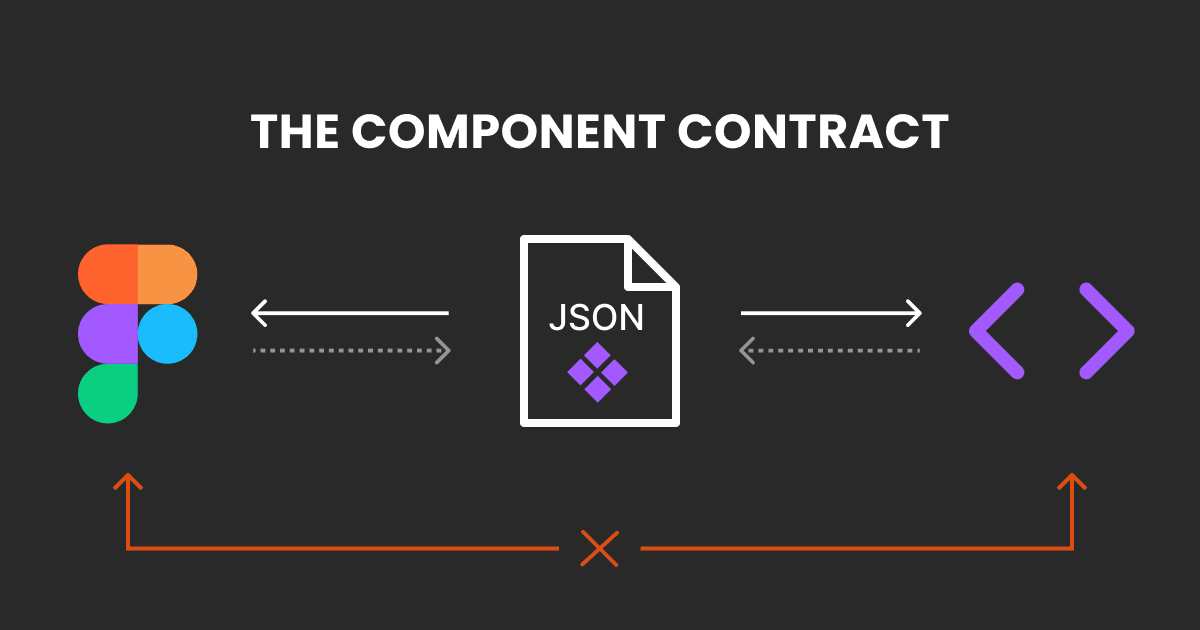
Design system contracts: the component lives in neither Figma nor code
Christine Vallaure introduces the design system contract model — a single JSON or YAML file per component that sits between Figma and code, neither of which is treated as the canonical source. Both the Figma library and the codebase are generated from that one file, and a checker verifies all three surfaces still agree. The model was popularised by Southleft (founded by TJ Petri, who recently joined Figma), whose open-source proof-of-concept has been validated against Shoelace, Mantine, Carbon, and Polaris. The urgency is practical: in Southleft’s A/B test an AI working without the contract scored 69 out of 100 — inventing options, hard-coding colours, and restyling components — while the same AI constrained by the contract scored 100 out of 100 and flagged genuine gaps instead of hallucinating. Vallaure is candid about scope: the contract fixes composition and token mapping but does not govern prose-level craft like drag, typeahead, or motion; ARIA semantics are included, which she calls a pleasant surprise. Critically, unlike Code Connect or UXPin Merge, the contract crowns neither Figma nor code — a distinction that preserves designers’ decision-making authority.
READ_FULL_LOGarrow_forwardArticle · ACCESSIBILITYREAD TIME: 9m
How to Create Accessible Modals and Pop-ups Using HTML, CSS, and Minimal JavaScript
Jabo Landry walks through building accessible overlays with modern HTML primitives. Pop-ups use the popover and popovertarget attributes for built-in Escape-to-close and light-dismiss, while modals use the <dialog> element with command="show-modal" and command="close" on their trigger and close buttons — a declarative pattern that requires no JavaScript. When command/commandfor browser support is uncertain, the fallback is the showModal() method. The article highlights two practical gotchas: applying display: flex or grid directly on a popover or <dialog> overrides the default display: none and keeps the element always visible — use :popover-open or dialog[open] selectors instead; and background scrolling while a modal is open can be suppressed with html:has(dialog[open]) { overflow: hidden; }. CSS Anchor Positioning (position-anchor, anchor-name) enables tethering a pop-up to its trigger purely in CSS, though the article notes this feature needs a browser-support check before production use.
READ_FULL_LOGarrow_forwardArticle · ECOSYSTEMREAD TIME: 6m
No, People Don't Want More AI In Their Life — Smashing Magazine
Vitaly Friedman surveys the gap between AI-feature ambition and real user appetite, citing IBM’s 2026 AI Adoption Gap study and Nielsen Norman Group research noting that AI chatbots actively discourage error-checking. His core claim: AI features are bolt-ons that pull people out of established workflows, and the cost of verifying AI output — skimming, spotting key points, checking rationale, articulating corrections, re-reviewing — often exceeds the time saved. Users don’t compare AI with human alternatives; they compare features with features, and any unreliable feature loses to a reliable one regardless of its technology. The practical prescription is AI-second design: ambient, calm, deeply integrated into existing mental models, automating genuinely tedious tasks rather than replacing creative or judgment-intensive work. Friedman quotes Bo Young Lee’s widely-shared formulation: people want AI to handle the physical and mental labour that taxes them so they can spend more time on work and relationships that are distinctly human.
READ_FULL_LOGarrow_forwardsummarizeDigest_Summary
Week 29 puts accessibility and design-system integrity under the microscope at a moment when AI is reshaping every layer of the front-end stack. The 2026 WebAIM Million report lands a sobering finding: after years of gradual improvement, both detected errors and WCAG conformance failures increased — a reversal the TetraLogical team traces directly to unchecked AI adoption in development workflows.
On the component-authoring side, two pieces show how the web platform has quietly made accessible widgets easier to build. aria-expanded is now only one tool in a richer kit that includes native <details>, <dialog>, the Popover API, and invoker commands — patterns that cut JavaScript overhead while improving AT compatibility. The freeCodeCamp walkthrough reinforces the same point with concrete command/commandfor patterns and the ::backdrop pseudo-element.
Christine Vallaure’s piece on design system contracts reframes the Figma-vs-code drift debate: a single JSON/YAML contract sits in the middle, and Southleft’s A/B test showed an AI constrained by that contract scored 100/100, versus 69/100 when working without it — a concrete proof point for schema-driven governance.
Vitaly Friedman closes the issue with a user-research corrective: people don’t crave more AI, they want AI to absorb tedious labour so human work feels more rewarding — a lens every design-system team should apply before shipping the next AI-powered feature.
Key Takeaways- The 2026 WebAIM Million found accessibility errors and WCAG failures both increased, reversing years of progress — AI-assisted development without governance is a likely driver.
- Native HTML elements (
<details>, <dialog>, Popover API, invoker commands) now cover many patterns that previously required custom aria-expanded wiring and heavy JavaScript. - A JSON/YAML design-system contract sitting between Figma and code cuts AI-induced drift: constrained AI scored 100/100 vs 69/100 without the contract in Southleft’s test.