The defining story of this week — and arguably of early 2026 for the web platform — is The Astro Technology Company joining Cloudflare. Cloudflare has acquired the… Compiled for immediate developer deployment.
calendar_todaysummarizeWeek 3-2026bolt1 CRITICAL
article
TAG: ACQUISITIONREAD_TIME: 4_MIN
The Astro Technology Company Joins Cloudflare
Cloudflare has acquired The Astro Technology Company, bringing the full-time Astro engineering team under Cloudflare's umbrella while keeping the framework free, MIT-licensed, and platform-agnostic. Astro — downloaded nearly 1,000,000 times per week and used by companies such as Webflow, Wix, Microsoft, and Google — will continue to support all deployment targets, not just Cloudflare. The deal ends the team's years-long search for a sustainable business model: previous attempts at paid hosted primitives, databases, and e-commerce layers all failed to gain traction. Co-founder Fred K. Schott and Cloudflare CTO Dane Knecht had been discussing the future of content-driven websites and AI-era frameworks for over a year before the acquisition. Astro 6 is currently in beta, and the team's 2026 roadmap remains publicly governed and open to community contribution.
The Node.js project released security updates for the 20.x, 22.x, 24.x, and 25.x release lines on January 13, 2026, addressing eight vulnerabilities in total. The three high-severity CVEs are: CVE-2025-55131 (uninitialized buffer memory exposure via Buffer.alloc timing races in the vm module), CVE-2025-55130 (permission model bypass via crafted symlinks allowing arbitrary file read/write), and CVE-2025-59465 (HTTP/2 server crash via malformed HPACK HEADERS frame causing unhandled ECONNRESET). Medium-severity issues include CVE-2025-59466 (uncatchable stack overflow crash when async_hooks are active), a TLS client-certificate memory leak (CVE-2025-59464, already fixed in 24.12.0), a Unix Domain Socket permission bypass on 25.x (CVE-2026-21636), and a TLS PSK/ALPN callback DoS (CVE-2026-21637). Dependency updates to c-ares 1.34.6 and undici 6.23.0/7.18.0 are also included. All active release lines are affected; immediate upgrade is recommended.
Node.js: Mitigating DoS from Stack Exhaustion When async_hooks Are Enabled (React, Next.js, APM Impact)
When async_hooks are enabled in Node.js, a stack overflow in user code causes the process to exit immediately with code 7 rather than throwing a catchable RangeError. The root cause is that async_hooks callbacks run on the same call stack as user code, so a stack overflow inside a hook triggers TryCatchScope::kFatal, bypassing all error handlers including process.on('uncaughtException'). React Server Components and Next.js both rely on AsyncLocalStorage (internally built on async_hooks in Node.js <24) for request context tracking; major APM tools (Datadog, New Relic, Dynatrace, OpenTelemetry) use the same API. A remote attacker sending deeply nested JSON to a Next.js API route can crash the entire server process. Patched versions — Node.js 20.20.0, 22.22.0, 24.13.0, and 25.3.0 — re-throw stack-overflow errors to user code instead of treating them as fatal. The Node.js team stresses that stack exhaustion recovery is unspecified ECMAScript behavior; applications must validate and bound recursive input depth independently.
The Svelte team has released patches for five vulnerabilities spanningdevalue, svelte, @sveltejs/kit, and @sveltejs/adapter-node. Two separate DoS flaws in devalue.parse — CVE-2026-22775 (versions 5.1.0–5.6.1) and CVE-2026-22774 (versions 5.3.0–5.6.1) — allow malicious payloads to cause arbitrarily large memory allocation, crashing the process; SvelteKit apps with remote functions enabled are directly exposed. CVE-2026-22803 affects @sveltejs/kit2.49.0–2.49.4 and lets attackers cause memory amplification DoS via the binary form deserializer when experimental.remoteFunctions is active. CVE-2025-67647 enables DoS and potential Server-Side Request Forgery (SSRF) against prerendered routes, with SSRF escalating to cache-poisoning XSS under specific reverse-proxy configurations. CVE-2025-15265 is an XSS bug in svelte5.46.0–5.46.3 via unsanitized keys in the hydratable API. Fixed versions are devalue 5.6.2, svelte 5.46.4, @sveltejs/kit 2.49.5, and @sveltejs/adapter-node 5.5.1.
Anthropic Commits $1.5M to Python Software Foundation for Ecosystem Security
Anthropic is investing $1.5 million in the Python Software Foundation (PSF) over two years, with a specific focus on Python ecosystem and supply-chain security. The funds will support the PSF's Security Developer-in-Residence program (currently Seth Larson) and PyPI Safety and Security Engineer Mike Fiedler, and will accelerate work on automated proactive malware detection for all PyPI uploads — moving beyond the current reactive-only review process. A planned output is a reusable dataset of known malware enabling capability-based analysis transferable to other package registries. Analysts at Forrester and Constellation Research praised the investment as both strategically self-interested — Anthropic generates responses that execute Python code on client machines — and broadly beneficial for the open-source community. Industry observers note that stronger PyPI defenses could have knock-on benefits for other ecosystems, pointing to the recent Shai-Hulud worm that infected more than 500 npm packages as a cautionary parallel.
When the Tech Leopard Eats Your Face: Tailwind's AI Revenue Crisis
Go Make Things author Chris Ferdinandi writes a pointed commentary on Tailwind CSS founder Adam Wathan's announcement that 75% of the engineering team lost their jobs due to AI's impact on the business. Despite Tailwind growing faster than ever in adoption, documentation traffic is down roughly 40% from early 2023 — because developers increasingly consult LLMs rather than official docs — and revenue has fallen close to 80%, since docs are the primary funnel for Tailwind's commercial products. Ferdinandi frames the situation as poetic irony: Wathan built Tailwind partly by devaluing CSS expertise and encouraging backend developers to bypass CSS professionals, and now a new technology is doing the same to his own livelihood. Vercel CEO Guillermo Rauch and Google AI Studio subsequently announced sponsorship of the Tailwind project, but the article notes no public announcement was made about support for the laid-off employees.
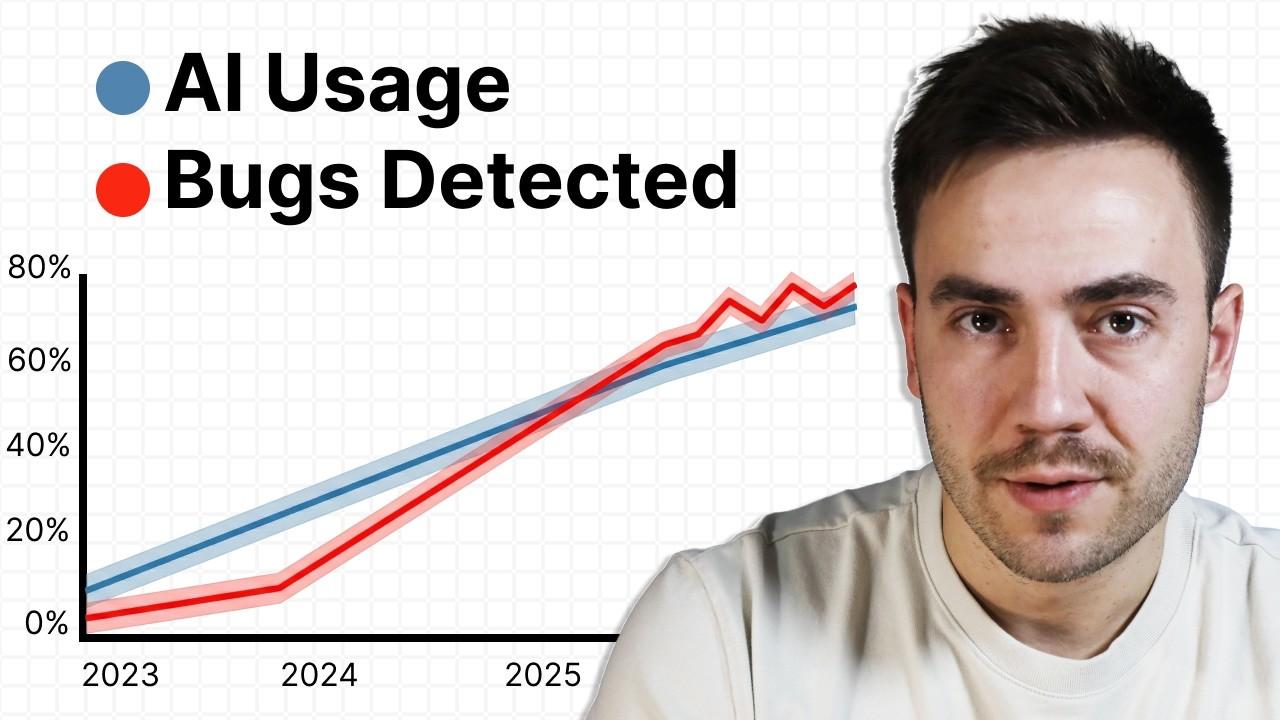
Brad Traversy breaks down multiple industry reports showing that AI-generated code introduces measurably more security vulnerabilities than human-written code. A Veracode study found 45% of AI-generated code failed security tests and introduced OWASP Top 10 issues — results that held even as models improved. A CodeRabbit analysis of 470 open-source GitHub pull requests found AI PRs averaged 10.83 issues versus 6.45 for human PRs (1.7× higher), with AI producing 1.4× more critical-severity issues and roughly 2× more minor issues. AI-generated PRs also tend to run 18% larger, making human review harder. Traversy argues the core problems are developer over-reliance on AI for architecture decisions beyond its competence, and lack of accountability when submitters don't understand their own code. His recommended mitigation: treat AI like a capable junior engineer — use automated first-pass tools like CodeRabbit CLI for local review before the PR is opened, but never skip mandatory human review.
Cloudflare has acquired The Astro Technology Company, bringing the full-time Astro engineering team under Cloudflare's umbrella while keeping the framework free, MIT-licensed, and platform-agnostic. Astro — downloaded nearly 1,000,000 times per week and used by companies such as Webflow, Wix, Microsoft, and Google — will continue to support all deployment targets, not just Cloudflare. The deal ends the team's years-long search for a sustainable business model: previous attempts at paid hosted primitives, databases, and e-commerce layers all failed to gain traction. Co-founder Fred K. Schott and Cloudflare CTO Dane Knecht had been discussing the future of content-driven websites and AI-era frameworks for over a year before the acquisition. Astro 6 is currently in beta, and the team's 2026 roadmap remains publicly governed and open to community contribution.
Brad Traversy breaks down multiple industry reports showing that AI-generated code introduces measurably more security vulnerabilities than human-written code. A Veracode study found 45% of AI-generated code failed security tests and introduced OWASP Top 10 issues — results that held even as models improved. A CodeRabbit analysis of 470 open-source GitHub pull requests found AI PRs averaged 10.83 issues versus 6.45 for human PRs (1.7× higher), with AI producing 1.4× more critical-severity issues and roughly 2× more minor issues. AI-generated PRs also tend to run 18% larger, making human review harder. Traversy argues the core problems are developer over-reliance on AI for architecture decisions beyond its competence, and lack of accountability when submitters don't understand their own code. His recommended mitigation: treat AI like a capable junior engineer — use automated first-pass tools like CodeRabbit CLI for local review before the PR is opened, but never skip mandatory human review.
The Node.js project released security updates for the 20.x, 22.x, 24.x, and 25.x release lines on January 13, 2026, addressing eight vulnerabilities in total. The three high-severity CVEs are: CVE-2025-55131 (uninitialized buffer memory exposure via Buffer.alloc timing races in the vm module), CVE-2025-55130 (permission model bypass via crafted symlinks allowing arbitrary file read/write), and CVE-2025-59465 (HTTP/2 server crash via malformed HPACK HEADERS frame causing unhandled ECONNRESET). Medium-severity issues include CVE-2025-59466 (uncatchable stack overflow crash when async_hooks are active), a TLS client-certificate memory leak (CVE-2025-59464, already fixed in 24.12.0), a Unix Domain Socket permission bypass on 25.x (CVE-2026-21636), and a TLS PSK/ALPN callback DoS (CVE-2026-21637). Dependency updates to c-ares 1.34.6 and undici 6.23.0/7.18.0 are also included. All active release lines are affected; immediate upgrade is recommended.
Node.js: Mitigating DoS from Stack Exhaustion When async_hooks Are Enabled (React, Next.js, APM Impact)
When async_hooks are enabled in Node.js, a stack overflow in user code causes the process to exit immediately with code 7 rather than throwing a catchable RangeError. The root cause is that async_hooks callbacks run on the same call stack as user code, so a stack overflow inside a hook triggers TryCatchScope::kFatal, bypassing all error handlers including process.on('uncaughtException'). React Server Components and Next.js both rely on AsyncLocalStorage (internally built on async_hooks in Node.js <24) for request context tracking; major APM tools (Datadog, New Relic, Dynatrace, OpenTelemetry) use the same API. A remote attacker sending deeply nested JSON to a Next.js API route can crash the entire server process. Patched versions — Node.js 20.20.0, 22.22.0, 24.13.0, and 25.3.0 — re-throw stack-overflow errors to user code instead of treating them as fatal. The Node.js team stresses that stack exhaustion recovery is unspecified ECMAScript behavior; applications must validate and bound recursive input depth independently.
The Svelte team has released patches for five vulnerabilities spanningdevalue, svelte, @sveltejs/kit, and @sveltejs/adapter-node. Two separate DoS flaws in devalue.parse — CVE-2026-22775 (versions 5.1.0–5.6.1) and CVE-2026-22774 (versions 5.3.0–5.6.1) — allow malicious payloads to cause arbitrarily large memory allocation, crashing the process; SvelteKit apps with remote functions enabled are directly exposed. CVE-2026-22803 affects @sveltejs/kit2.49.0–2.49.4 and lets attackers cause memory amplification DoS via the binary form deserializer when experimental.remoteFunctions is active. CVE-2025-67647 enables DoS and potential Server-Side Request Forgery (SSRF) against prerendered routes, with SSRF escalating to cache-poisoning XSS under specific reverse-proxy configurations. CVE-2025-15265 is an XSS bug in svelte5.46.0–5.46.3 via unsanitized keys in the hydratable API. Fixed versions are devalue 5.6.2, svelte 5.46.4, @sveltejs/kit 2.49.5, and @sveltejs/adapter-node 5.5.1.
Anthropic Commits $1.5M to Python Software Foundation for Ecosystem Security
Anthropic is investing $1.5 million in the Python Software Foundation (PSF) over two years, with a specific focus on Python ecosystem and supply-chain security. The funds will support the PSF's Security Developer-in-Residence program (currently Seth Larson) and PyPI Safety and Security Engineer Mike Fiedler, and will accelerate work on automated proactive malware detection for all PyPI uploads — moving beyond the current reactive-only review process. A planned output is a reusable dataset of known malware enabling capability-based analysis transferable to other package registries. Analysts at Forrester and Constellation Research praised the investment as both strategically self-interested — Anthropic generates responses that execute Python code on client machines — and broadly beneficial for the open-source community. Industry observers note that stronger PyPI defenses could have knock-on benefits for other ecosystems, pointing to the recent Shai-Hulud worm that infected more than 500 npm packages as a cautionary parallel.
When the Tech Leopard Eats Your Face: Tailwind's AI Revenue Crisis
Go Make Things author Chris Ferdinandi writes a pointed commentary on Tailwind CSS founder Adam Wathan's announcement that 75% of the engineering team lost their jobs due to AI's impact on the business. Despite Tailwind growing faster than ever in adoption, documentation traffic is down roughly 40% from early 2023 — because developers increasingly consult LLMs rather than official docs — and revenue has fallen close to 80%, since docs are the primary funnel for Tailwind's commercial products. Ferdinandi frames the situation as poetic irony: Wathan built Tailwind partly by devaluing CSS expertise and encouraging backend developers to bypass CSS professionals, and now a new technology is doing the same to his own livelihood. Vercel CEO Guillermo Rauch and Google AI Studio subsequently announced sponsorship of the Tailwind project, but the article notes no public announcement was made about support for the laid-off employees.
The defining story of this week — and arguably of early 2026 for the web platform — is The Astro Technology Company joining Cloudflare. Cloudflare has acquired the full-time Astro engineering team while keeping the framework MIT-licensed, platform-agnostic, and fully open-governed. Astro, downloaded nearly one million times per week and used by Webflow, Wix, Microsoft, and Google, ends years of searching for a sustainable business model: previous attempts at hosted databases, e-commerce layers, and paid primitives all failed to gain traction. Co-founder Fred K. Schott and Cloudflare CTO Dane Knecht had been discussing the future of content-driven websites and AI-era frameworks for over a year. The 2026 roadmap stays public and community-governed; Astro 6, currently in beta, is unaffected.
Security headlines dominated the rest of the issue. Node.js released coordinated patches for all active release lines (20.x–25.x) covering eight CVEs — three rated High: an uninitialized buffer exposure in the vm module (CVE-2025-55131), a permission-model bypass via crafted symlinks (CVE-2025-55130), and an HTTP/2 HPACK crash (CVE-2025-59465). A separate deep-dive explained the async_hooks DoS vector: when AsyncLocalStorage is active — as it is in React Server Components, Next.js, and most APM tools — a stack overflow from deeply nested user input kills the process with exit code 7 rather than throwing a catchable error. Svelte patched five CVEs spanning DoS, SSRF, cache-poisoning XSS, and an XSS bug in the hydratable API.
Two broader industry stories rounded out the issue. Anthropic committed $1.5 million to the Python Software Foundation for supply-chain security, specifically to fund automated malware detection for all PyPI uploads — a move analysts at Forrester framed as both strategically self-interested and broadly beneficial. And Brad Traversy surfaced hard data on AI-generated code security: a CodeRabbit analysis of 470 open-source PRs found AI-generated ones averaged 1.7× more issues, with 1.4× more critical-severity findings — a sobering counterpoint to the Tailwind AI revenue crisis story, where AI's disruption of documentation traffic drove an ~80% revenue drop.
Key Takeaways
Cloudflare has acquired The Astro Technology Company — the framework remains MIT-licensed and platform-agnostic, ending years of failed monetisation attempts while securing full-time engineering resources.
Node.js patched 8 CVEs across all active release lines; the async_hooks DoS is especially critical because React Server Components, Next.js, and most APM tools rely on AsyncLocalStorage — upgrade immediately to 20.20.0 / 22.22.0 / 24.13.0.
Svelte patched 5 CVEs including memory-amplification DoS in devalue.parse and cache-poisoning XSS via prerendered routes; update to devalue 5.6.2, @sveltejs/kit 2.49.5, and svelte 5.46.4.