The featured essay this week is a direct challenge to the React default: a senior Automattic performance engineer marshals hard numbers — react-dom's 33% bundle… Compiled for immediate developer deployment.
calendar_todaysummarizeWeek 7-2026
article
TAG: DEEP DIVEREAD_TIME: 31_MIN
JS-heavy approaches are not compatible with long-term performance goals
A senior Automattic performance engineer makes a substantiated case that JS-heavy SPAs — particularly those built on React — are structurally incompatible with sustained good performance. Key arguments: react-dom grew 33% in bundle size from v18 to v19, moment has grown 10% over five years, and frameworks like React make performance-degrading patterns (monolithic Redux reducers, missing memoisation, synchronous top-level imports) far easier than the correct alternatives. The author explains how a single bad import can undo months of optimisation work, and how React's siloed DevTools prevent correlating framework profiles with native browser profiles. Mitigations — code splitting, bundle size CI checks, forbidden-import linting, Playwright-based perf suites — are outlined but acknowledged as high-overhead. The piece concludes with a call to favour server-centric MPAs, htmx, the WordPress Interactivity API, or smaller reactive frameworks (Preact, Svelte, Solid) when client-side rendering cannot be justified by actual user workflow.
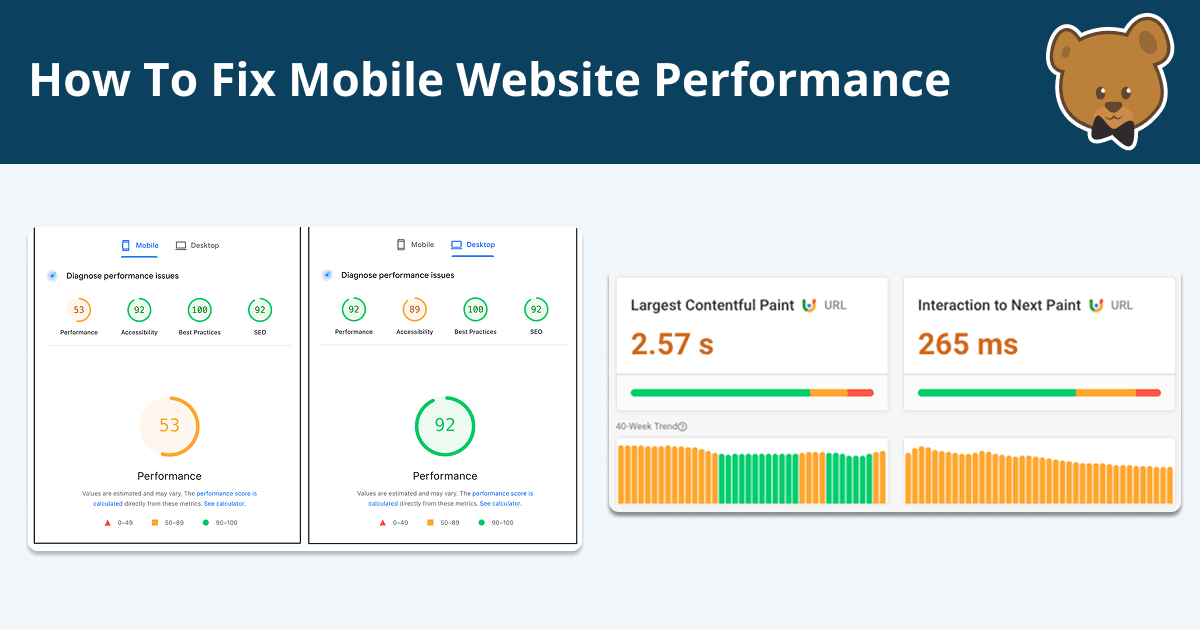
Mobile performance: How to make your website mobile friendly | DebugBear
DebugBear's Jakub Andrzejewski demonstrates that even Apple.com and Amazon score poorly on Lighthouse mobile — Amazon's mobile Performance score is 56 — yet both pass the Core Web Vitals CrUX assessment for real users, illustrating why lab and field data must be read together. The article enumerates five concrete code-level fixes: serve responsive images using srcset/sizes with WebP formats and loading="lazy"; apply defer and async to non-critical scripts to unblock initial render; inline above-the-fold CSS and load non-critical stylesheets with the print media trick; wrap third-party widgets in requestIdleCallback to prevent input delay; and set explicit width/height attributes on images to eliminate layout shift (CLS). The DebugBear monitor is then presented as a tool for scheduling real-device tests on 3G/4G connections and tracking Core Web Vitals trends over time.
Playwright vs Cypress: The Ultimate Guide to QA Automation
Meghna Sen compares Playwright (Microsoft, multi-language: JS/TS/Python/Java/C#, native Chromium/Firefox/WebKit) against Cypress (JS/TS only, in-browser Electron model, Chrome-family + Firefox) across architecture, parallelism, debugging, and ecosystem maturity. Playwright's external Node process via Chrome DevTools Protocol enables built-in parallel isolated browser contexts, while Cypress requires paid cloud infrastructure for parallelism. Cypress's interactive time-travel debugger and step-by-step command log make it faster for front-end iteration; Playwright's Trace Viewer captures screenshots, DOM snapshots, network logs, and timing data per step. The recommended pattern for mature QA teams is layered: Cypress for fast developer-side component feedback, Playwright for full regression suites in CI/CD. Neither framework covers native mobile — both offer browser emulation only — a gap the article uses to introduce Panto QA, an AI-driven no-code platform that generates deterministic Appium/Maestro scripts from plain-English flow descriptions and runs them on real devices via BrowserStack or LambdaTest.
Virtual Scrolling for Billions of Rows — Techniques from HighTable
Sylvain Lesage documents five techniques used in the open-source HighTable React component (hyparam/hightable) to render billions of rows without a canvas element or fake scrollbar. Technique 1 (lazy loading) reduces a theoretical 1 TB dataset to ~3 KB of loaded data by computing visible row indices on every scroll event. Technique 2 (table slicing) keeps the DOM constant at ~30 rendered rows regardless of total count, satisfying Chrome's recommendation of fewer than 300 element updates. Technique 3 (infinite pixels) caps the canvas div at 8 million pixels and applies a downscale factor — necessary because Firefox's maximum element height is only ~17 million pixels — enabling navigation across 10-billion-row tables. Technique 4 (pixel-precise dual scroll) distinguishes local mouse-wheel moves from global scrollbar drags so every row remains reachable, guaranteeing 1-pixel fidelity up to 2 trillion rows. Technique 5 (two-step random access) decouples vertical and horizontal scroll to support full keyboard navigation via WAI Grid Pattern without conflicting programmatic scrollTop writes.
We Measured the N+1 Query Problem. The Numbers Are Worse Than You Think.
Ko-Hsin Liang builds a benchmark suite against PostgreSQL 17 with Prisma 6.3.1 and measures four N+1 scenarios on a dataset of 100 users. The worst case — many-to-one orders fetching their owning user — ran 201 queries versus 2 with eager loading, yielding a 22.2x speedup (82.54 ms → 3.72 ms) on localhost where network latency is zero. Three-level nested fetching (users → posts → comments) fired 401 queries versus 3, with the bad path reaching a P95 of 185 ms. Scaling to 1,000 users, the nested bad path crossed 1.27 seconds (4,001 queries). The conditional batch-fetch pattern — collect IDs into a Set, one findMany with WHERE IN, O(1) Map lookup — turned 56 queries into 2 and scaled better than linearly at 10x data size. The piece concludes that the speedup factors grew with dataset size in every test case, directly refuting the common belief that N+1 is a "scaling problem" safe to defer.
The Hidden Cost of Slow Code Reviews: Data from 8 Million PRs
Vitalii Petrenko aggregates data from LinearB's 8.1-million-PR study, Google's engineering research, DORA, SmartBear, and UC Irvine to put dollar figures on review latency. LinearB tiering shows elite teams achieve pickup under 7 hours with PRs under 219 lines; lagging teams wait 50–137+ hours with PRs of 395–793+ lines. At $82/hour fully loaded cost and 5.8 lost hours per developer per week, a 10-person team wastes approximately $237,800 per year in idle time. SmartBear's study of 2,500 PRs found defect detection drops from 87% for sub-100-line reviews to 28% for 1,000+ line reviews, meaning slow large PRs simultaneously waste time and miss more bugs. Recommended actions: target PRs around 50 lines (Graphite's optimum), enforce CODEOWNERS assignment, set same-business-day pickup SLAs, add AI tools for first-pass review (reducing turnaround from 2–3 hours to 20–30 minutes), and surface PR cycle time on team dashboards.
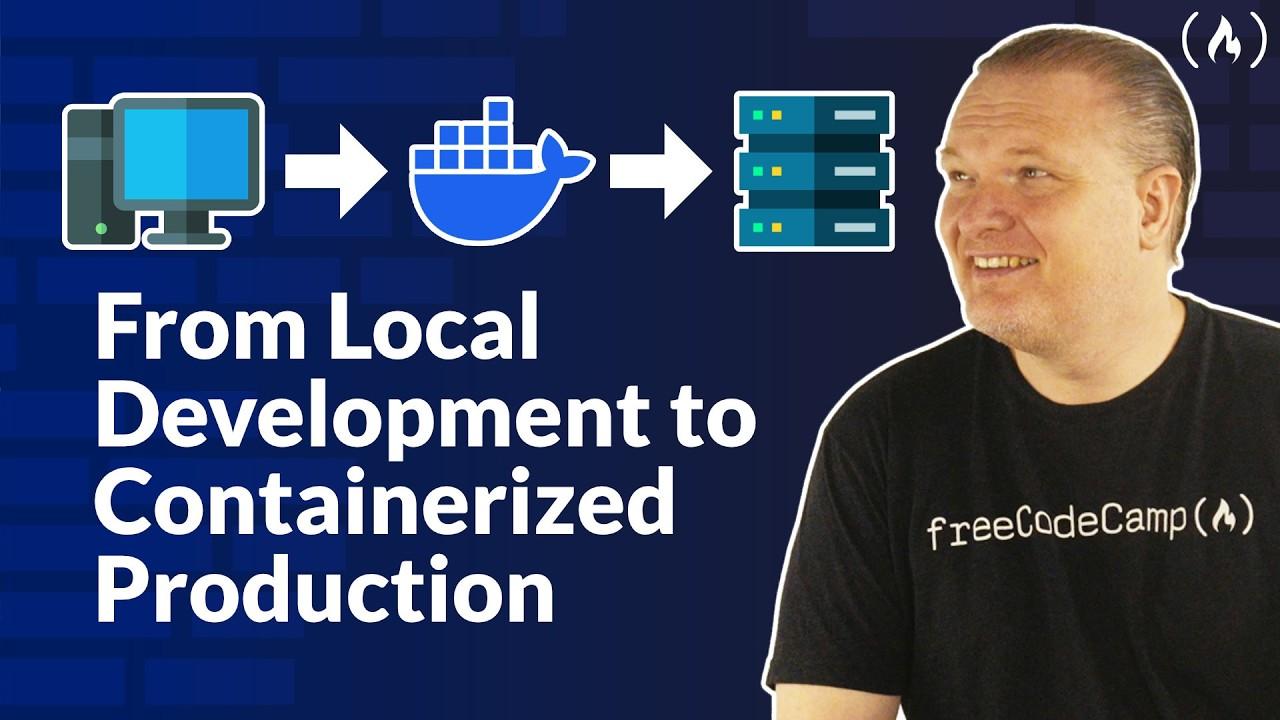
Master Full-Stack Docker & CI/CD – Build a Production-Ready Pipeline
Gavin Lawn walks through containerising and deploying a full-stack React + Go + MongoDB movie-streaming application called Magic Stream to Hostinger's VPS using Docker Manager. The course first demonstrates the fast path: pointing Docker Manager at a raw GitHub-hosted docker-compose.yml URL, configuring environment variables (OpenAI API key, CORS allow-origins, API host IP) through the visual editor, and clicking Deploy — the entire setup takes minutes. A GitHub Actions workflow that builds Docker images from Dockerfile.prod files and pushes them to DockerHub is then shown triggering a CI/CD cycle: a one-line heading change in the React component propagates to production after a single git push and a Deploy button click in Docker Manager. The second half of the course goes under the hood: writing Dockerfiles layer by layer for both the Node 20-Alpine client and the Go 1.24.2-Alpine server, building images with docker build -t, running individual containers with docker run -p port mapping and --env-file injection, and finally composing both services with a docker-compose.yml to replace the multi-command workflow with a single docker compose up.
JS-heavy approaches are not compatible with long-term performance goals
A senior Automattic performance engineer makes a substantiated case that JS-heavy SPAs — particularly those built on React — are structurally incompatible with sustained good performance. Key arguments: react-dom grew 33% in bundle size from v18 to v19, moment has grown 10% over five years, and frameworks like React make performance-degrading patterns (monolithic Redux reducers, missing memoisation, synchronous top-level imports) far easier than the correct alternatives. The author explains how a single bad import can undo months of optimisation work, and how React's siloed DevTools prevent correlating framework profiles with native browser profiles. Mitigations — code splitting, bundle size CI checks, forbidden-import linting, Playwright-based perf suites — are outlined but acknowledged as high-overhead. The piece concludes with a call to favour server-centric MPAs, htmx, the WordPress Interactivity API, or smaller reactive frameworks (Preact, Svelte, Solid) when client-side rendering cannot be justified by actual user workflow.
Master Full-Stack Docker & CI/CD – Build a Production-Ready Pipeline
Gavin Lawn walks through containerising and deploying a full-stack React + Go + MongoDB movie-streaming application called Magic Stream to Hostinger's VPS using Docker Manager. The course first demonstrates the fast path: pointing Docker Manager at a raw GitHub-hosted docker-compose.yml URL, configuring environment variables (OpenAI API key, CORS allow-origins, API host IP) through the visual editor, and clicking Deploy — the entire setup takes minutes. A GitHub Actions workflow that builds Docker images from Dockerfile.prod files and pushes them to DockerHub is then shown triggering a CI/CD cycle: a one-line heading change in the React component propagates to production after a single git push and a Deploy button click in Docker Manager. The second half of the course goes under the hood: writing Dockerfiles layer by layer for both the Node 20-Alpine client and the Go 1.24.2-Alpine server, building images with docker build -t, running individual containers with docker run -p port mapping and --env-file injection, and finally composing both services with a docker-compose.yml to replace the multi-command workflow with a single docker compose up.
Mobile performance: How to make your website mobile friendly | DebugBear
DebugBear's Jakub Andrzejewski demonstrates that even Apple.com and Amazon score poorly on Lighthouse mobile — Amazon's mobile Performance score is 56 — yet both pass the Core Web Vitals CrUX assessment for real users, illustrating why lab and field data must be read together. The article enumerates five concrete code-level fixes: serve responsive images using srcset/sizes with WebP formats and loading="lazy"; apply defer and async to non-critical scripts to unblock initial render; inline above-the-fold CSS and load non-critical stylesheets with the print media trick; wrap third-party widgets in requestIdleCallback to prevent input delay; and set explicit width/height attributes on images to eliminate layout shift (CLS). The DebugBear monitor is then presented as a tool for scheduling real-device tests on 3G/4G connections and tracking Core Web Vitals trends over time.
Playwright vs Cypress: The Ultimate Guide to QA Automation
Meghna Sen compares Playwright (Microsoft, multi-language: JS/TS/Python/Java/C#, native Chromium/Firefox/WebKit) against Cypress (JS/TS only, in-browser Electron model, Chrome-family + Firefox) across architecture, parallelism, debugging, and ecosystem maturity. Playwright's external Node process via Chrome DevTools Protocol enables built-in parallel isolated browser contexts, while Cypress requires paid cloud infrastructure for parallelism. Cypress's interactive time-travel debugger and step-by-step command log make it faster for front-end iteration; Playwright's Trace Viewer captures screenshots, DOM snapshots, network logs, and timing data per step. The recommended pattern for mature QA teams is layered: Cypress for fast developer-side component feedback, Playwright for full regression suites in CI/CD. Neither framework covers native mobile — both offer browser emulation only — a gap the article uses to introduce Panto QA, an AI-driven no-code platform that generates deterministic Appium/Maestro scripts from plain-English flow descriptions and runs them on real devices via BrowserStack or LambdaTest.
Virtual Scrolling for Billions of Rows — Techniques from HighTable
Sylvain Lesage documents five techniques used in the open-source HighTable React component (hyparam/hightable) to render billions of rows without a canvas element or fake scrollbar. Technique 1 (lazy loading) reduces a theoretical 1 TB dataset to ~3 KB of loaded data by computing visible row indices on every scroll event. Technique 2 (table slicing) keeps the DOM constant at ~30 rendered rows regardless of total count, satisfying Chrome's recommendation of fewer than 300 element updates. Technique 3 (infinite pixels) caps the canvas div at 8 million pixels and applies a downscale factor — necessary because Firefox's maximum element height is only ~17 million pixels — enabling navigation across 10-billion-row tables. Technique 4 (pixel-precise dual scroll) distinguishes local mouse-wheel moves from global scrollbar drags so every row remains reachable, guaranteeing 1-pixel fidelity up to 2 trillion rows. Technique 5 (two-step random access) decouples vertical and horizontal scroll to support full keyboard navigation via WAI Grid Pattern without conflicting programmatic scrollTop writes.
We Measured the N+1 Query Problem. The Numbers Are Worse Than You Think.
Ko-Hsin Liang builds a benchmark suite against PostgreSQL 17 with Prisma 6.3.1 and measures four N+1 scenarios on a dataset of 100 users. The worst case — many-to-one orders fetching their owning user — ran 201 queries versus 2 with eager loading, yielding a 22.2x speedup (82.54 ms → 3.72 ms) on localhost where network latency is zero. Three-level nested fetching (users → posts → comments) fired 401 queries versus 3, with the bad path reaching a P95 of 185 ms. Scaling to 1,000 users, the nested bad path crossed 1.27 seconds (4,001 queries). The conditional batch-fetch pattern — collect IDs into a Set, one findMany with WHERE IN, O(1) Map lookup — turned 56 queries into 2 and scaled better than linearly at 10x data size. The piece concludes that the speedup factors grew with dataset size in every test case, directly refuting the common belief that N+1 is a "scaling problem" safe to defer.
The Hidden Cost of Slow Code Reviews: Data from 8 Million PRs
Vitalii Petrenko aggregates data from LinearB's 8.1-million-PR study, Google's engineering research, DORA, SmartBear, and UC Irvine to put dollar figures on review latency. LinearB tiering shows elite teams achieve pickup under 7 hours with PRs under 219 lines; lagging teams wait 50–137+ hours with PRs of 395–793+ lines. At $82/hour fully loaded cost and 5.8 lost hours per developer per week, a 10-person team wastes approximately $237,800 per year in idle time. SmartBear's study of 2,500 PRs found defect detection drops from 87% for sub-100-line reviews to 28% for 1,000+ line reviews, meaning slow large PRs simultaneously waste time and miss more bugs. Recommended actions: target PRs around 50 lines (Graphite's optimum), enforce CODEOWNERS assignment, set same-business-day pickup SLAs, add AI tools for first-pass review (reducing turnaround from 2–3 hours to 20–30 minutes), and surface PR cycle time on team dashboards.
The featured essay this week is a direct challenge to the React default: a senior Automattic performance engineer marshals hard numbers — react-dom's 33% bundle growth from v18 to v19, moment's decade of bloat — to argue that JS-heavy SPAs are structurally incompatible with sustained performance. The piece is not an anti-React polemic but a sober engineering audit that calls for server-centric MPAs, htmx, or smaller reactive frameworks whenever client-side rendering cannot be justified by the actual user workflow.
Performance rigor runs through the rest of the week's content. An empirical N+1 study with PostgreSQL 17 and Prisma shows that naive relational fetching at 1,000 rows crosses 1.27 seconds across 4,001 queries, and that the penalty grows with dataset size — directly rebutting the idea that N+1 is a deferred scaling concern. Virtual scrolling for billion-row data tables gets an equally methodical treatment, covering five techniques that avoid canvas elements and fake scrollbars. Mobile performance completes the triad, showing how lab scores and real-user field data must be read in tandem.
Workflow and testing close out the week. A $237,800-per-year cost estimate for slow code reviews (from 8.1 million PRs) makes a data-backed case for smaller PRs and same-day pickup SLAs. The Playwright versus Cypress comparison settles into a practical split: Cypress for component-level developer feedback, Playwright for full CI regression. And a four-hour Docker and CI/CD course shows the full containerization pipeline from Dockerfile to production deploy.
Key Takeaways
react-dom grew 33% in bundle size from v18 to v19 — measure your framework's weight against actual user workflow complexity before defaulting to a full SPA architecture.
N+1 query penalties grow with dataset size, not shrink: a 1,000-user nested fetch produces 4,001 queries and crosses 1.27 seconds, meaning the problem must be solved before scaling, not after.
Elite engineering teams keep PRs under 219 lines with pickup under 7 hours; LinearB data shows lagging teams waste roughly $237,800 per year in idle wait time on a 10-person team.