The web development general category this week orbited a single gravitational question: what does the developer's job look like when AI writes most of the code?… Compiled for immediate developer deployment.
calendar_todaysummarizeWeek 8-2026
article
TAG: PERFORMANCEREAD_TIME: 6_MIN
Fastest Frontend Tooling for Humans & AI
The author, who adopted TypeScript's Go rewrite (tsgo) across 20+ projects ranging from 1,000 to 1,000,000 lines of code, reports roughly 10x faster type checking — and found that tsgo caught type errors the original JS implementation missed. The post also advocates replacing Prettier with Oxfmt (which bundles import sorting and Tailwind class sorting as built-ins) and ESLint with Oxlint, which now runs ESLint plugins directly via a NAPI-RS shim. For Node.js servers, a nodemon + ts-node + swc combo still tops every alternative for instant restarts. The author's @nkzw/oxlint-config package enforces an "Error, Never Warn" philosophy and bans slow rules like no-unused-vars in favor of TypeScript's noUnusedLocals, resulting in a linting setup that also guides LLMs toward fewer bugs.
Lessons from OWASP Top 10 for Agentic Applications
OWASP's 2026 Top 10 for Agentic Applications defines ten risks — from ASI01 Agent Goal Hijack (prompt injection redirecting an agent's core objective) to ASI10 Rogue Agents (persistent goal drift after the malicious source is gone) — and frames the overarching principle as "Least Agency" rather than just least privilege. The Auth0 post maps each risk cluster to concrete identity controls: Step-Up Authentication and CIBA (push-to-phone approval) for high-risk tool calls (ASI01/ASI02); per-agent Client IDs with mTLS for inter-agent communication to close the attribution gap (ASI03/ASI07); and Fine-Grained Authorization on RAG stores plus per-session memory segmentation to counter context poisoning (ASI06). For supply-chain and RCE risks (ASI04/ASI05) where identity cannot prevent the exploit, scoped short-lived tokens and network egress allowlists limit blast radius. Auth0's Universal Login is recommended as an immutable consent boundary to prevent Human-Agent Trust Exploitation (ASI09).
Spotify's co-CEO revealed their most experienced engineers haven't written a single line of code since December, using an internal Claude Code-based system called Honk to ship 50+ features in 2025. DORA and Faros AI data show AI-heavy teams merged nearly twice as many PRs while review time jumped 91%; PRs are 18% larger, incidents per PR up 24%, change failure rates up 30%, and roughly 45% of AI-written code carries security issues. The author frames Git as the new primary skill — detailing practical use of git reflog for recovering lost commits, git bisect run for automated binary-search debugging, git worktree for parallel branch checkouts without stashing, and named git stash entries for managing concurrent experiments. Addy Osmani's concept of "comprehension debt" — merging code you can't explain — is highlighted as the core professional risk developers now face.
Observability in Headless & Composable Architectures
The article argues that failures in headless commerce happen between services, not within them — a healthy payment API and a healthy order management system can together produce a 15% checkout conversion drop that traditional health checks will never surface. The author details a five-layer observability model (telemetry producers, pipeline, consumers, analytics, visualization) and explains why async event-driven workflows are the deepest blind spot: one real-world example saw webhook processing fail 12% of the time at peak, with P99 latency spiking from 3.2 seconds to 23 seconds and a 23-minute average detection lag. OpenTelemetry is recommended as the vendor-neutral foundation — "one agent to rule them all" — while 23% of organizations currently fragment monitoring across 10–15 tools. The piece also warns that over-instrumentation adds 15–20% application latency and recommends targeting 3–15 spans per request for typical web services.
Beyond vibe coding: the case for spec-driven AI development
Matthias Steiner, VP of Global Business Innovation at SAP consultancy Syntax, argues that vibe coding's minimal upfront structure is a liability for enterprise software with 10–20 year lifespans, and proposes spec-driven development as the mature alternative. In spec-driven development, a single functional specification acts as the source of truth from which AI agents generate designs, code, tests, and documentation consistently. Steiner's 30-person team currently runs 10 product builds in parallel using a venture-capital portfolio model — assuming half will be discarded — with ShiftBook, a manufacturing shift-handover app integrating SAP Manufacturing Cloud, as the first completed end-to-end spec-driven build. He invokes Jevons' paradox to warn that AI productivity gains will multiply the total software maintenance burden, not reduce it. Open frameworks cited as enablers include SpecKit, OpenSpec, and Claude Task Master.
Why Kubernetes 1.35 is a game-changer for stateful workload scaling
Kubernetes 1.35 promotes In-Place Pod Resize to GA and the VPA InPlaceOrRecreate update mode to beta, allowing the Vertical Pod Autoscaler to adjust CPU and memory on running pods without eviction or restart — a critical change for stateful and restart-sensitive workloads. The tutorial walks through a full Minikube setup: installing VPA's three components (Recommender, Updater, Admission Controller) via the autoscaler repo's vpa-up.sh script, deploying an NGINX workload with deliberately low 50 millicore / 64 MiB requests, and observing how the Recommender proposes a corrected target while minAllowed floors enforce a 25 millicore minimum. When InPlaceOrRecreate mode is applied and a load generator drives traffic, the Updater patches pods through the /resize subresource — pod UID, container ID, and restart count remain unchanged. For pre-1.35 clusters, the Auto or Recreate modes still handle the same task via traditional eviction.
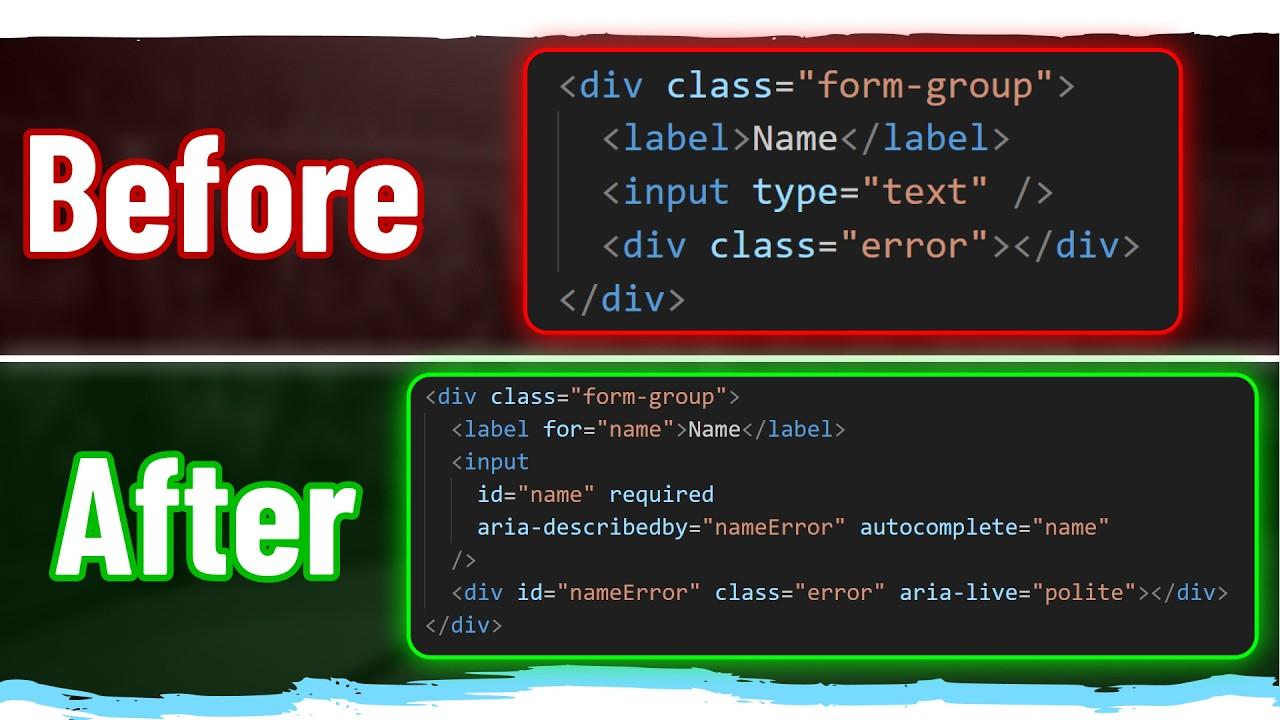
Kyle from Web Dev Simplified runs through 17 high-impact accessibility wins drawn from an 80-item checklist. Key topics include: pairing aria-describedby with aria-live="polite" so screen readers announce dynamic form errors without interrupting ongoing output; applying the HTML inert attribute to off-screen drawers and modal backgrounds so focus never leaks to hidden content; using autocomplete with granular values like given-name rather than name for precise autofill; enforcing a minimum 24×24 px (recommended 44×44 px) touch target size; and never using role="button" on a div when a real button element suffices. The video also covers CSS tab-order traps caused by flex-direction: column-reverse, how Chrome DevTools' rendering panel emulates color-vision deficiencies and prefers-reduced-motion, and using Lighthouse's accessibility audit as a baseline check.
The author, who adopted TypeScript's Go rewrite (tsgo) across 20+ projects ranging from 1,000 to 1,000,000 lines of code, reports roughly 10x faster type checking — and found that tsgo caught type errors the original JS implementation missed. The post also advocates replacing Prettier with Oxfmt (which bundles import sorting and Tailwind class sorting as built-ins) and ESLint with Oxlint, which now runs ESLint plugins directly via a NAPI-RS shim. For Node.js servers, a nodemon + ts-node + swc combo still tops every alternative for instant restarts. The author's @nkzw/oxlint-config package enforces an "Error, Never Warn" philosophy and bans slow rules like no-unused-vars in favor of TypeScript's noUnusedLocals, resulting in a linting setup that also guides LLMs toward fewer bugs.
Kyle from Web Dev Simplified runs through 17 high-impact accessibility wins drawn from an 80-item checklist. Key topics include: pairing aria-describedby with aria-live="polite" so screen readers announce dynamic form errors without interrupting ongoing output; applying the HTML inert attribute to off-screen drawers and modal backgrounds so focus never leaks to hidden content; using autocomplete with granular values like given-name rather than name for precise autofill; enforcing a minimum 24×24 px (recommended 44×44 px) touch target size; and never using role="button" on a div when a real button element suffices. The video also covers CSS tab-order traps caused by flex-direction: column-reverse, how Chrome DevTools' rendering panel emulates color-vision deficiencies and prefers-reduced-motion, and using Lighthouse's accessibility audit as a baseline check.
Lessons from OWASP Top 10 for Agentic Applications
OWASP's 2026 Top 10 for Agentic Applications defines ten risks — from ASI01 Agent Goal Hijack (prompt injection redirecting an agent's core objective) to ASI10 Rogue Agents (persistent goal drift after the malicious source is gone) — and frames the overarching principle as "Least Agency" rather than just least privilege. The Auth0 post maps each risk cluster to concrete identity controls: Step-Up Authentication and CIBA (push-to-phone approval) for high-risk tool calls (ASI01/ASI02); per-agent Client IDs with mTLS for inter-agent communication to close the attribution gap (ASI03/ASI07); and Fine-Grained Authorization on RAG stores plus per-session memory segmentation to counter context poisoning (ASI06). For supply-chain and RCE risks (ASI04/ASI05) where identity cannot prevent the exploit, scoped short-lived tokens and network egress allowlists limit blast radius. Auth0's Universal Login is recommended as an immutable consent boundary to prevent Human-Agent Trust Exploitation (ASI09).
Spotify's co-CEO revealed their most experienced engineers haven't written a single line of code since December, using an internal Claude Code-based system called Honk to ship 50+ features in 2025. DORA and Faros AI data show AI-heavy teams merged nearly twice as many PRs while review time jumped 91%; PRs are 18% larger, incidents per PR up 24%, change failure rates up 30%, and roughly 45% of AI-written code carries security issues. The author frames Git as the new primary skill — detailing practical use of git reflog for recovering lost commits, git bisect run for automated binary-search debugging, git worktree for parallel branch checkouts without stashing, and named git stash entries for managing concurrent experiments. Addy Osmani's concept of "comprehension debt" — merging code you can't explain — is highlighted as the core professional risk developers now face.
Observability in Headless & Composable Architectures
The article argues that failures in headless commerce happen between services, not within them — a healthy payment API and a healthy order management system can together produce a 15% checkout conversion drop that traditional health checks will never surface. The author details a five-layer observability model (telemetry producers, pipeline, consumers, analytics, visualization) and explains why async event-driven workflows are the deepest blind spot: one real-world example saw webhook processing fail 12% of the time at peak, with P99 latency spiking from 3.2 seconds to 23 seconds and a 23-minute average detection lag. OpenTelemetry is recommended as the vendor-neutral foundation — "one agent to rule them all" — while 23% of organizations currently fragment monitoring across 10–15 tools. The piece also warns that over-instrumentation adds 15–20% application latency and recommends targeting 3–15 spans per request for typical web services.
Beyond vibe coding: the case for spec-driven AI development
Matthias Steiner, VP of Global Business Innovation at SAP consultancy Syntax, argues that vibe coding's minimal upfront structure is a liability for enterprise software with 10–20 year lifespans, and proposes spec-driven development as the mature alternative. In spec-driven development, a single functional specification acts as the source of truth from which AI agents generate designs, code, tests, and documentation consistently. Steiner's 30-person team currently runs 10 product builds in parallel using a venture-capital portfolio model — assuming half will be discarded — with ShiftBook, a manufacturing shift-handover app integrating SAP Manufacturing Cloud, as the first completed end-to-end spec-driven build. He invokes Jevons' paradox to warn that AI productivity gains will multiply the total software maintenance burden, not reduce it. Open frameworks cited as enablers include SpecKit, OpenSpec, and Claude Task Master.
Why Kubernetes 1.35 is a game-changer for stateful workload scaling
Kubernetes 1.35 promotes In-Place Pod Resize to GA and the VPA InPlaceOrRecreate update mode to beta, allowing the Vertical Pod Autoscaler to adjust CPU and memory on running pods without eviction or restart — a critical change for stateful and restart-sensitive workloads. The tutorial walks through a full Minikube setup: installing VPA's three components (Recommender, Updater, Admission Controller) via the autoscaler repo's vpa-up.sh script, deploying an NGINX workload with deliberately low 50 millicore / 64 MiB requests, and observing how the Recommender proposes a corrected target while minAllowed floors enforce a 25 millicore minimum. When InPlaceOrRecreate mode is applied and a load generator drives traffic, the Updater patches pods through the /resize subresource — pod UID, container ID, and restart count remain unchanged. For pre-1.35 clusters, the Auto or Recreate modes still handle the same task via traditional eviction.
The web development general category this week orbited a single gravitational question: what does the developer's job look like when AI writes most of the code? The featured piece on fastest frontend tooling set the practical baseline — tsgo delivering 10x type-check speed, Oxfmt and Oxlint replacing slower incumbents — but the more provocative articles pushed into professional identity. The "Git is the new code" piece cited Spotify's internal data (50+ features shipped with Claude Code's Honk tool by engineers who wrote zero lines since December) alongside DORA metrics showing AI-heavy teams have 30% higher change failure rates and 45% of AI-written code carrying security issues. Addy Osmani's concept of comprehension debt named the core risk concisely.
The spec-driven development case argued the structural response: vibe coding's minimal upfront planning is a liability for software with 10-20 year lifespans, and a single functional spec as source of truth keeps AI-generated designs, code, tests, and documentation consistent. The OWASP Top 10 for Agentic Applications framed the security dimension with the concept of "Least Agency" — ten risk categories from prompt-injection goal hijacking to rogue agent goal drift — and mapped each to concrete identity controls like Step-Up Authentication and per-session memory segmentation.
The infrastructure corner delivered Kubernetes 1.35's In-Place Pod Resize reaching GA and VPA InPlaceOrRecreate going beta — a meaningful step for stateful workloads — while the headless commerce observability piece reminded teams that failures happen at service boundaries, not inside healthy services, and that webhook processing can silently degrade for 23 minutes before traditional monitoring surfaces it.
Key Takeaways
AI-heavy teams merge twice as many PRs but face 30% higher change failure rates and ~45% security issue rates in AI-written code — comprehension debt is the new professional liability
OWASP 2026 Agentic Top 10 introduces Least Agency as the core security principle; map each of the ten risk categories to identity controls before shipping agentic features
Kubernetes 1.35 brings In-Place Pod Resize to GA, enabling VPA to scale stateful workloads without eviction — pair with OpenTelemetry for boundary-level observability