This week's JavaScript story is dominated by performance — at every layer of the stack. The featured release of Claude Sonnet 4.6 reshaped the AI-coding landscape,… Compiled for immediate developer deployment.
calendar_todaysummarizeWeek 8-2026
article
TAG: RELEASEREAD_TIME: 3_MIN
Anthropic's new Claude Sonnet 4.6 promises Opus-level coding at Sonnet pricing
Anthropic launched Claude Sonnet 4.6 at $3/$15 per million input/output tokens — significantly undercutting Opus 4.6's $5/$25 pricing — while delivering benchmark results within a percentage point of the flagship model on most coding tasks. On OpenAI's GDPval office-task benchmark, Sonnet 4.6 actually surpasses Opus 4.6 as well as Gemini 3 Pro and GPT-5.2. Developers in Anthropic's own tests preferred Sonnet 4.6 over the previous-generation Opus 4.5 model 59% of the time, citing less tendency to overengineer solutions and fewer false-success hallucinations. New API features include context compaction (beta) and adaptive thinking, which lets the model self-select its extended-thinking token budget based on task complexity. Sonnet 4.6 becomes the default model on claude.ai for free and Pro plan users.
Platformatic details how enabling V8 pointer compression in Node.js 25 cuts heap usage by ~50% with only 2–4%average latency overhead, and actually lowers P99 latency by 7% due to reduced GC pressure. The key blocker — a shared 4 GB pointer cage across all isolates — was resolved by IsolateGroups, a new V8 feature implemented by Igalia (sponsored by Cloudflare) that gives each worker thread its own independent 4 GB cage. Integration into Node.js required just 62 lines across 8 files, authored by James Snell. Platformatic packaged this as node-caged, a drop-in Docker image (FROM platformatic/node-caged:25-slim) requiring no code changes. Benchmarks on AWS EKS with a real Next.js e-commerce SSR app at 400 req/s show that combining Watt + pointer compression yields 15% fasteraverage throughput and 43% better P99 vs. baseline Node.js.
We Ralph Wiggumed WebStreams to make them 10x faster
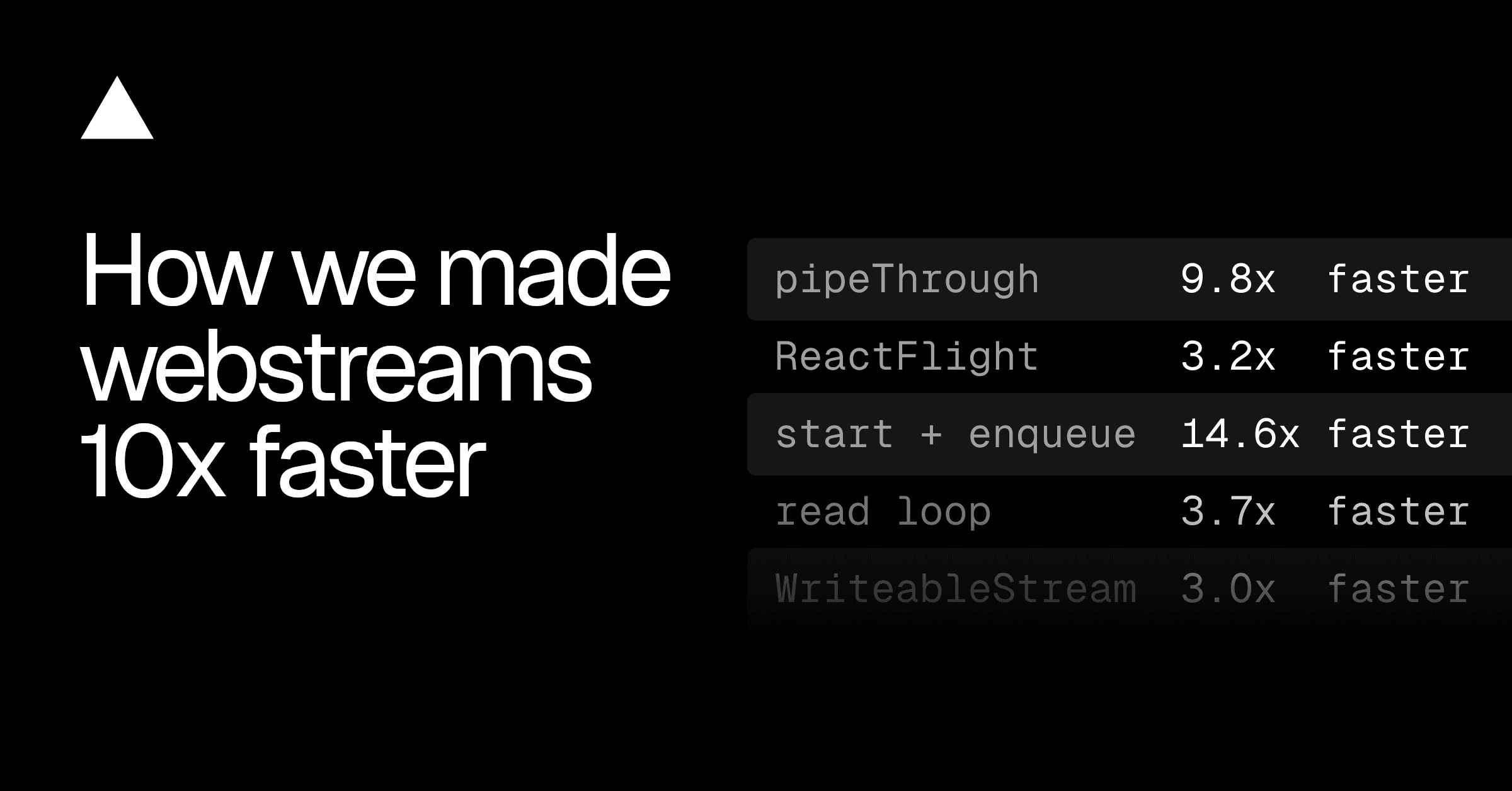
Vercel's fast-webstreams library reimplements the WHATWG ReadableStream, WritableStream, and TransformStream APIs backed by Node.js streams internally, eliminating per-chunk Promise and object allocation overhead. The core optimization: when chaining pipeThrough/pipeTo between fast streams, the library defers piping, collects upstream links, and issues a single pipeline() call — achieving ~6,200 MB/s vs. native WebStreams' 630 MB/s (roughly 10x). For the React Flight byte-stream pattern (used by React Server Components), throughput reaches 1,600 MB/s against native's 110 MB/s — a 14.6x gain. The library passes 1,100 of 1,116 Web Platform Tests. Upstream improvements are already in progress: Matteo Collina's Node.js PR #61807 applies two of these fast-path ideas directly to Node.js native WebStreams, showing ~17–20% faster buffered reads and ~11% fasterpipeTo with no library required.
Yield to Main: setTimeout vs queueMicrotask vs scheduler.postTask | Joan León
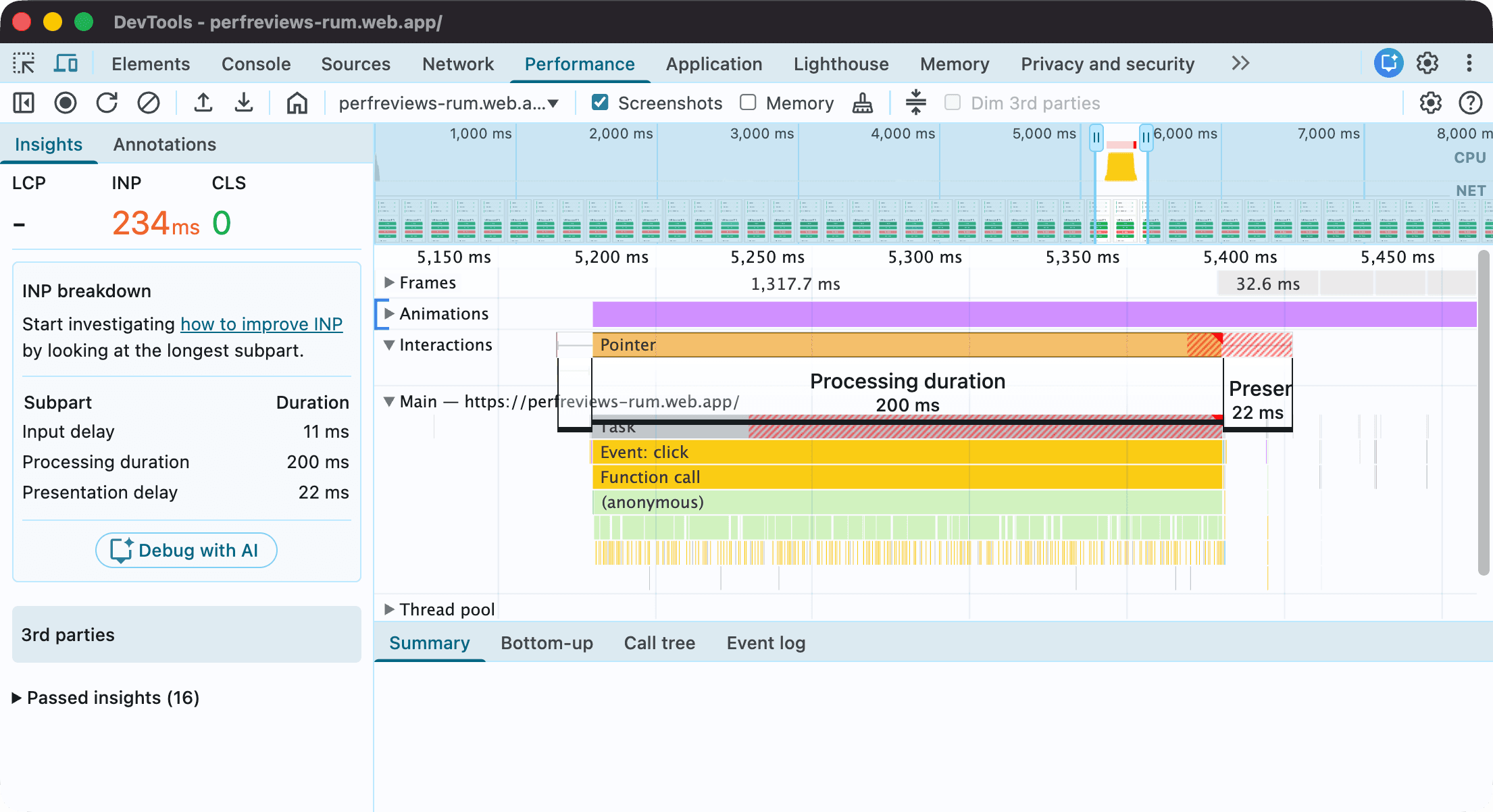
Joan León compares the three main JavaScript yielding strategies for improving Interaction to Next Paint (INP) by breaking long tasks (>50 ms) into smaller chunks. `setTimeout(fn, 0)` queues a macrotask after the browser renders, incurring ~1–4 ms overhead per yield but enabling genuine render opportunities between chunks; splitting a 487 ms blocking task into 24 chunks of ~12 ms each adds only +44 ms total overhead. `queueMicrotask()` is ~235x faster than `setTimeout` but executes before render — it does not yield to main and cannot improve INP, making infinite microtask loops a browser-freeze risk. `scheduler.postTask()` offers three priority levels (`user-blocking`, `user-visible`, `background`) and `AbortSignal`-based cancellation, with similar throughput overhead to `setTimeout`, but requires a polyfill for Firefox and is unsupported in Safari as of 2026. The article includes a full decision tree, measurable benchmarks, and a universal `yieldToMain()` helper that falls back to `setTimeout`.
Frontend Memory Leaks: A 500-Repository Static Analysis and Five-Scenario Benchmark Study
Ko-Hsin Liang ran AST-based detectors across 714,217 files in 500 starred open-source repos (210 React, 150 Vue, 140 Angular) and found 55,864 missing-cleanup instances in 86% of projects — including Kibana (1,796), Next.js (1,103), and Playwright (1,104). Timer cleanup (setTimeout/setInterval) accounts for 43.9% of all findings, followed by event listener removal (19%) and subscription cleanup (13.9%). Five controlled Node.js benchmarks (100 mount/unmount cycles × 50 repeats, forced GC) measured the cost: every pattern — React useEffect listener, Vue onMounted timer, Angular .subscribe(), Vue watch stop handle, RAF cancel — leaked at ~8 KB/cycle with near-zero variance (Cohen's d > 20 in all cases). A GOOD variant with proper cleanup retained under 3 KB total across 100 cycles. The fix in every case is a one-line teardown addition.
Jessica Wachtel walks through a practical tutorial that pits Rust-compiled WebAssembly against vanilla JavaScript for large CSV row-counting in the browser. Using wasm-bindgen for Rust-to-JS interoperability, the app compiles a Rust count_rows function into a pkg/ Wasm module and benchmarks it against a pure JS implementation. The crossover point is revealing: below ~500,000 rows, JavaScript is faster; above 2,000,000 rows, Wasm pulls ahead and stays ahead. The project uses Python to generate test CSV files (adjustable via NUM_ROWS), making it easy to reproduce the inflection point on any machine. The tutorial is part of a series building intuition for when Wasm's computational advantage offsets its initialization and interop overhead.
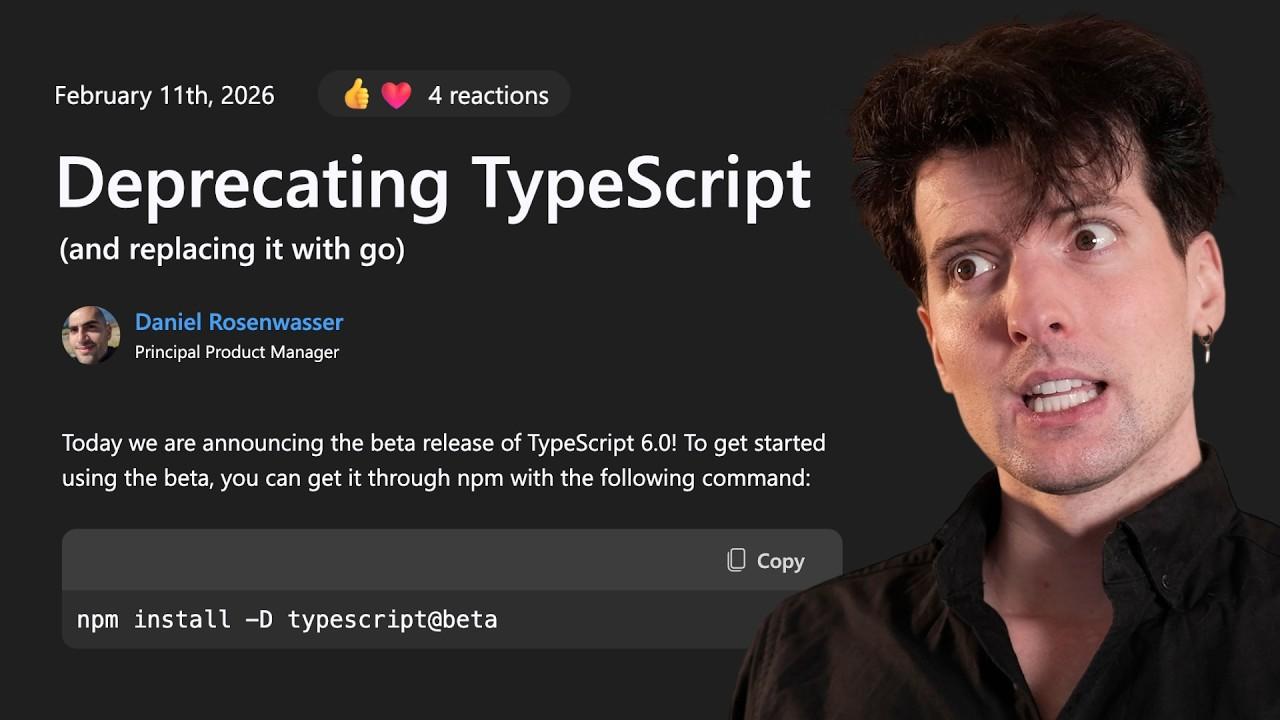
Theo walks through the TypeScript 6 beta and the ongoing port of the TypeScript compiler to Go (TypeScript 7), explaining why the team chose Go over Rust — Go's garbage collector is fine for compilers, and its flexibility accommodates JavaScript's quirky semantics while enabling shared-memory multi-threading that Rust's borrow checker would fight. TypeScript 6 is explicitly the last JavaScript-based release, serving as a bridge to TypeScript 7 by deprecating legacy options (AMD, outFile, baseURL, NaN-based namespaces) and enabling stricter defaults (strict: true, module: ESNext, target: ES2025). TypeScript Go already exceeds 2 million weekly downloads on npm and delivers 10x+ type-checking performance. New in TS6: stable type ordering flag for deterministic parallel checking, subpath imports support, ES2025 targets, Temporal built-in types, and upsert methods for Map. Theo also walks through a long-running inference bug with generic object methods that remains partially unfixed in TS6.
Anthropic's new Claude Sonnet 4.6 promises Opus-level coding at Sonnet pricing
Anthropic launched Claude Sonnet 4.6 at $3/$15 per million input/output tokens — significantly undercutting Opus 4.6's $5/$25 pricing — while delivering benchmark results within a percentage point of the flagship model on most coding tasks. On OpenAI's GDPval office-task benchmark, Sonnet 4.6 actually surpasses Opus 4.6 as well as Gemini 3 Pro and GPT-5.2. Developers in Anthropic's own tests preferred Sonnet 4.6 over the previous-generation Opus 4.5 model 59% of the time, citing less tendency to overengineer solutions and fewer false-success hallucinations. New API features include context compaction (beta) and adaptive thinking, which lets the model self-select its extended-thinking token budget based on task complexity. Sonnet 4.6 becomes the default model on claude.ai for free and Pro plan users.
Theo walks through the TypeScript 6 beta and the ongoing port of the TypeScript compiler to Go (TypeScript 7), explaining why the team chose Go over Rust — Go's garbage collector is fine for compilers, and its flexibility accommodates JavaScript's quirky semantics while enabling shared-memory multi-threading that Rust's borrow checker would fight. TypeScript 6 is explicitly the last JavaScript-based release, serving as a bridge to TypeScript 7 by deprecating legacy options (AMD, outFile, baseURL, NaN-based namespaces) and enabling stricter defaults (strict: true, module: ESNext, target: ES2025). TypeScript Go already exceeds 2 million weekly downloads on npm and delivers 10x+ type-checking performance. New in TS6: stable type ordering flag for deterministic parallel checking, subpath imports support, ES2025 targets, Temporal built-in types, and upsert methods for Map. Theo also walks through a long-running inference bug with generic object methods that remains partially unfixed in TS6.
Platformatic details how enabling V8 pointer compression in Node.js 25 cuts heap usage by ~50% with only 2–4%average latency overhead, and actually lowers P99 latency by 7% due to reduced GC pressure. The key blocker — a shared 4 GB pointer cage across all isolates — was resolved by IsolateGroups, a new V8 feature implemented by Igalia (sponsored by Cloudflare) that gives each worker thread its own independent 4 GB cage. Integration into Node.js required just 62 lines across 8 files, authored by James Snell. Platformatic packaged this as node-caged, a drop-in Docker image (FROM platformatic/node-caged:25-slim) requiring no code changes. Benchmarks on AWS EKS with a real Next.js e-commerce SSR app at 400 req/s show that combining Watt + pointer compression yields 15% fasteraverage throughput and 43% better P99 vs. baseline Node.js.
We Ralph Wiggumed WebStreams to make them 10x faster
Vercel's fast-webstreams library reimplements the WHATWG ReadableStream, WritableStream, and TransformStream APIs backed by Node.js streams internally, eliminating per-chunk Promise and object allocation overhead. The core optimization: when chaining pipeThrough/pipeTo between fast streams, the library defers piping, collects upstream links, and issues a single pipeline() call — achieving ~6,200 MB/s vs. native WebStreams' 630 MB/s (roughly 10x). For the React Flight byte-stream pattern (used by React Server Components), throughput reaches 1,600 MB/s against native's 110 MB/s — a 14.6x gain. The library passes 1,100 of 1,116 Web Platform Tests. Upstream improvements are already in progress: Matteo Collina's Node.js PR #61807 applies two of these fast-path ideas directly to Node.js native WebStreams, showing ~17–20% faster buffered reads and ~11% fasterpipeTo with no library required.
Yield to Main: setTimeout vs queueMicrotask vs scheduler.postTask | Joan León
Joan León compares the three main JavaScript yielding strategies for improving Interaction to Next Paint (INP) by breaking long tasks (>50 ms) into smaller chunks. `setTimeout(fn, 0)` queues a macrotask after the browser renders, incurring ~1–4 ms overhead per yield but enabling genuine render opportunities between chunks; splitting a 487 ms blocking task into 24 chunks of ~12 ms each adds only +44 ms total overhead. `queueMicrotask()` is ~235x faster than `setTimeout` but executes before render — it does not yield to main and cannot improve INP, making infinite microtask loops a browser-freeze risk. `scheduler.postTask()` offers three priority levels (`user-blocking`, `user-visible`, `background`) and `AbortSignal`-based cancellation, with similar throughput overhead to `setTimeout`, but requires a polyfill for Firefox and is unsupported in Safari as of 2026. The article includes a full decision tree, measurable benchmarks, and a universal `yieldToMain()` helper that falls back to `setTimeout`.
Frontend Memory Leaks: A 500-Repository Static Analysis and Five-Scenario Benchmark Study
Ko-Hsin Liang ran AST-based detectors across 714,217 files in 500 starred open-source repos (210 React, 150 Vue, 140 Angular) and found 55,864 missing-cleanup instances in 86% of projects — including Kibana (1,796), Next.js (1,103), and Playwright (1,104). Timer cleanup (setTimeout/setInterval) accounts for 43.9% of all findings, followed by event listener removal (19%) and subscription cleanup (13.9%). Five controlled Node.js benchmarks (100 mount/unmount cycles × 50 repeats, forced GC) measured the cost: every pattern — React useEffect listener, Vue onMounted timer, Angular .subscribe(), Vue watch stop handle, RAF cancel — leaked at ~8 KB/cycle with near-zero variance (Cohen's d > 20 in all cases). A GOOD variant with proper cleanup retained under 3 KB total across 100 cycles. The fix in every case is a one-line teardown addition.
Jessica Wachtel walks through a practical tutorial that pits Rust-compiled WebAssembly against vanilla JavaScript for large CSV row-counting in the browser. Using wasm-bindgen for Rust-to-JS interoperability, the app compiles a Rust count_rows function into a pkg/ Wasm module and benchmarks it against a pure JS implementation. The crossover point is revealing: below ~500,000 rows, JavaScript is faster; above 2,000,000 rows, Wasm pulls ahead and stays ahead. The project uses Python to generate test CSV files (adjustable via NUM_ROWS), making it easy to reproduce the inflection point on any machine. The tutorial is part of a series building intuition for when Wasm's computational advantage offsets its initialization and interop overhead.
This week's JavaScript story is dominated by performance — at every layer of the stack. The featured release of Claude Sonnet 4.6 reshaped the AI-coding landscape, but closer to the runtime, Platformatic's deep dive into Node.js 25 V8 pointer compression demonstrated how a 62-line patch — backed by Igalia and Cloudflare's IsolateGroups work — can slash heap usage by 50% while actually improving P99 latency. Vercel's fast-webstreams library pushed the envelope further, reimplementing WHATWG streams atop Node.js streams to hit 10x throughput gains and 14.6x for the React Flight pattern specifically.
The week's research dimension was sobering. A 500-repo static analysis found missing cleanup in 86% of open-source projects, with timers alone accounting for 44% of leaks — and each leaked pattern costs ~8 KB per mount/unmount cycle. On scheduling, Joan Leon's thorough INP guide clarified that queueMicrotask is 235x faster than setTimeout but cannot yield to the main thread, making it useless for INP improvement. Meanwhile Theo's breakdown of TypeScript 6 and the Go-based TypeScript 7 compiler underscored that a 10x type-checking speedup is now within reach for every codebase.
The Wasm vs. JavaScript benchmark rounded out the week with a concrete crossover finding: below 500k rows JavaScript wins; above 2M rows Wasm pulls ahead. Together these pieces paint a picture of a runtime ecosystem actively reinventing its performance ceiling.
Key Takeaways
Node.js 25 pointer compression + IsolateGroups cuts heap by ~50% with no code changes required via the node-caged drop-in image
86% of open-source frontend projects have missing cleanup; every leaking pattern costs ~8 KB per cycle — a one-line teardown fix closes the gap
TypeScript 7 (Go compiler) delivers 10x type-check speed and already has 2M+ weekly npm downloads in early access