The headline of Week 9 is the React Foundation: React, React Native, and JSX moved out of Meta's ownership and into an independent foundation hosted by the Linux… Compiled for immediate developer deployment.
calendar_todaysummarizeWeek 9-2026
article
TAG: ANNOUNCEMENTREAD_TIME: 2_MIN
The React Foundation: A New Home for React Hosted by the Linux Foundation – React
React, React Native, and JSX are no longer owned by Meta — they now belong to the React Foundation, an independent foundation hosted by the Linux Foundation. The Foundation launched with eight Platinum founding members: Amazon, Callstack, Expo, Huawei, Meta, Microsoft, Software Mansion, and Vercel, with Seth Webster serving as executive director. Technical governance will remain independent from the board, guided by a newly formed provisional leadership council of active contributors. Upcoming work includes finalizing that governance structure, transferring repositories and infrastructure, and planning the next React Conf.
Deno 2.7: Temporal API, Windows ARM, and npm overrides | Deno
Deno 2.7 stabilizes the Temporal API — no more --unstable-temporal flag — following Chrome 144's January 2026 ship via the V8 14.5 upgrade. Official Windows ARM builds (aarch64-pc-windows-msvc) arrive for Surface Pro X, ThinkPad X13s, and Snapdragon devices without x86 emulation. The release adds package.json overrides field support, new Deno.spawn(), Deno.spawnAndWait(), and Deno.spawnAndWaitSync() subprocess helpers (currently unstable), Brotli support in CompressionStream, SHA3-256/384/512 in crypto.subtle, FsFile.tryLock(), and a deno install --compile flag that compiles npm packages into standalone native binaries.
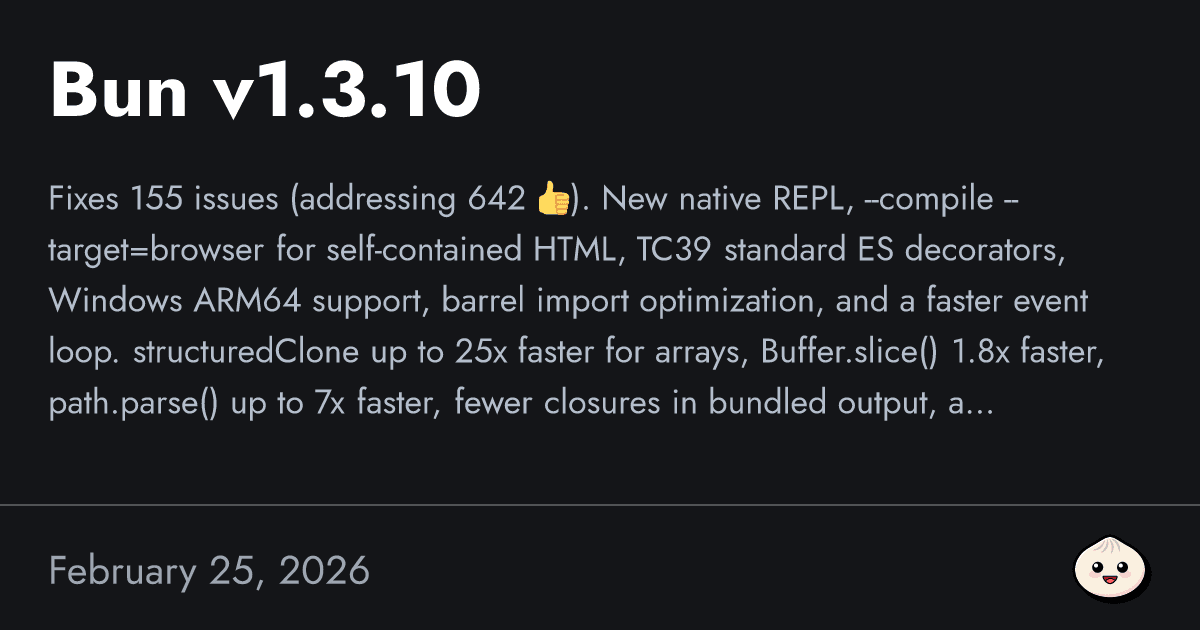
Bun v1.3.10 delivers a fully rewritten REPL in Zig with persistent history, tab completion, and top-level await, plus full TC39 Stage 3 standard ES Decorators support including the accessor keyword, Symbol.metadata, and ClassMethodDecoratorContext. The bundler gains barrel import optimization — packages with "sideEffects": false get automatic tree-shaking of unused re-exports — and a bun build --compile --target=browser flag that produces self-contained HTML files with inlined JS, CSS, and data-URI assets. Performance wins include structuredClone up to 25x faster for primitive arrays, Buffer.slice()~1.8x faster via a native C++ path, String.prototype.endsWith up to 10.5x faster in JIT, and deep rope string slicing 168x faster. Windows ARM64 support and a fix for Python asyncio MCP servers broken by shutdown() calls round out a packed release.
Node.js 24.14.0 'Krypton' lands a broad set of semver-minor additions: async_hooks gains a trackPromises option in createHook(), http gets http.setGlobalProxyFromEnv() for environment-driven proxy config, fs.watch adds an ignore option, and the module system now permits subpath imports starting with #/. The sqlite built-in enables defensive mode by default and adds prepare options args. The test runner gains an env option for the run() function and supports expecting a test case to fail. The cjs-module-lexer is replaced with the faster merve, and LIEF is introduced as a new dependency to support splitting SEA binary manipulation code. npm is bumped to 11.9.0 and undici to 7.21.0.
Both the REST and GraphQL codegen ecosystems have independently converged on the same pattern: stop generating React hooks, start generating framework-agnostic options objects. On the REST side, @hey-api/openapi-ts produces queryOptions, mutationOptions, and infiniteQueryOptions functions that spread directly into TanStack Query v5 hooks, while Orval still generates hooks by default but excels at built-in MSW mock generation. For GraphQL, the graphql-codegen client preset generates TypedDocumentNode or TypedDocumentString depending on documentMode, while gql.tada eliminates the build step entirely via TypeScript type-level inference. Fragment masking — where each component owns its data contract via a fragment type — is the recommended pattern for passing typed data down component trees without per-query type explosion or hook wrappers.
React State Management in 2026: A Data-Driven Comparison
Drawing on live npm registry data from February 25, 2026, Zustand has overtaken Redux as the most-downloaded dedicated state management library at 22.6M weekly downloads, while Nanostores grew 6.6x in 12 months (737K to 4.9M monthly) driven largely by Astro adoption. GitHub metrics show Zustand (57.1K stars, only 4 open issues) and Jotai (21K stars, 3 issues) as the best-maintained libraries, while Recoil was archived by Meta in early 2025. The State of React 2025 survey confirms Zustand crossed 50% usage. The author recommends Zustand as the safe default, Jotai for complex derived state, and Nanostores (286 bytes) for bundle-critical or multi-framework projects. React Compiler v1.0 (October 2025) weakens the performance argument for signals libraries by providing automatic memoization.
Scott Tolinski and Wes Bos walk through the entire Interop 2026 focus area list at fpt.fyi/interop2026, where Chrome Canary already scores 87/100. Highlights include container style queries (CSS if-statements for theming), anchor positioning (cross-DOM relative placement without nesting), CSS ATTR function improvements (data-attribute values usable directly as CSS property values), media pseudo-classes (playing, paused, buffering, stalled for styling audio/video state in pure CSS), scroll-driven animations, and cross-document view transitions for multi-page apps. Investigation items cover JPEG XL support (with all browser vendors signaling commitment), accessibility tree consistency testing, and Web Transport as an HTTP/3-based alternative to WebSockets for mobile network-switching scenarios.
The React Foundation: A New Home for React Hosted by the Linux Foundation – React
React, React Native, and JSX are no longer owned by Meta — they now belong to the React Foundation, an independent foundation hosted by the Linux Foundation. The Foundation launched with eight Platinum founding members: Amazon, Callstack, Expo, Huawei, Meta, Microsoft, Software Mansion, and Vercel, with Seth Webster serving as executive director. Technical governance will remain independent from the board, guided by a newly formed provisional leadership council of active contributors. Upcoming work includes finalizing that governance structure, transferring repositories and infrastructure, and planning the next React Conf.
Scott Tolinski and Wes Bos walk through the entire Interop 2026 focus area list at fpt.fyi/interop2026, where Chrome Canary already scores 87/100. Highlights include container style queries (CSS if-statements for theming), anchor positioning (cross-DOM relative placement without nesting), CSS ATTR function improvements (data-attribute values usable directly as CSS property values), media pseudo-classes (playing, paused, buffering, stalled for styling audio/video state in pure CSS), scroll-driven animations, and cross-document view transitions for multi-page apps. Investigation items cover JPEG XL support (with all browser vendors signaling commitment), accessibility tree consistency testing, and Web Transport as an HTTP/3-based alternative to WebSockets for mobile network-switching scenarios.
Deno 2.7: Temporal API, Windows ARM, and npm overrides | Deno
Deno 2.7 stabilizes the Temporal API — no more --unstable-temporal flag — following Chrome 144's January 2026 ship via the V8 14.5 upgrade. Official Windows ARM builds (aarch64-pc-windows-msvc) arrive for Surface Pro X, ThinkPad X13s, and Snapdragon devices without x86 emulation. The release adds package.json overrides field support, new Deno.spawn(), Deno.spawnAndWait(), and Deno.spawnAndWaitSync() subprocess helpers (currently unstable), Brotli support in CompressionStream, SHA3-256/384/512 in crypto.subtle, FsFile.tryLock(), and a deno install --compile flag that compiles npm packages into standalone native binaries.
Bun v1.3.10 delivers a fully rewritten REPL in Zig with persistent history, tab completion, and top-level await, plus full TC39 Stage 3 standard ES Decorators support including the accessor keyword, Symbol.metadata, and ClassMethodDecoratorContext. The bundler gains barrel import optimization — packages with "sideEffects": false get automatic tree-shaking of unused re-exports — and a bun build --compile --target=browser flag that produces self-contained HTML files with inlined JS, CSS, and data-URI assets. Performance wins include structuredClone up to 25x faster for primitive arrays, Buffer.slice()~1.8x faster via a native C++ path, String.prototype.endsWith up to 10.5x faster in JIT, and deep rope string slicing 168x faster. Windows ARM64 support and a fix for Python asyncio MCP servers broken by shutdown() calls round out a packed release.
Node.js 24.14.0 'Krypton' lands a broad set of semver-minor additions: async_hooks gains a trackPromises option in createHook(), http gets http.setGlobalProxyFromEnv() for environment-driven proxy config, fs.watch adds an ignore option, and the module system now permits subpath imports starting with #/. The sqlite built-in enables defensive mode by default and adds prepare options args. The test runner gains an env option for the run() function and supports expecting a test case to fail. The cjs-module-lexer is replaced with the faster merve, and LIEF is introduced as a new dependency to support splitting SEA binary manipulation code. npm is bumped to 11.9.0 and undici to 7.21.0.
Both the REST and GraphQL codegen ecosystems have independently converged on the same pattern: stop generating React hooks, start generating framework-agnostic options objects. On the REST side, @hey-api/openapi-ts produces queryOptions, mutationOptions, and infiniteQueryOptions functions that spread directly into TanStack Query v5 hooks, while Orval still generates hooks by default but excels at built-in MSW mock generation. For GraphQL, the graphql-codegen client preset generates TypedDocumentNode or TypedDocumentString depending on documentMode, while gql.tada eliminates the build step entirely via TypeScript type-level inference. Fragment masking — where each component owns its data contract via a fragment type — is the recommended pattern for passing typed data down component trees without per-query type explosion or hook wrappers.
React State Management in 2026: A Data-Driven Comparison
Drawing on live npm registry data from February 25, 2026, Zustand has overtaken Redux as the most-downloaded dedicated state management library at 22.6M weekly downloads, while Nanostores grew 6.6x in 12 months (737K to 4.9M monthly) driven largely by Astro adoption. GitHub metrics show Zustand (57.1K stars, only 4 open issues) and Jotai (21K stars, 3 issues) as the best-maintained libraries, while Recoil was archived by Meta in early 2025. The State of React 2025 survey confirms Zustand crossed 50% usage. The author recommends Zustand as the safe default, Jotai for complex derived state, and Nanostores (286 bytes) for bundle-critical or multi-framework projects. React Compiler v1.0 (October 2025) weakens the performance argument for signals libraries by providing automatic memoization.
The headline of Week 9 is the React Foundation: React, React Native, and JSX moved out of Meta's ownership and into an independent foundation hosted by the Linux Foundation, with Amazon, Expo, Microsoft, Vercel, and four other Platinum members aboard. This is a governance milestone that the JavaScript community has been anticipating, signaling a more open stewardship model for the most widely deployed UI library in the world.
The runtime ecosystem had a packed week of its own. Deno 2.7 stabilized the long-awaited Temporal API — no flag required — and added official Windows ARM builds, while Bun v1.3.10 delivered a fully rewritten REPL, TC39 Stage 3 ES Decorators, barrel-import tree-shaking, and a raft of performance gains including structuredClone up to 25x faster. Node.js 24.14.0 LTS rounded things out with environment-driven proxy config and sqlite defensive mode on by default.
On the tooling front, the REST and GraphQL codegen ecosystems have converged on framework-agnostic options objects rather than hooks, and a data-driven state management survey confirmed Zustand has overtaken Redux at 22.6M weekly downloads, while Nanostores grew 6.6x in a year riding the Astro wave.
Key Takeaways
React is now governed by an independent Linux Foundation body — Meta, Vercel, Microsoft, and five other Platinum members share stewardship.
Deno 2.7 stabilizes Temporal API and adds Windows ARM; Bun v1.3.10 delivers ES Decorators and up to 25x faster structuredClone.
Zustand has overtaken Redux as the top-downloaded state library at 22.6M weekly downloads, and codegen is shifting toward framework-agnostic options objects.