The featured piece from Addy Osmani introduces the factory model: autonomous coding agents represent an abstraction shift comparable to… Compiled for immediate developer deployment.
calendar_todaysummarizeWeek 9-2026
article
TAG: AIREAD_TIME: 12_MIN
The Factory Model: How Coding Agents Changed Software Engineering
Addy Osmani argues that autonomous coding agents represent the same kind of abstraction leap as the shift from assembly to managed languages — and introduces the "factory model" framing: engineers no longer write code, they build the system that builds software. Third-generation agents now run for hours, set up environments, hit failures, research solutions, and deliver pull requests while the engineer works elsewhere. The piece emphasizes that the bottleneck has moved from generation to verification: tests written before implementation (red/green TDD) become near-mandatory at fleet scale, because agents optimizing for passing tests will find ways to pass them regardless of correctness. Skills that gain value are specification clarity, problem decomposition, architectural judgment, and output evaluation — not keystroke speed.
Two 2026 papers reveal a counterintuitive finding about AGENTS.md context files: LLM-generated files (from /init) reduced task success by 2–3% while increasing cost by over 20%, whereas developer-written files improved success by ~4%. The core problem is redundancy — agents can already discover directory structure and tech stack from the repo itself, so auto-generated overviews add noise, not signal. The ETH Zurich study found that when all existing docs were stripped first, auto-generated files actually helped by 2.7%, confirming the issue is duplication, not the format. Lines that earn a place: non-discoverable tooling gotchas like "use uv not pip" (agents used uv1.6×/task when mentioned vs. <0.01× when not). Osmani recommends treating AGENTS.md as a living list of codebase smells rather than a permanent configuration.
How we migrated to TypeIDs without breaking clients
Buttondown migrated its entire API from opaque UUIDs to TypeIDs — Stripe-style prefixed identifiers like sub_01h455vb4pex5vsknk084sn02q — without breaking a single existing integration. The approach: each Django model declares a type_id_prefix, and a BaseModel.__init_subclass__ hook auto-registers it in a global TypeIDRegistry. A custom TypeIDAwareManager intercepts Django ORM calls (filter, get, exclude) and converts TypeID inputs to UUIDs via munge_kwargs_for_type_id, handling id, _id, and __in lookups. On the output side, response migrations keyed on the X-API-Version header determine whether clients receive TypeIDs (2026-01-01+) or plain UUIDs (older). The team migrated 29 routes incrementally, starting with low-risk endpoints like images and building to high-traffic ones like subscribers, with every route covered by dual-format tests.
Krasimir Tsonev delivers a structured critique of AI-assisted coding across three developer tiers. For juniors, the core danger is eliminating the "struggle" phase — debugging, reading docs, understanding why something works — which is precisely what builds expertise, leading to cargo-cult programming at scale. For mid-level engineers, more code shipped faster does not equate to better software, because the real bottleneck is understanding requirements and managing complexity, not typing speed. Tsonev also flags the homogenization problem: models trained on the same public corpus push the same libraries and patterns, reducing solution diversity. He cites Stanford 2023 and GitGuardian studies showing AI-generated code is more likely to contain security vulnerabilities, and highlights the open source sustainability paradox — AI companies extract billions of dollars in value from OSS training data while maintainers see none of it.
The Missing Index Crisis: A 40-Repo Scan and Five-Module Benchmark Study of Prisma and PostgreSQL
Ko-Hsin Liang scanned 40 production Prisma repositories and found 1,209 missing index patterns across 22 repos (55% prevalence), then benchmarked five scenarios at 1K–1M rows with 30 trials each. The headline results: an unindexed foreign-key column (WHERE user_id = ?) runs 153× slower than an indexed one, ORDER BY created_at without an index runs 190× slower, and a composite index on (status, createdAt) is 166× faster than a single-column index. Critically, Prisma does not auto-create FK indexes on PostgreSQL, and its missing-index warning (added in v4.7.0) only fires when relationMode = "prisma" is set — the silent default is relationMode = "foreignKeys". The 150–190× penalties appear even at 1K rows. One negative result: covering indexes with INCLUDE showed no benefit on low-cardinality status columns because the planner chose a sequential scan regardless.
Malte Ubl from Vercel outlines four distinct actors in every agentic system — the agent harness, agent secrets, generated code execution, and the filesystem — and explains why conflating their trust levels creates critical attack surfaces. The central risk is prompt injection: a crafted log entry can instruct an agent to exfiltrate ~/.ssh and ~/.aws/credentials via generated shell scripts. The article describes an architecture progression from zero boundaries (today's default) to secret injection proxies to the recommended approach: running agent harness and generated code in separate VMs with distinct security contexts. Vercel Sandbox provides ephemeral Linux VMs per execution, and combining it with secret injection at the network layer means generated code can use credentials through the proxy but can never read or exfiltrate raw secrets.
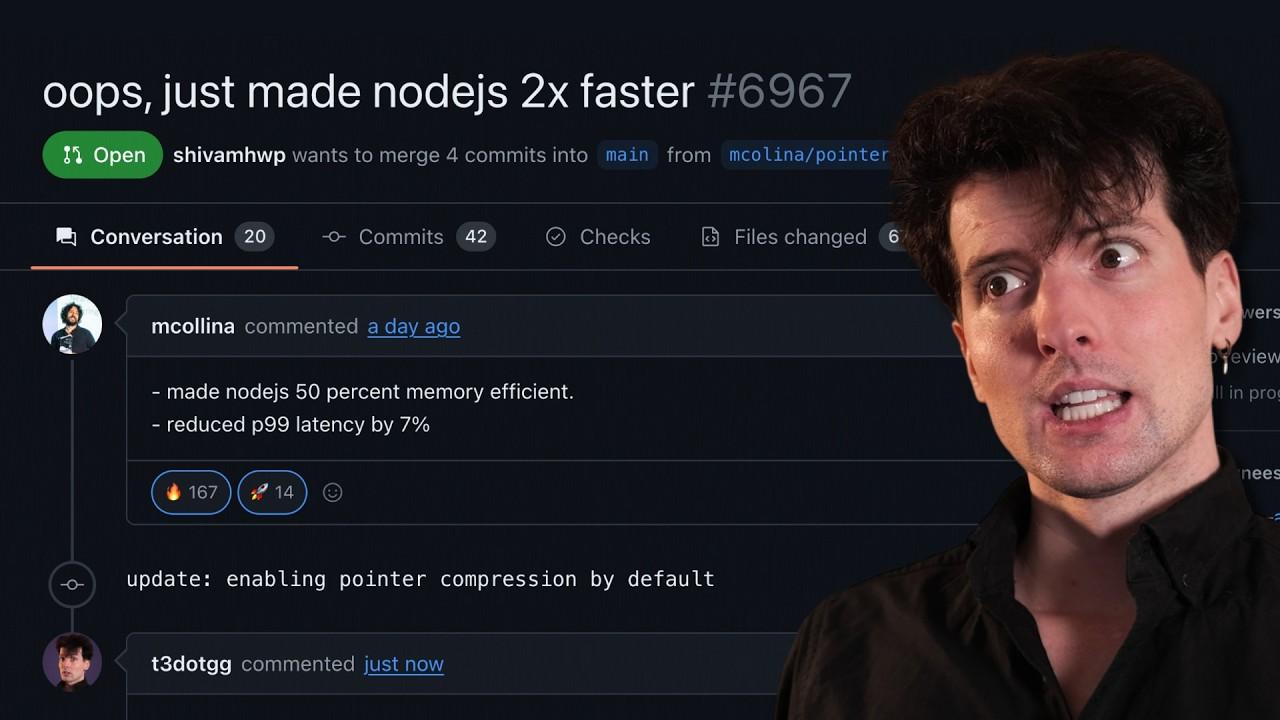
Theo covers Matteo Collina's blog post on NodeCaged — a Node 25 Docker image with V8 pointer compression enabled, reducing each pointer from 64 bits to 32 bits and achieving ~50% heap memory savings. The technical blocker had been V8's 4 GB pointer cage: all threads in a process shared a single 4 GB memory space. Cloudflare sponsored Igalia's work on "isolate groups" in V8 — a 62-line C++ change across 8 files that took a year (Nov 2024 to Oct 2025) to merge — so each worker thread gets its own 4 GB cage. Benchmarked on a Next.js SSR e-commerce app on AWS EKS, NodeCaged showed 2–4% average latency increase alongside a 7% P99 latency improvement, because smaller heaps mean shorter and less frequent garbage collection pauses. The practical upside: teams running 2 GB/pod can drop to 1 GB, halving node count or doubling tenant density.
The Factory Model: How Coding Agents Changed Software Engineering
Addy Osmani argues that autonomous coding agents represent the same kind of abstraction leap as the shift from assembly to managed languages — and introduces the "factory model" framing: engineers no longer write code, they build the system that builds software. Third-generation agents now run for hours, set up environments, hit failures, research solutions, and deliver pull requests while the engineer works elsewhere. The piece emphasizes that the bottleneck has moved from generation to verification: tests written before implementation (red/green TDD) become near-mandatory at fleet scale, because agents optimizing for passing tests will find ways to pass them regardless of correctness. Skills that gain value are specification clarity, problem decomposition, architectural judgment, and output evaluation — not keystroke speed.
Theo covers Matteo Collina's blog post on NodeCaged — a Node 25 Docker image with V8 pointer compression enabled, reducing each pointer from 64 bits to 32 bits and achieving ~50% heap memory savings. The technical blocker had been V8's 4 GB pointer cage: all threads in a process shared a single 4 GB memory space. Cloudflare sponsored Igalia's work on "isolate groups" in V8 — a 62-line C++ change across 8 files that took a year (Nov 2024 to Oct 2025) to merge — so each worker thread gets its own 4 GB cage. Benchmarked on a Next.js SSR e-commerce app on AWS EKS, NodeCaged showed 2–4% average latency increase alongside a 7% P99 latency improvement, because smaller heaps mean shorter and less frequent garbage collection pauses. The practical upside: teams running 2 GB/pod can drop to 1 GB, halving node count or doubling tenant density.
Two 2026 papers reveal a counterintuitive finding about AGENTS.md context files: LLM-generated files (from /init) reduced task success by 2–3% while increasing cost by over 20%, whereas developer-written files improved success by ~4%. The core problem is redundancy — agents can already discover directory structure and tech stack from the repo itself, so auto-generated overviews add noise, not signal. The ETH Zurich study found that when all existing docs were stripped first, auto-generated files actually helped by 2.7%, confirming the issue is duplication, not the format. Lines that earn a place: non-discoverable tooling gotchas like "use uv not pip" (agents used uv1.6×/task when mentioned vs. <0.01× when not). Osmani recommends treating AGENTS.md as a living list of codebase smells rather than a permanent configuration.
How we migrated to TypeIDs without breaking clients
Buttondown migrated its entire API from opaque UUIDs to TypeIDs — Stripe-style prefixed identifiers like sub_01h455vb4pex5vsknk084sn02q — without breaking a single existing integration. The approach: each Django model declares a type_id_prefix, and a BaseModel.__init_subclass__ hook auto-registers it in a global TypeIDRegistry. A custom TypeIDAwareManager intercepts Django ORM calls (filter, get, exclude) and converts TypeID inputs to UUIDs via munge_kwargs_for_type_id, handling id, _id, and __in lookups. On the output side, response migrations keyed on the X-API-Version header determine whether clients receive TypeIDs (2026-01-01+) or plain UUIDs (older). The team migrated 29 routes incrementally, starting with low-risk endpoints like images and building to high-traffic ones like subscribers, with every route covered by dual-format tests.
Krasimir Tsonev delivers a structured critique of AI-assisted coding across three developer tiers. For juniors, the core danger is eliminating the "struggle" phase — debugging, reading docs, understanding why something works — which is precisely what builds expertise, leading to cargo-cult programming at scale. For mid-level engineers, more code shipped faster does not equate to better software, because the real bottleneck is understanding requirements and managing complexity, not typing speed. Tsonev also flags the homogenization problem: models trained on the same public corpus push the same libraries and patterns, reducing solution diversity. He cites Stanford 2023 and GitGuardian studies showing AI-generated code is more likely to contain security vulnerabilities, and highlights the open source sustainability paradox — AI companies extract billions of dollars in value from OSS training data while maintainers see none of it.
The Missing Index Crisis: A 40-Repo Scan and Five-Module Benchmark Study of Prisma and PostgreSQL
Ko-Hsin Liang scanned 40 production Prisma repositories and found 1,209 missing index patterns across 22 repos (55% prevalence), then benchmarked five scenarios at 1K–1M rows with 30 trials each. The headline results: an unindexed foreign-key column (WHERE user_id = ?) runs 153× slower than an indexed one, ORDER BY created_at without an index runs 190× slower, and a composite index on (status, createdAt) is 166× faster than a single-column index. Critically, Prisma does not auto-create FK indexes on PostgreSQL, and its missing-index warning (added in v4.7.0) only fires when relationMode = "prisma" is set — the silent default is relationMode = "foreignKeys". The 150–190× penalties appear even at 1K rows. One negative result: covering indexes with INCLUDE showed no benefit on low-cardinality status columns because the planner chose a sequential scan regardless.
Malte Ubl from Vercel outlines four distinct actors in every agentic system — the agent harness, agent secrets, generated code execution, and the filesystem — and explains why conflating their trust levels creates critical attack surfaces. The central risk is prompt injection: a crafted log entry can instruct an agent to exfiltrate ~/.ssh and ~/.aws/credentials via generated shell scripts. The article describes an architecture progression from zero boundaries (today's default) to secret injection proxies to the recommended approach: running agent harness and generated code in separate VMs with distinct security contexts. Vercel Sandbox provides ephemeral Linux VMs per execution, and combining it with secret injection at the network layer means generated code can use credentials through the proxy but can never read or exfiltrate raw secrets.
The featured piece from Addy Osmani introduces the factory model: autonomous coding agents represent an abstraction shift comparable to assembly-to-managed-language, moving engineers from writing code to building systems that build software. The bottleneck has migrated from generation to verification — which makes upfront red/green TDD nearly mandatory at fleet scale, since agents will find ways to pass tests regardless of correctness. The complementary piece on AGENTS.md revealed that LLM-generated context files reduce task success by 2-3% while raising cost by 20%+, whereas developer-written files improve it by 4%. The implication: keep AGENTS.md lean, non-discoverable, and specific.
On the infrastructure side, a 40-repo Prisma benchmark found missing indexes in 55% of production repositories, with unindexed foreign-key queries running 153x slower and ORDER BY without an index 190x slower — penalties that appear even at 1K rows. Prisma does not auto-generate FK indexes on PostgreSQL, and its missing-index warning only fires under a non-default config. Vercel's Malte Ubl outlined the prompt injection threat in agentic architectures and recommended running agent harness and generated code in separate VMs with secret injection at the network layer.
Rounding out the week, Buttondown detailed a zero-downtime UUID-to-TypeID migration across29 Django routes using version-negotiated response migrations, and Krasimir Tsonev offered a structured critique of AI-assisted coding — noting that junior developers lose the productive struggle, mid-level engineers face a complexity bottleneck not a typing bottleneck, and AI-generated code carries higher vulnerability rates per the Stanford 2023 study.
Key Takeaways
The factory model reframes engineering: agents handle generation, humans handle specification and verification — making upfront TDD essential and AGENTS.md files most effective when written by humans, not generated.
55% of production Prisma repos have missing indexes; unindexed foreign-key queries run 153x slower even at 1K rows, and Prisma's warning only fires under a non-default relationMode.
Agentic architectures need VM-level isolation between harness and generated code to prevent prompt-injection credential exfiltration.