Monthly Recap
June 2026 Monthly Recap: The Stack Became Machine-Readable and Attackable
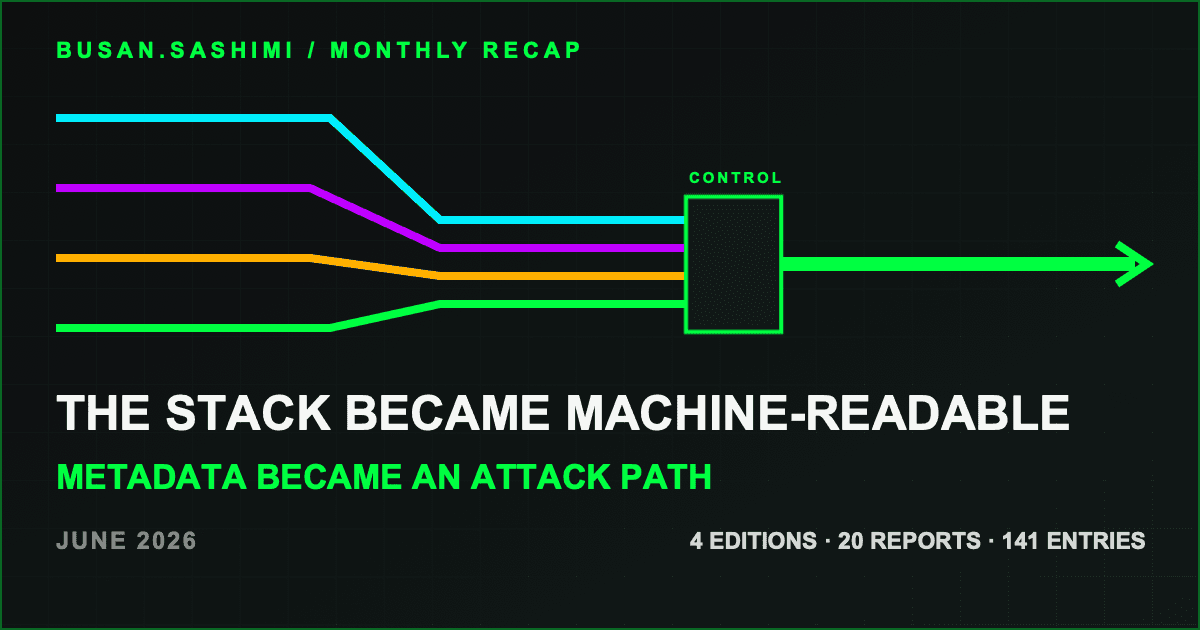
Four Weekly Digest editions connected Rust toolchains, modern CSS, AI-ready design systems, and agent workflows with attacks that turned package and configuration metadata into execution paths.
July in numbers
- Weekly editions
- 4
- Category reports
- 20
- Digest entries
- 141
The month capability and control scaled together
June showed that every machine-readable contract can improve automation and simultaneously become a path that must be defended.
June 2026 brought the machine-readable stack into focus. VoidZero joined Cloudflare while keeping its toolchain projects open source. Astro 7 moved its compiler and bundler path further into Rust. Grid Lanes gained a detailed field guide, modern CSS theming combined light-dark(), contrast-color(), and style queries, and design-system authors proposed Markdown specs, closed token vocabularies, and Open Design System Format bundles for agents. Intent, components, and platform behavior were becoming queryable infrastructure.
Attackers were reading the same infrastructure. Miasma bypassed package.json lifecycle checks through binding.gyp and wrote into AI coding-tool configuration. The Mastra compromise affected more than 140 packages and targeted wallet extensions. A Claude Code GitHub Action vulnerability showed prompt injection reaching OIDC tokens. npm 12's plan to block install scripts by default was an important defensive shift, but June proved that metadata, configuration, and trusted automation all needed to be treated as executable surfaces.
That combination is the month's durable lesson. native toolchains consolidated under larger infrastructure; css and design systems became machine-readable contracts; metadata and configuration became executable attack surfaces; intent and least agency became core architecture. None of these arcs can be evaluated through output volume alone. The useful question is whether the system made correct change cheaper to verify and safer to reverse. A faster compiler, a declarative API, or an agent fleet creates durable value only when its compatibility, permissions, and failure behavior are visible to the people operating it.
June in numbers
The corpus contains 4 complete Weekly Digest editions and 20 category reports, but its counts describe the publication archive rather than the whole industry.
This recap draws from 4 Weekly Digest editions published in June: W23, W24, W25, W26. They contain 20 category reports and 141 digest entries. The source index preserves 141 distinct archived external URLs and 79 source keys. We verified all 60 localized issue URLs across English, Korean, and Japanese and ran the weekly schema and editorial checks before treating the cohort as evidence.
These totals need boundaries. The cohort uses each edition's publication time in Asia/Seoul and includes the complete edition rather than splitting a cross-boundary week. A digest entry is an editorial row, not proof of an independent event, and 141 archived URLs are not a census of everything published in June. The value comes from applying the same five editorial lenses to consecutive releases and then following only themes that recur or materially change.
Rust speed met platform stewardship
VoidZero's Cloudflare move and Astro 7 placed open-source continuity, native execution, and deployment infrastructure on one path.
VoidZero's move to Cloudflare combined the Vite, Rolldown, Oxlint, and Oxfmt projects with a global deployment company while explicitly retaining MIT licensing and open development. Later, Astro 7 described an end-to-end Rust direction around its compiler and Rolldown, with reported real-world build improvements ranging from 15% to 61%. Rspack and TanStack work in the same cohort reinforced the pattern: performance gains were coming from lower-level implementation and type-system discipline rather than additional application abstraction.
The acquisition created opportunity and concentration risk at the same time. Stable funding and infrastructure can accelerate a shared toolchain, but teams should watch governance, roadmap independence, and portability. Astro's gains also remain project-specific. The practical strategy is to lean on open plugin contracts and reproducible builds, keep deployment assumptions outside application logic, and measure upgrade behavior. An open license is valuable, but operational portability depends on tests, artifacts, and documented seams.
June opened with organizational consolidation and closed with a framework release built directly on that native-toolchain direction. Open-source licensing does not by itself guarantee independent governance or frictionless migration. The operational consequence is concrete: Test the toolchain on a second deployment environment and retain reproducible artifacts so infrastructure choice remains reversible. This is the difference between adopting a headline and changing a system. The first adds another dependency or workflow; the second defines ownership, evidence, and a safe way back when the assumption fails.
Layout, color, and intent became queryable
Grid Lanes, modern theming, Markdown design specs, and ODSF turned visual decisions into structured inputs for browsers and agents.
WebKit's Grid Lanes field guide made masonry-style layout concrete, while accessibility reporting warned that incomplete reading-flow support could violate WCAG 2.4.3 when visual and focus order diverged. Modern theming combined light-dark(), contrast-color(), and style queries around one brand input. Design-system authors proposed Markdown specifications, closed token vocabularies, audit scripts, and Open Design System Format bundles so agents could query approved components and values instead of approximating them. Visual intent was becoming data.
Structured intent is useful only when it projects to the runtime faithfully. A Markdown rule that diverges from component code creates two sources of truth. A token format that omits focus behavior gives agents a precise but incomplete contract. June's design evidence therefore favors generated projections and reciprocal tests: source tokens produce CSS; component metadata points to real examples; accessibility checks compare visual order, DOM order, and keyboard flow. Machine readability should make discrepancies easier to detect, not make documentation look authoritative.
The month moved from browser layout documentation to an explicit proposal for handing an entire design system to an agent. A structured format can encode an incomplete or inaccessible decision just as precisely as a good one. The operational consequence is concrete: Generate runtime values from the canonical token source and test semantics, focus order, and hard-coded drift on every change. This is the difference between adopting a headline and changing a system. The first adds another dependency or workflow; the second defines ownership, evidence, and a safe way back when the assumption fails.
The dangerous code was not always in package.json
Miasma, Mastra, CI prompt injection, and editor persistence showed attackers moving into native build and agent configuration paths.
Miasma used binding.gyp and native build behavior to evade controls that inspected only package.json preinstall and postinstall entries. It also targeted AI coding-tool settings so opening a repository could establish another execution path. The Mastra compromise affected more than 140 packages through a hijacked contributor and targeted credentials and wallet extensions. A Claude Code GitHub Action vulnerability showed untrusted issue text reaching workflow context and OIDC tokens. In every case, configuration or metadata had become code by consequence.
Security inventories usually separate source code, configuration, and metadata. June showed that attackers do not. Any artifact that can invoke a compiler, shell, extension, tool, or workflow is executable policy. Controls must scan binding.gyp, editor tasks, agent hooks, CI definitions, and generated package contents; protect configuration changes with code owners; and keep OIDC claims narrowly scoped. Behavioral egress controls matter because a novel execution path can still be stopped from reaching credentials or an external command server.
The attacks expanded from package-native build hooks to repositories, agent settings, CI identity, and large package families. Blocking install scripts closes one path but not native build hooks, import-time code, or compromised workflow identities. The operational consequence is concrete: Treat configuration as code, monitor it for drift, and run installation and agent tooling in environments with no durable secrets. This is the difference between adopting a headline and changing a system. The first adds another dependency or workflow; the second defines ownership, evidence, and a safe way back when the assumption fails.
Agents amplified undocumented authority
Intent debt and confused-deputy failures showed that agents inherit every missing rationale and every excessive credential in a system.
Intent debt named the cost of goals and rationale that remain in a person's head while multiple agents act on the repository. Specs, architecture decisions, and AGENTS.md files were proposed as durable coordination surfaces. The confused-deputy framing supplied the security counterpart: an agent holding broad OAuth or production authority can perform a technically permitted action that the user never intended. June's reported incidents included destructive production behavior and prompt-driven access paths. The model was not the only variable; delegated authority and missing intent were the architecture.
A longer prompt cannot repair an authorization model that grants one identity every capability. Teams need least agency: task-specific credentials, short lifetimes, audience-restricted tokens, approval for destructive actions, and separation between diagnosis and mutation. Intent artifacts also need ownership and expiry so old rationale does not become a permanent command. The goal is not to document every thought. It is to preserve the constraints that another person—or agent—must not rediscover through a production incident.
The month began by describing missing intent and ended by showing the operational damage of broad delegated authority. Documentation helps agents choose, but only enforcement prevents an out-of-scope mutation. The operational consequence is concrete: Pair each intent artifact with the runtime permission, test, or approval gate that makes the stated boundary real. This is the difference between adopting a headline and changing a system. The first adds another dependency or workflow; the second defines ownership, evidence, and a safe way back when the assumption fails.
A practical operating plan
The month's gains become durable only when migration, security, accessibility, and review controls are designed as part of delivery.
Classify every file that can cause execution—package metadata, binding.gyp, editor tasks, agent settings, CI actions, MCP configuration—as code. Review and monitor it accordingly. Pin packages and actions, isolate installation, restrict OIDC and egress, and adopt npm's script approval before the default changes. On the productive side, use machine-readable design and intent files to reduce ambiguity, but generate runtime CSS or component rules mechanically and validate the projection so documentation cannot drift from what ships.
A useful review can be organized around four questions. What capability is being added? Which human, service, or agent receives new authority? What deterministic evidence proves the change works and remains accessible? How quickly can the team stop or reverse it? Apply those questions to rust speed met platform stewardship, layout, color, and intent became queryable, the dangerous code was not always in package.json, agents amplified undocumented authority. They turn a monthly trend report into a backlog of testable controls rather than a list of technologies to chase.
What to watch next
The watchlist names unresolved signals, not predictions, and should be retired when owner evidence changes.
Watch Cloudflare's stewardship of the VoidZero toolchain, Astro 7's real-world migration profile, Grid Lanes' reading-order and cross-engine progress, and the emergence of interoperable design-system formats. Watch npm 12's install-script default closely, but do not mistake it for complete protection: June's attacks also used native build metadata, import-time code, OIDC, and agent configuration. The next defensive boundary is behavior after installation.
The strongest watch signal is convergence across independent layers. If a browser feature gains multi-engine support, a native toolchain preserves plugin compatibility, a registry default blocks a recurring attack, or an agent workflow lowers review and incident cost in measured production use, the theme becomes more actionable. If those signals diverge, teams should preserve the fallback and keep the claim narrow.
Methodology and sources
This article synthesizes Weekly Digest editions published in June 2026 and freezes ordinary follow-up evidence at the month's final second in Asia/Seoul.
Membership is mechanical: include a complete Weekly Digest when its meta.publishedAt falls inside June 2026 in Asia/Seoul. That selects W23, W24, W25, W26. Every included edition has content, translations, and article metadata; its local Zod and editorial validation passed; and its five issue pages returned HTTP 200 in English, Korean, and Japanese. The recap does not claim that every underlying event happened inside the calendar month.
Theme claims map to archived weekly stories in theme-ledger.json. Follow-up research was limited to storylines already present in the cohort and owner or high-trust pages loaded through Chrome. Ordinary evidence is frozen at 2026-06-30T23:59:59+09:00; later material would be recorded as a correction rather than silently changing the historical narrative. Search snippets were not treated as evidence, inaccessible pages were omitted, and reported benchmarks retain their original scope.
What to carry forward
- Test the toolchain on a second deployment environment and retain reproducible artifacts so infrastructure choice remains reversible.
- Generate runtime values from the canonical token source and test semantics, focus order, and hard-coded drift on every change.
- Treat configuration as code, monitor it for drift, and run installation and agent tooling in environments with no durable secrets.
- Pair each intent artifact with the runtime permission, test, or approval gate that makes the stated boundary real.
Sources and Weekly Digest editions
- Weekly Digest W23: javascript
- Weekly Digest W23: styling
- Weekly Digest W23: design systems
- Weekly Digest W23: tech news
- Weekly Digest W23: web dev general
- Weekly Digest W24: javascript
- Weekly Digest W24: styling
- Weekly Digest W24: design systems
- Weekly Digest W24: tech news
- Weekly Digest W24: web dev general
- Weekly Digest W25: javascript
- Weekly Digest W25: styling
- Weekly Digest W25: design systems
- Weekly Digest W25: tech news
- Weekly Digest W25: web dev general
- Weekly Digest W26: javascript
- Weekly Digest W26: styling
- Weekly Digest W26: design systems
- Weekly Digest W26: tech news
- Weekly Digest W26: web dev general
- VoidZero is Joining Cloudflare
- Introducing the Field Guide to Grid Lanes
- Miasma npm Supply Chain Attack: Self-Spreading Worm via Phantom Gyp
- How To Make Your Design System AI-Ready