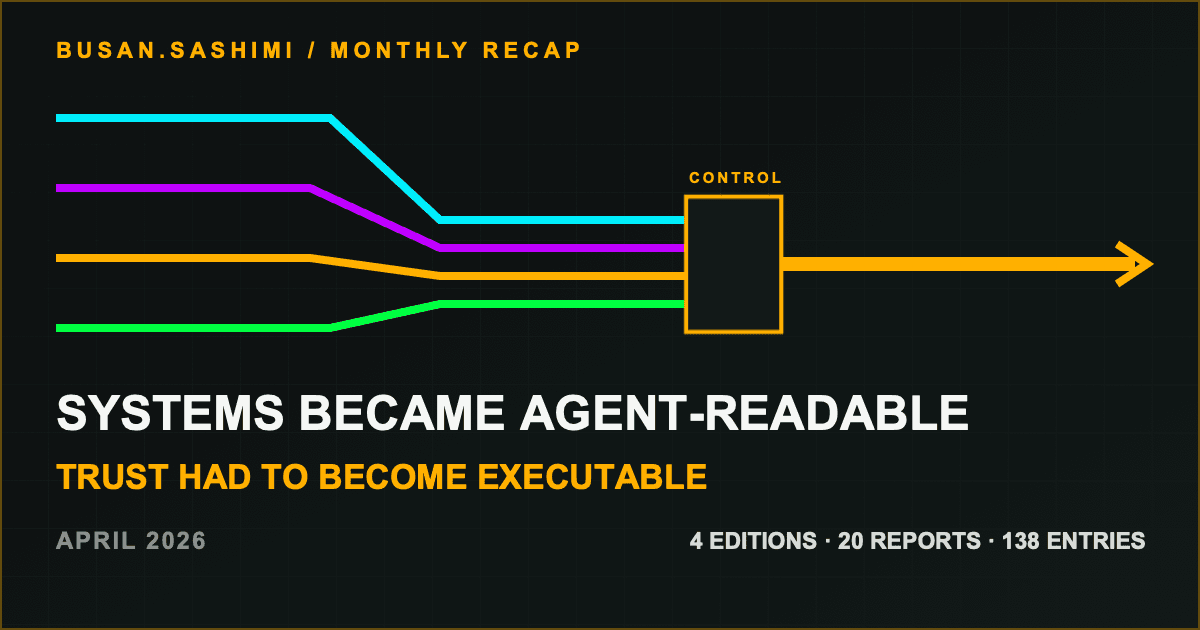
Monthly Recap
April 2026 Monthly Recap: Agent-Ready Systems Became a Security Requirement
Four Weekly Digest editions showed native toolchains and agent-readable interfaces maturing while package compromise and integration risk made machine-readable rules essential.
July in numbers
- Weekly editions
- 4
- Category reports
- 20
- Digest entries
- 138
The month capability and control scaled together
April's durable shift was that documentation, design systems, toolchains, and security boundaries all had to become machine-readable without becoming machine-trusting.
April 2026 made agent readiness look less like a chatbot feature and more like systems architecture. Storybook exposed component metadata through MCP. Sites experimented with Markdown negotiation, llms.txt discovery, and compact documentation designed for agent context windows. Vite 8, TypeScript 7 work, and ES2026 features continued moving toolchains toward native execution and standard primitives. The common ambition was to give machines a more precise contract so they could operate with less guesswork.
Precision did not create safety by itself. Malicious axios releases used a maintainer-account compromise to deliver a remote-access payload. A compromised Bitwarden CLI package arrived through a trusted distribution path and targeted developer credentials, including agent-tool tokens. OAuth integrations and out-of-band framework patches reinforced the same point: an agent-readable system exposes more interfaces to automation, and every automated interface needs authentication, least privilege, provenance, and a rollback path. April turned machine-readable context into a security requirement.
That combination is the month's durable lesson. agent-readable contracts replaced prompt-only integration; native execution and standards compressed the toolchain; trusted integrations became execution paths for attackers; agent scale increased the value of engineering judgment. None of these arcs can be evaluated through output volume alone. The useful question is whether the system made correct change cheaper to verify and safer to reverse. A faster compiler, a declarative API, or an agent fleet creates durable value only when its compatibility, permissions, and failure behavior are visible to the people operating it.
April in numbers
The corpus contains 4 complete Weekly Digest editions and 20 category reports, but its counts describe the publication archive rather than the whole industry.
This recap draws from 4 Weekly Digest editions published in April: W14, W15, W16, W17. They contain 20 category reports and 138 digest entries. The source index preserves 138 distinct archived external URLs and 80 source keys. We verified all 60 localized issue URLs across English, Korean, and Japanese and ran the weekly schema and editorial checks before treating the cohort as evidence.
These totals need boundaries. The cohort uses each edition's publication time in Asia/Seoul and includes the complete edition rather than splitting a cross-boundary week. A digest entry is an editorial row, not proof of an independent event, and 138 archived URLs are not a census of everything published in April. The value comes from applying the same five editorial lenses to consecutive releases and then following only themes that recur or materially change.
Context became infrastructure
Storybook MCP, Markdown delivery, llms.txt, and compact documentation moved agent context into versioned product surfaces.
Storybook 10.3 provided three MCP-facing layers for development, documentation, and testing, giving agents a structured path to components instead of asking them to infer a design system from screenshots. Agentic Engine Optimization made a similar case for documentation: quick-start material under 15,000 tokens, API references under 25,000, Markdown-first formatting, and discovery indexes. Evil Martians narrowed the advice further to clean .md routes and HTTP content negotiation. Context was becoming a maintained interface with budgets and tests.
A large context window does not make unclear documentation precise. The useful change was moving knowledge from private meetings and sprawling pages into versioned artifacts that both humans and tools could query. That improves more than generation: it makes drift visible in code review and gives teams one place to correct a rule. The caveat is authority. Reading component metadata should not grant publication access, and serving Markdown should not expose private source. Context and capability need separate permissions.
The month progressed from component-level MCP to site-level content negotiation and explicit token budgets. Machine readability is a discoverability contract, not an authorization grant. The operational consequence is concrete: Version agent-facing documentation beside the code, test links and examples, and expose only the minimum public context needed for the task. This is the difference between adopting a headline and changing a system. The first adds another dependency or workflow; the second defines ownership, evidence, and a safe way back when the assumption fails.
Speed came from rebuilding the layer below
TypeScript 7, Vite 8, Node.js, ES2026, and browser releases moved performance and semantics into shared implementations.
TypeScript 7's Go compiler work reported 8–10× type-checking and roughly three times lower memory in the cited migration tests. Vite 8, Vite+ open sourcing, and Oxlint plugin compatibility placed build, lint, and format work on a native path. Node.js stabilized require(esm) and advanced built-in SQLite, while ES2026 coverage moved Temporal and explicit resource management into the language baseline. Browser releases added more scroll, shape, transition, and containment behavior. The toolchain was getting smaller by making shared layers stronger.
Native does not mean compatible by default. Compiler APIs, framework adapters, custom ESLint rules, and deployment hooks sit exactly where a rewrite can break an established workflow. April's best evidence paired headline speed with migration boundaries. Teams should maintain a representative compatibility suite before replacing the compiler or bundler, and should compare memory, incremental behavior, source maps, and error output—not only clean-build time. A faster tool that obscures failures can increase total delivery time.
The month connected compiler rewrites, consolidated tools, language standards, and browser primitives into one lower-layer investment cycle. Early performance reports establish possibility, not a universal production result. The operational consequence is concrete: Build a migration fixture that exercises framework plugins, declaration output, source maps, incremental builds, and CI before changing the default tool. This is the difference between adopting a headline and changing a system. The first adds another dependency or workflow; the second defines ownership, evidence, and a safe way back when the assumption fails.
The compromise arrived through familiar tools
axios, Bitwarden CLI, extensions, OAuth apps, and patch channels showed that trusted distribution was part of the attack surface.
The axios compromise used the most ordinary-looking path possible: a familiar package, plausible versions, and a maintainer publishing channel. The malicious releases delivered a remote-access payload through install behavior. By the final week, @bitwarden/cli 2026.4.0 had become a self-propagating worm that harvested SSH, cloud, npm, environment, and agent-tool credentials. OAuth application compromise and out-of-band framework patches added further evidence that trusted integrations, not obscure downloads, were the highest-value execution path.
Reputation and provenance still matter, but neither answers what a newly published artifact does. Teams need a delay and inspection layer between upstream publication and privileged execution: immutable lockfiles, minimum package age, lifecycle-script approval, artifact diffs, isolated install jobs, and alerts when a trusted dependency suddenly adds binaries or credential access. Recovery must assume the process read every secret available to it. Rotating only the token named in an advisory is not enough when developer agents aggregate access across services.
April moved from a compromised library account to a worm that explicitly targeted the credentials of modern agentic development. Even signed or provenance-attested artifacts can be malicious when the trusted publishing identity is compromised. The operational consequence is concrete: Separate install from build, build from deploy, and developer credentials from automation credentials so one artifact cannot traverse the entire delivery chain. This is the difference between adopting a headline and changing a system. The first adds another dependency or workflow; the second defines ownership, evidence, and a safe way back when the assumption fails.
The harness mattered more than the model headline
AEO, durable workflows, design principles, and measured AI slowdowns all favored explicit constraints over maximal generation.
Agentic Engine Optimization argued that the interface around a model—documentation shape, examples, discoverability, and token budgets—could improve outcomes without another model upgrade. Elsewhere, harness changes moved the same model dramatically on Terminal Bench. A counter-signal came from mature-codebase work: developers reported feeling 20% faster with assistance while a cited METR study measured them completing tasks 19% slower. Perceived acceleration and delivered acceleration were not the same metric.
Experienced engineering became more valuable because agents made plausible output cheap. The scarce skills were problem framing, reference selection, architecture boundaries, risk classification, and knowing when a nearly correct change would create future coupling. April's practical distinction was green, yellow, and red work: automate low-risk, easily verified tasks; increase review for integration work; and slow down around authentication, money, privacy, and distributed state. That is a portfolio policy for attention, not a judgment about one model.
The month replaced model-centric enthusiasm with evidence that context and task selection determined net value. One productivity study cannot predict every codebase, but the mismatch between feeling and timing demands local measurement. The operational consequence is concrete: Measure end-to-end completion, review, and rework by task risk; improve the harness before buying more autonomy. This is the difference between adopting a headline and changing a system. The first adds another dependency or workflow; the second defines ownership, evidence, and a safe way back when the assumption fails.
A practical operating plan
The month's gains become durable only when migration, security, accessibility, and review controls are designed as part of delivery.
Create one source of truth for each machine-consumed contract: component metadata in Storybook, design intent in tokens and principles, site content in accessible HTML and optional Markdown, and architecture rules in short human-maintained files. Then wrap those contracts with controls: immutable package pins, restricted lifecycle scripts, scoped OAuth, secret-free sandboxes, and deterministic checks after every agent action. Machine readability should reduce ambiguity, not expand authority.
A useful review can be organized around four questions. What capability is being added? Which human, service, or agent receives new authority? What deterministic evidence proves the change works and remains accessible? How quickly can the team stop or reverse it? Apply those questions to context became infrastructure, speed came from rebuilding the layer below, the compromise arrived through familiar tools, the harness mattered more than the model headline. They turn a monthly trend report into a backlog of testable controls rather than a list of technologies to chase.
What to watch next
The watchlist names unresolved signals, not predictions, and should be retired when owner evidence changes.
Watch TypeScript's native compiler and Vite's consolidated toolchain for compatibility boundaries, Storybook's MCP integration for measurable design-system reuse, and content negotiation for real crawler and agent adoption. The higher-risk watch item is integration compromise: package accounts, OAuth apps, CLI releases, and agent configuration files were all becoming privileged execution paths. Any new convenience that can invoke tools should receive the same threat modeling as an API.
The strongest watch signal is convergence across independent layers. If a browser feature gains multi-engine support, a native toolchain preserves plugin compatibility, a registry default blocks a recurring attack, or an agent workflow lowers review and incident cost in measured production use, the theme becomes more actionable. If those signals diverge, teams should preserve the fallback and keep the claim narrow.
Methodology and sources
This article synthesizes Weekly Digest editions published in April 2026 and freezes ordinary follow-up evidence at the month's final second in Asia/Seoul.
Membership is mechanical: include a complete Weekly Digest when its meta.publishedAt falls inside April 2026 in Asia/Seoul. That selects W14, W15, W16, W17. Every included edition has content, translations, and article metadata; its local Zod and editorial validation passed; and its five issue pages returned HTTP 200 in English, Korean, and Japanese. The recap does not claim that every underlying event happened inside the calendar month.
Theme claims map to archived weekly stories in theme-ledger.json. Follow-up research was limited to storylines already present in the cohort and owner or high-trust pages loaded through Chrome. Ordinary evidence is frozen at 2026-04-30T23:59:59+09:00; later material would be recorded as a correction rather than silently changing the historical narrative. Search snippets were not treated as evidence, inaccessible pages were omitted, and reported benchmarks retain their original scope.
What to carry forward
- Version agent-facing documentation beside the code, test links and examples, and expose only the minimum public context needed for the task.
- Build a migration fixture that exercises framework plugins, declaration output, source maps, incremental builds, and CI before changing the default tool.
- Separate install from build, build from deploy, and developer credentials from automation credentials so one artifact cannot traverse the entire delivery chain.
- Measure end-to-end completion, review, and rework by task risk; improve the harness before buying more autonomy.
Sources and Weekly Digest editions
- Weekly Digest W14: javascript
- Weekly Digest W14: styling
- Weekly Digest W14: design systems
- Weekly Digest W14: tech news
- Weekly Digest W14: web dev general
- Weekly Digest W15: javascript
- Weekly Digest W15: styling
- Weekly Digest W15: design systems
- Weekly Digest W15: tech news
- Weekly Digest W15: web dev general
- Weekly Digest W16: javascript
- Weekly Digest W16: styling
- Weekly Digest W16: design systems
- Weekly Digest W16: tech news
- Weekly Digest W16: web dev general
- Weekly Digest W17: javascript
- Weekly Digest W17: styling
- Weekly Digest W17: design systems
- Weekly Digest W17: tech news
- Weekly Digest W17: web dev general
- Storybook 10.3
- Tales from the Void: March 2026 Recap
- axios compromised on npm: maintainer account hijacked, RAT deployed
- Agentic Engine Optimization (AEO)