Monthly Recap
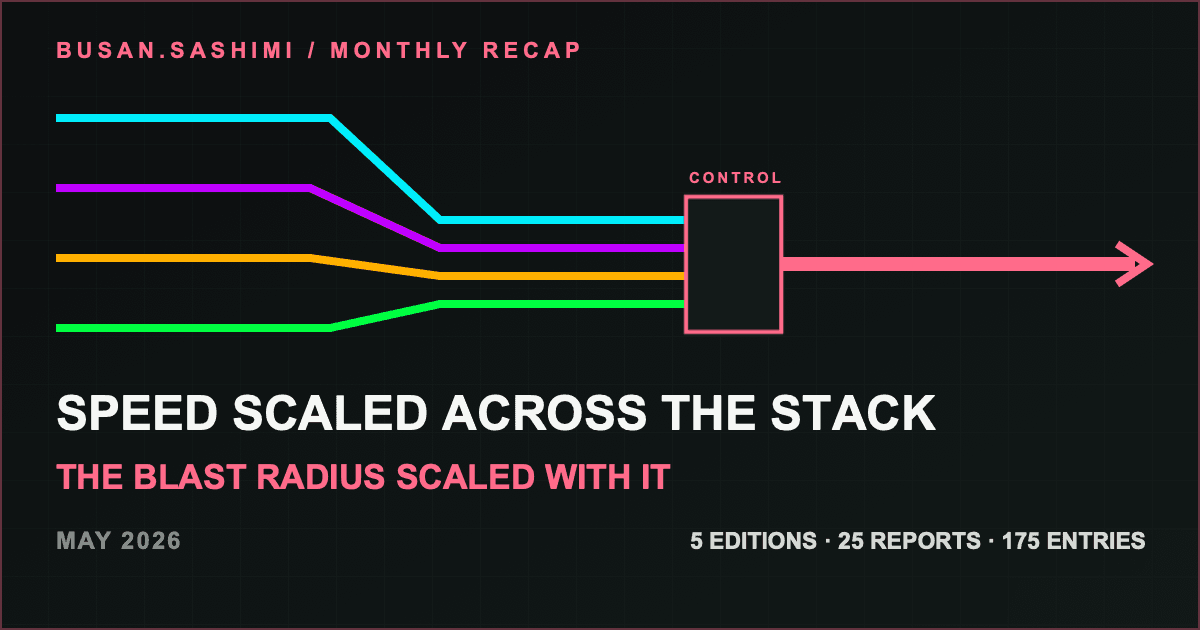
May 2026 Monthly Recap: Speed Scaled, and So Did the Blast Radius
Five Weekly Digest editions showed runtimes, CSS, and agent workflows getting faster while self-spreading package attacks and review bottlenecks enlarged the cost of every mistake.
July in numbers
- Weekly editions
- 5
- Category reports
- 25
- Digest entries
- 175
The month capability and control scaled together
May showed that scaling delivery without scaling containment simply moves the bottleneck from creation to incident response and review.
May 2026 delivered an unusually coherent performance story. Node.js 26 enabled Temporal by default. Rolldown 1.0 declared production readiness with Rollup plugin compatibility. Deno 2.8 pushed Node API compatibility and cold-install performance forward. CSS if(), contrast-color(), gap decorations, and declarative partial updates kept transferring conditional UI work into the platform. Storybook 10.4 and design-system agents tried to turn tests, mocks, tokens, and accessibility knowledge into reusable generation constraints. The stack could do more work with less ceremony.
That increased capacity also increased the blast radius of weak boundaries. A TanStack package compromise became a detailed postmortem, but the wider Mini Shai-Hulud campaign continued across packages and organizations, carried persistence into editor and agent configuration, and demonstrated that valid provenance could coexist with malicious behavior. The human side showed the same scaling problem: more agents created an orchestration tax because review remained serial. May's lesson was not to slow every system down. It was to scale containment and review capacity with generation capacity.
That combination is the month's durable lesson. runtime and build performance became the default product story; native css and html absorbed more conditional ui; self-spreading package attacks enlarged the blast radius; agent throughput hit a human review ceiling. None of these arcs can be evaluated through output volume alone. The useful question is whether the system made correct change cheaper to verify and safer to reverse. A faster compiler, a declarative API, or an agent fleet creates durable value only when its compatibility, permissions, and failure behavior are visible to the people operating it.
May in numbers
The corpus contains 5 complete Weekly Digest editions and 25 category reports, but its counts describe the publication archive rather than the whole industry.
This recap draws from 5 Weekly Digest editions published in May: W18, W19, W20, W21, W22. They contain 25 category reports and 175 digest entries. The source index preserves 175 distinct archived external URLs and 91 source keys. We verified all 75 localized issue URLs across English, Korean, and Japanese and ran the weekly schema and editorial checks before treating the cohort as evidence.
These totals need boundaries. The cohort uses each edition's publication time in Asia/Seoul and includes the complete edition rather than splitting a cross-boundary week. A digest entry is an editorial row, not proof of an independent event, and 175 archived URLs are not a census of everything published in May. The value comes from applying the same five editorial lenses to consecutive releases and then following only themes that recur or materially change.
The fast path became mainstream
Node.js 26, Rolldown 1.0, Deno 2.8, Bun, and Astro moved runtime and build gains into supported releases.
Node.js 26 enabled Temporal by default and began the path toward its October LTS promotion while removing older APIs. Rolldown 1.0 declared production readiness with Rollup plugin compatibility; cited teams reported 57–64% build-time reductions. Deno 2.8 reported 76.4% Node API compatibility and 3.66× faster cold npm installs. Bun added image and HTTP/3 work, while Astro's Rust pipeline continued reducing build time. Performance was no longer a preview-only differentiator. It was shipping as a supported product contract.
Supported does not mean interchangeable. Node's LTS timing, Rolldown plugin behavior, Deno's compatibility gaps, and Bun's evolving APIs each affect a different risk surface. May's evidence favors staged adoption: put the new runtime or bundler behind reproducible builds, compare production traces, and retain a rollback artifact until the workload is stable. The strategic payoff comes when a faster shared layer lets teams delete private scripts and configuration, not when two toolchains run forever.
The month moved from major releases to compatibility and install metrics that could support real migration decisions. Vendor and adopter benchmarks must be reproduced on the repository, deployment target, and traffic shape that will bear the risk. The operational consequence is concrete: Define exit criteria for the old tool before starting a migration, including plugin parity, source maps, deploy reproducibility, and rollback time. This is the difference between adopting a headline and changing a system. The first adds another dependency or workflow; the second defines ownership, evidence, and a safe way back when the assumption fails.
The browser learned more application logic
CSS if(), contrast-color(), gap decorations, and declarative partial updates moved logic from libraries into standards.
CSS if() brought style, media, and feature conditions into a property value in Chrome, while contrast-color() moved accessible black-or-white text selection into style calculation. Gap decorations and sibling functions targeted familiar grid and animation hacks. Declarative Partial Updates went further, proposing out-of-order HTML streaming and insertion without application JavaScript. The details varied from Baseline features to flags and partial engine support, but May's browser story was unmistakable: standards were taking on conditional UI and streaming responsibilities.
Native logic can reduce dependency and hydration cost, but only if teams keep semantics and support status visible. A color function does not prove the entire theme meets contrast requirements. A declarative update does not define application authorization. A Chrome flag is not a cross-browser contract. The right approach is a progressive stack: semantic HTML first, native enhancement second, tested fallback third. This allows teams to adopt platform gains without converting standards enthusiasm into production exclusion.
The month moved from conditional styling to declarative streaming, widening the definition of browser-owned application behavior. Native capability reduces custom code but does not replace product-state, security, or accessibility decisions. The operational consequence is concrete: Record feature status beside each component recipe and test forced colors, keyboard flow, server authorization, and no-support fallbacks. This is the difference between adopting a headline and changing a system. The first adds another dependency or workflow; the second defines ownership, evidence, and a safe way back when the assumption fails.
A package incident became an ecosystem incident
TanStack's postmortem and successive Mini Shai-Hulud waves showed how credentials, provenance, and editor persistence enabled propagation.
The TanStack postmortem documented a compromise that turned routine installation into credential theft. Mini Shai-Hulud then spread across more than 160 package names and later reached @antv packages with roughly 1.1 million weekly downloads. The campaign could arrive with valid SLSA Build Level 3 provenance because the trusted build identity itself had been abused. It also wrote persistence into editor and agent configuration, so removing the named package did not necessarily end execution. The unit of recovery had expanded from dependency to workstation and account graph.
May broke the comforting assumption that provenance equals benign behavior. Provenance can establish who built an artifact and how; it cannot prove that a compromised identity intended something safe. Teams need controls before, during, and after installation: minimum package age, immutable lockfiles, lifecycle-script allowlists, isolated runners, egress restrictions, secret scanning, and alerts for changes to editor or agent settings. Incident playbooks should rotate every reachable credential and check persistence locations, not wait for a second indicator.
Each weekly update widened the affected namespace and added a new persistence or trust-bypass technique. No single registry policy can protect credentials that are already available to a compromised process. The operational consequence is concrete: Reduce the secrets present at install time, monitor configuration files as executable policy, and rehearse whole-account recovery. This is the difference between adopting a headline and changing a system. The first adds another dependency or workflow; the second defines ownership, evidence, and a safe way back when the assumption fails.
The serial stage did not disappear
The orchestration tax, cognitive surrender, and supervised-agent data showed that review capacity—not agent count—set sustainable throughput.
The orchestration-tax argument named the basic queueing problem: agents can produce in parallel, but expert review and product judgment remain serial. Other May evidence warned about cognitive surrender, citing controlled cases where people accepted wrong AI answers 73% of the time. A developer survey reported 63% keeping agents supervised. Storybook 10.4 offered a constructive direction by automating mock setup, stories, and interaction tests for up to 10 components, using deterministic checks to reduce routine review rather than pretending review could be removed.
Adding agents beyond review capacity increases work in progress, context switching, and stale assumptions. The answer is not to reserve every keystroke for a senior engineer. It is to mechanize repeatable evidence—types, tests, accessibility checks, security policy, visual diffs—so humans review the decisions that cannot be reduced to a predicate. Teams should size agent fleets to validated throughput and use queues with explicit ownership. Unreviewed output is inventory, not progress.
May moved from agent-assisted implementation to a clearer model of the review queue and the automation needed around it. Supervision is not meaningful when reviewers lack time or context to challenge plausible output. The operational consequence is concrete: Measure arrival rate, review time, rejection, and rework; cap work in progress before adding another agent lane. This is the difference between adopting a headline and changing a system. The first adds another dependency or workflow; the second defines ownership, evidence, and a safe way back when the assumption fails.
A practical operating plan
The month's gains become durable only when migration, security, accessibility, and review controls are designed as part of delivery.
Adopt performance improvements with explicit failure budgets. Test Node, Rolldown, and Deno migrations against cold installs, plugin compatibility, memory, and rollback. Put native CSS behind support checks and accessibility tests. For packages, require minimum age, immutable versions, install-script approval, and isolated credentials. For agents, cap concurrency at the number of changes humans can deeply review, and route routine checks through deterministic automation so reviewers spend attention on architecture, security, and product behavior.
A useful review can be organized around four questions. What capability is being added? Which human, service, or agent receives new authority? What deterministic evidence proves the change works and remains accessible? How quickly can the team stop or reverse it? Apply those questions to the fast path became mainstream, the browser learned more application logic, a package incident became an ecosystem incident, the serial stage did not disappear. They turn a monthly trend report into a backlog of testable controls rather than a list of technologies to chase.
What to watch next
The watchlist names unresolved signals, not predictions, and should be retired when owner evidence changes.
Watch whether Node.js 26's October LTS path and Rolldown's stable plugin contract hold under broad production use, whether CSS if() and declarative HTML updates progress beyond limited engines, and whether design-system agents improve measured accessibility rather than only story count. On supply-chain defense, watch for registry policies that block self-propagation and for persistence in editor or agent settings that survives package removal.
The strongest watch signal is convergence across independent layers. If a browser feature gains multi-engine support, a native toolchain preserves plugin compatibility, a registry default blocks a recurring attack, or an agent workflow lowers review and incident cost in measured production use, the theme becomes more actionable. If those signals diverge, teams should preserve the fallback and keep the claim narrow.
Methodology and sources
This article synthesizes Weekly Digest editions published in May 2026 and freezes ordinary follow-up evidence at the month's final second in Asia/Seoul.
Membership is mechanical: include a complete Weekly Digest when its meta.publishedAt falls inside May 2026 in Asia/Seoul. That selects W18, W19, W20, W21, W22. Every included edition has content, translations, and article metadata; its local Zod and editorial validation passed; and its five issue pages returned HTTP 200 in English, Korean, and Japanese. The recap does not claim that every underlying event happened inside the calendar month.
Theme claims map to archived weekly stories in theme-ledger.json. Follow-up research was limited to storylines already present in the cohort and owner or high-trust pages loaded through Chrome. Ordinary evidence is frozen at 2026-05-31T23:59:59+09:00; later material would be recorded as a correction rather than silently changing the historical narrative. Search snippets were not treated as evidence, inaccessible pages were omitted, and reported benchmarks retain their original scope.
What to carry forward
- Define exit criteria for the old tool before starting a migration, including plugin parity, source maps, deploy reproducibility, and rollback time.
- Record feature status beside each component recipe and test forced colors, keyboard flow, server authorization, and no-support fallbacks.
- Reduce the secrets present at install time, monitor configuration files as executable policy, and rehearse whole-account recovery.
- Measure arrival rate, review time, rejection, and rework; cap work in progress before adding another agent lane.
Sources and Weekly Digest editions
- Weekly Digest W18: javascript
- Weekly Digest W18: styling
- Weekly Digest W18: design systems
- Weekly Digest W18: tech news
- Weekly Digest W18: web dev general
- Weekly Digest W19: javascript
- Weekly Digest W19: styling
- Weekly Digest W19: design systems
- Weekly Digest W19: tech news
- Weekly Digest W19: web dev general
- Weekly Digest W20: javascript
- Weekly Digest W20: styling
- Weekly Digest W20: design systems
- Weekly Digest W20: tech news
- Weekly Digest W20: web dev general
- Weekly Digest W21: javascript
- Weekly Digest W21: styling
- Weekly Digest W21: design systems
- Weekly Digest W21: tech news
- Weekly Digest W21: web dev general
- Weekly Digest W22: javascript
- Weekly Digest W22: styling
- Weekly Digest W22: design systems
- Weekly Digest W22: tech news
- Weekly Digest W22: web dev general
- Node.js 26.0.0 (Current)
- Algorithmic Theming Engines: Building Self-Correcting Color Systems With contrast-color()
- Postmortem: TanStack npm supply-chain compromise
- Storybook 10.4