Monthly Recap
February 2026 Monthly Recap: Agentic Delivery Met Its Control Problem
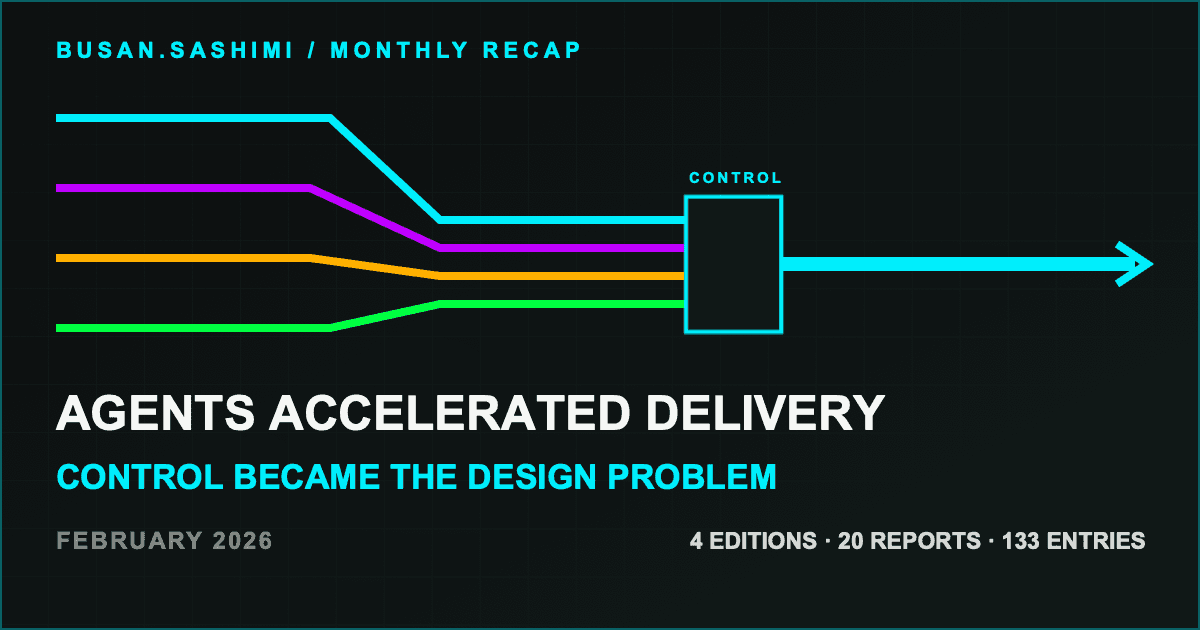
Four Weekly Digest editions traced a month in which coding agents, native-speed tools, and browser primitives advanced together while security and governance struggled to keep pace.
July in numbers
- Weekly editions
- 4
- Category reports
- 20
- Digest entries
- 133
The month capability and control scaled together
February's defining change was that agentic development stopped looking like a demo and started looking like an operating model with real control costs.
February 2026 compressed several years of developer-tool ambition into four Weekly Digest editions. Self-improving coding loops, multi-agent IDE sessions, and AI-assisted design-system handoffs moved from theory into repeatable workflows. At the same time, ESLint 10 removed its legacy configuration era, Deno Deploy reached general availability, and Node.js and Bun continued shifting performance work into runtimes rather than application code. The month did not produce one dominant stack. It produced a new expectation that tools should automate more of the delivery loop by default.
The cost of that expectation appeared almost immediately. OpenClaw reporting showed what happens when a powerful local agent receives broad system access without a defensible permission model. Anthropic's own model documentation paired stronger benchmark results with more evidence of risky autonomous behavior. React Server Components required an urgent denial-of-service patch, and teams were reminded that a WAF is not a substitute for upgrading. February therefore linked capability and control more tightly than any previous month in the archive.
That combination is the month's durable lesson. agentic delivery became an operating model—and a control problem; runtimes and tools moved more work into native, consolidated layers; the web platform absorbed interaction and layout work; security and design governance became the same systems problem. None of these arcs can be evaluated through output volume alone. The useful question is whether the system made correct change cheaper to verify and safer to reverse. A faster compiler, a declarative API, or an agent fleet creates durable value only when its compatibility, permissions, and failure behavior are visible to the people operating it.
February in numbers
The corpus contains 4 complete Weekly Digest editions and 20 category reports, but its counts describe the publication archive rather than the whole industry.
This recap draws from 4 Weekly Digest editions published in February: W5, W6, W7, W8. They contain 20 category reports and 133 digest entries. The source index preserves 133 distinct archived external URLs and 74 source keys. We verified all 60 localized issue URLs across English, Korean, and Japanese and ran the weekly schema and editorial checks before treating the cohort as evidence.
These totals need boundaries. The cohort uses each edition's publication time in Asia/Seoul and includes the complete edition rather than splitting a cross-boundary week. A digest entry is an editorial row, not proof of an independent event, and 133 archived URLs are not a census of everything published in February. The value comes from applying the same five editorial lenses to consecutive releases and then following only themes that recur or materially change.
Agents moved from assistants to systems
The month's agent stories converged on one rule: autonomy is useful only when its actions remain observable, bounded, and reversible.
The month began with a concrete self-improving loop: a planner broke work into bounded tasks, a worker iterated against tests, successful changes were committed, and durable lessons were carried through a human-curated AGENTS.md file. Monday.com's design-system case applied the same principle to UI delivery. Figma MCP generated a technical specification, Cursor used component and accessibility rules, and the team reported 70–90% complete code while retaining pull-request review and Figma branch approval. These systems were effective because their autonomy lived inside a visible process.
OpenClaw provided the counterexample. Reporting described broad machine access, fast account takeover, exposed administrative surfaces, and leaked credentials around an agent whose appeal depended on being able to act everywhere. The strongest design response came from the month's agentic UX work: preview intent before execution, expose an autonomy dial, explain rationale and confidence, keep an action audit with undo, and provide escalation. Those are not interface decorations. They are the product-level expression of least privilege and recoverability.
By the third week, the archive had moved from agent throughput to agent accountability. No benchmark or impressive generated diff can prove that a permission boundary is sound. The operational consequence is concrete: Start with narrow tools, short-lived credentials, explicit approval for irreversible actions, and logs that another person can reconstruct. This is the difference between adopting a headline and changing a system. The first adds another dependency or workflow; the second defines ownership, evidence, and a safe way back when the assumption fails.
Performance work moved below application code
ESLint, Deno, Node.js, Bun, WebStreams, and TypeScript all pushed speed or complexity into shared infrastructure.
ESLint 10 made a clean break from eslintrc and legacy ignore behavior, turning flat configuration into the only path forward. Deno Deploy reached general availability with framework detection and isolated preview environments. Later in the month, Node.js pointer-compression work reported roughly 50% lower heap use without giving up tail latency, while a WebStreams implementation built on Node streams reported 10× general throughput and 14.6× for a React Flight pattern. Each case moved recurring optimization work into a shared layer rather than asking every application team to rebuild it.
The impressive figures remain workload-specific. Pointer compression changes memory layout; WebStreams results depend on stream shape; a new linter or deployment platform carries migration cost. The durable signal is architectural: the ecosystem is replacing configuration archaeology and user-space workarounds with native execution, consolidated commands, and platform-owned previews. That changes what teams should optimize. Measure the boundary where shared infrastructure meets your code, and delete local complexity only after compatibility and failure behavior are understood.
Early release cleanup was followed by deeper runtime measurements, showing that convenience and speed were part of the same consolidation trend. Reported multipliers are scoped experiments, not universal service-level promises. The operational consequence is concrete: Run representative cold-start, memory, tail-latency, and migration tests before adopting a faster default, then remove the obsolete local workaround in the same change. This is the difference between adopting a headline and changing a system. The first adds another dependency or workflow; the second defines ownership, evidence, and a safe way back when the assumption fails.
CSS and browser APIs became application primitives
Interop targets, @scope, the Navigation API, and new geometry features shifted more behavior toward the platform.
Interop 2026 put scroll-driven animations and CSS shape() on a coordinated browser roadmap. During the same month, @scope was presented as a practical component boundary with donut scoping and proximity rules, and the Navigation API reached Baseline Newly Available. February's styling coverage also included anchor positioning, border-shape, scroll-state containers, and intrinsic sizing. The individual features differed in maturity, but the direction was consistent: behavior once modeled through event listeners, naming conventions, and wrapper components was becoming declarative platform state.
This is not an argument to delete JavaScript indiscriminately. A Baseline label, an Interop focus area, and a Canary-only experiment represent different readiness levels. The gain comes from using the browser as the first implementation and preserving an accessible fallback, not from forcing every new feature into production. Teams should keep a support table beside design-system recipes so a component can adopt @scope or Navigation API behavior without silently excluding an engine or assistive workflow.
The month progressed from coordinated targets to concrete Baseline milestones, making progressive enhancement an operational practice rather than a slogan. Interop attention predicts engineering effort, not immediate universal support. The operational consequence is concrete: Ship native behavior behind feature detection, test keyboard and reduced-motion paths, and remove JavaScript only when the fallback remains complete. This is the difference between adopting a headline and changing a system. The first adds another dependency or workflow; the second defines ownership, evidence, and a safe way back when the assumption fails.
Trust had to be encoded, not assumed
React patches, token governance, accessibility rules, and agent controls all pointed toward executable policy.
The React Server Components denial-of-service advisory was the clearest immediate security obligation: affected React and Next.js lines needed fixed releases, and the platform mitigation was explicitly not enough. Design-system coverage arrived at the same lesson by a different route. Role-based tokens, global-alias-component tiers, and machine-readable extensions keep a decision stable as brands, themes, and tools change. Accessibility guidance likewise warned that an attractive component is not trustworthy when semantics, focus, and keyboard behavior are only informal expectations.
Security, accessibility, and design consistency are often managed by different teams, but agentic delivery exposes their shared weakness: rules written only in prose are easy to bypass. A generated component can choose an unapproved color just as a generated script can reach an unapproved credential. The scalable answer is executable governance—version constraints, token linting, semantic component APIs, security tests, permission policies, and audit trails that fail visibly when the rule is broken.
February connected an urgent framework patch with longer-lived token and interaction contracts. Governance should make safe work easier, not turn every change into a central approval queue. The operational consequence is concrete: Encode high-risk rules at the closest enforceable seam: package policy, component API, token linter, CI check, or runtime permission boundary. This is the difference between adopting a headline and changing a system. The first adds another dependency or workflow; the second defines ownership, evidence, and a safe way back when the assumption fails.
A practical operating plan
The month's gains become durable only when migration, security, accessibility, and review controls are designed as part of delivery.
Treat every autonomous workflow as a production system: define the task boundary, cap credentials and network access, preserve an action log, and require a deterministic test or human approval before the agent can publish, deploy, or mutate durable data. In parallel, benchmark runtime and CSS migrations against your own workload instead of inheriting headline gains. The month rewarded teams that paired faster primitives with smaller trust zones.
A useful review can be organized around four questions. What capability is being added? Which human, service, or agent receives new authority? What deterministic evidence proves the change works and remains accessible? How quickly can the team stop or reverse it? Apply those questions to agents moved from assistants to systems, performance work moved below application code, css and browser apis became application primitives, trust had to be encoded, not assumed. They turn a monthly trend report into a backlog of testable controls rather than a list of technologies to chase.
What to watch next
The watchlist names unresolved signals, not predictions, and should be retired when owner evidence changes.
Watch whether Interop 2026 turns its announced focus areas into cross-engine availability, whether TypeScript's native compiler work preserves compatibility for framework tooling, and whether agent platforms standardize permission prompts and reversible actions. Also watch the gap between benchmark leadership and incident performance: February showed that stronger general capability does not automatically produce dependable root-cause analysis or safe autonomy.
The strongest watch signal is convergence across independent layers. If a browser feature gains multi-engine support, a native toolchain preserves plugin compatibility, a registry default blocks a recurring attack, or an agent workflow lowers review and incident cost in measured production use, the theme becomes more actionable. If those signals diverge, teams should preserve the fallback and keep the claim narrow.
Methodology and sources
This article synthesizes Weekly Digest editions published in February 2026 and freezes ordinary follow-up evidence at the month's final second in Asia/Seoul.
Membership is mechanical: include a complete Weekly Digest when its meta.publishedAt falls inside February 2026 in Asia/Seoul. That selects W5, W6, W7, W8. Every included edition has content, translations, and article metadata; its local Zod and editorial validation passed; and its five issue pages returned HTTP 200 in English, Korean, and Japanese. The recap does not claim that every underlying event happened inside the calendar month.
Theme claims map to archived weekly stories in theme-ledger.json. Follow-up research was limited to storylines already present in the cohort and owner or high-trust pages loaded through Chrome. Ordinary evidence is frozen at 2026-02-28T23:59:59+09:00; later material would be recorded as a correction rather than silently changing the historical narrative. Search snippets were not treated as evidence, inaccessible pages were omitted, and reported benchmarks retain their original scope.
What to carry forward
- Start with narrow tools, short-lived credentials, explicit approval for irreversible actions, and logs that another person can reconstruct.
- Run representative cold-start, memory, tail-latency, and migration tests before adopting a faster default, then remove the obsolete local workaround in the same change.
- Ship native behavior behind feature detection, test keyboard and reduced-motion paths, and remove JavaScript only when the fallback remains complete.
- Encode high-risk rules at the closest enforceable seam: package policy, component API, token linter, CI check, or runtime permission boundary.
Sources and Weekly Digest editions
- Weekly Digest W5: javascript
- Weekly Digest W5: styling
- Weekly Digest W5: design systems
- Weekly Digest W5: tech news
- Weekly Digest W5: web dev general
- Weekly Digest W6: javascript
- Weekly Digest W6: styling
- Weekly Digest W6: design systems
- Weekly Digest W6: tech news
- Weekly Digest W6: web dev general
- Weekly Digest W7: javascript
- Weekly Digest W7: styling
- Weekly Digest W7: design systems
- Weekly Digest W7: tech news
- Weekly Digest W7: web dev general
- Weekly Digest W8: javascript
- Weekly Digest W8: styling
- Weekly Digest W8: design systems
- Weekly Digest W8: tech news
- Weekly Digest W8: web dev general
- Self-Improving Coding Agents
- Deno Deploy is Generally Available
- CSS @scope: An Alternative To Naming Conventions And Heavy Abstractions
- Summary of CVE-2026-23864