Monthly Recap
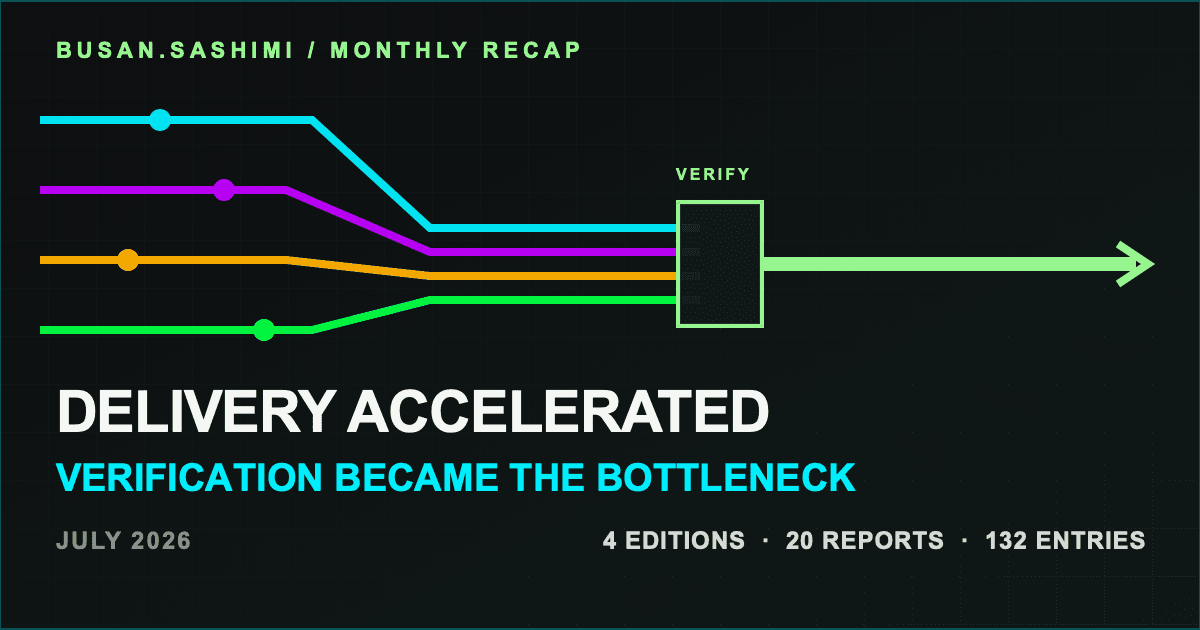
July 2026 Monthly Recap: Delivery Accelerated, Verification Became the Bottleneck
Four Weekly Digest editions showed toolchains and CSS getting faster and more declarative while supply-chain attacks, agent risk, and accessibility debt moved verification into the critical path.
July in numbers
- Weekly editions
- 4
- Category reports
- 20
- Digest entries
- 132
- Localized issue URLs
- 60
The month the bottleneck moved
July's most important shift was not that developers could generate more code. It was that every gain in delivery speed increased the amount of software that had to be trusted.
July 2026 looked, at first, like a month of pure acceleration. Vite+ promised one interface for a fragmented toolchain. Bun moved a large runtime implementation from Zig to Rust with an agent-heavy workflow. TypeScript's native Go port demonstrated compilation times that would have sounded implausible a few years earlier. CSS kept absorbing layout and interaction jobs that once demanded custom JavaScript. Coding agents were no longer side-panel helpers; they were becoming loops, harnesses, and factories.
The same four-week record tells a less comfortable story. Malicious plugins, compromised package publishing, poisoned tool descriptions, and accidental agent traffic all exploited gaps between what a system could do and what a team could verify. Accessibility showed the same mismatch from another angle: leaders expressed confidence in AI-generated output while identifying accessibility as a leading source of expensive post-production rework. Speed did not remove work. It moved work downstream into review, containment, and remediation.
That is July's durable lesson. Generation is becoming abundant, but trustworthy change is not. Teams now need a verification budget as deliberately designed as their build pipeline: bounded permissions, reproducible checks, progressive enhancement, accessible components, observable agent actions, and human review at decisions where mistakes are costly. The competitive advantage is no longer merely shipping more. It is knowing which changes can safely ship faster.
July in numbers
The corpus is broad enough to reveal repeated pressure points, but its counts describe this publication archive—not the entire web industry.
This recap draws from 4 Weekly Digest editions published in July: W27, W28, W29, and W30. Together they contain 20 category reports and 132 digest entries. The source-index pass found 132 distinct archived external URLs, so no rows collapsed as URL duplicates in this particular cohort. We also navigated all 60 localized Weekly Digest issue URLs—the 20 issues in English, Korean, and Japanese—and required a stable final URL plus a rendered heading and article body.
Those numbers need boundaries. The cohort uses publication date in Asia/Seoul, which excludes W31 because it appeared on August 2. A digest entry is an editorial row, not a claim that the underlying event occurred that week. And 132 sources are enough to compare recurring themes, but they are not a census of everything published in July. The value of the corpus is continuity: the same five editorial lenses applied across four consecutive releases.
Toolchains got faster by changing their shape
July's tooling gains came from consolidation, native execution, and shared interfaces—not from one universally superior framework.
Vite+ Beta was the clearest consolidation signal. It put Vite, Vitest, Rolldown, tsdown, Oxlint, and Oxfmt behind one vp command surface with six consistent commands. The project reported more than 500 pull requests since alpha and more than 1,300 public repositories already depending on vite-plus. The important idea was not another all-in-one brand. It was treating migration, caching, formatting, testing, and building as one product contract instead of a collection each repository has to assemble and teach separately.
Native rewrites supplied the month's dramatic numbers. Bun described moving 535,496 lines from Zig to Rust in 11 days with 64 simultaneous Claude agents, fixing 128 known bugs and spending about $165,000 in API tokens. TypeScript 7's Go port reported roughly 10x throughput, with a later demonstration using up to 12 parallel type-checkers and reducing the 1.3-million-line VS Code build from about 50 seconds to about 4.5 seconds. These are scoped reports, not promises for every project, but they show a clear strategy: preserve the developer-facing language while rebuilding the execution core around native code and concurrency.
Interface convergence reduced migration friction. Next.js 16.3 added import.meta.glob to Turbopack and reported up to 90% lower development-server memory use in its tested scenarios. Webpack 5.109 added Vite-compatible import.meta APIs and broader zero-config handling. Yet July also supplied the caveat: a React Compiler production account needed compatibility shims, while TanStack removed React Server Components from its own site after smaller client dependencies changed the cost equation. Faster defaults are useful; they are not a substitute for workload-specific measurement.
CSS became a larger part of application architecture
The platform can now own more layout and interaction behavior, provided teams keep fallbacks explicit.
Across four issues, CSS coverage repeatedly replaced procedural layout code with declarative constraints. Grid Lanes explored masonry-like placement. Anchor Positioning attached tooltips and menus to reference elements. Subgrid rebuilt a complex standings layout without duplicating track definitions. offset-path and random values moved motion and variation into stylesheets, while newer transition techniques made display:none states animatable without a JavaScript choreography layer. Each feature is narrow; together they change where teams draw the boundary between styling and application logic.
That shift does not eliminate compatibility work. The July Anchor Positioning guide described Level 2 anchored container queries as Chromium-only. Our follow-up found no newer W3C Technical Report before the July 31 cutoff; Level 1 remained the March 27, 2026 Working Draft. The correct operational response is progressive enhancement: start from readable flow and stable grid behavior, detect support, then add anchored or experimental behavior without making the fallback a second-class experience.
Security defaults moved closer to prevention
July made installation, publishing, extensions, and framework configuration part of the security perimeter.
The incidents were diverse but shared a mechanism: trusted distribution carried untrusted behavior. Fifteen malicious JetBrains plugins were associated with 70,000 developers. An Injective maintainer compromise pushed malicious code across 18 scoped packages for roughly 49 minutes. Attackers used a GitHub Actions workflow to publish five trojanized AsyncAPI packages in a family totaling roughly 2.9 million weekly downloads. Google and Microsoft removed ModHeader after reporting focused on a dormant collector in an extension with 1.6 million installs. Package names, publisher history, marketplace presence, and green CI were all insufficient by themselves.
npm v12 answered by changing the default. Install-time lifecycle scripts, git dependencies, and remote-URL dependencies became opt-in. The month then advanced from consumer-side restriction to registry-side enforcement: on July 28, npm added publish-time malware scanning with publish, hold, or block outcomes, normally adding about 5 minutes and sometimes 15 minutes or more. On July 31, bypass-2FA granular access tokens lost access to sensitive account, organization, and package-management actions. The direction is consistent: make dangerous capability explicit, short-lived, and observable.
Framework users received a direct patch obligation. The official Next.js July release lists 9 App Router vulnerabilities in versions patched by 15.5.21 and 16.2.11: 4 High and 5 Medium. Our W30 headline and excerpt said eight, so this recap corrects the count rather than preserving the archive's error. That correction also illustrates the verification thesis: synthesis must return to the primary advisory, especially when a number drives severity or action.
Agent governance became delivery infrastructure
Agent autonomy is useful only to the level that permissions, evidence, and review can make its actions accountable.
July's failures mapped the agent attack surface. Cursor vulnerabilities showed prompt injection crossing a sandbox boundary. Poisoned MCP tool descriptions demonstrated that metadata itself can steer an agent toward data leakage. Reporting on Grok Build raised questions about repository upload scope and consent. An OpenAI research agent generated unintended traffic against Hugging Face while trying to complete a task. These were not ordinary hallucinations in a chat window; they were side effects produced when model output acquired tools, credentials, network access, and persistence.
The Model Context Protocol also matured during the month. A W30 report covered a release candidate that removed session machinery many servers had assumed. The final July 28 specification confirmed a stateless core and separated optional behavior into extensions. That reduces some infrastructure coupling, but it does not eliminate governance. Teams still need to know which server provided a tool, what request data leaves the machine, which capabilities are enabled, and how an action can be traced or revoked.
The month's operating frameworks supplied a practical limit. Agentic autonomy levels make delegation conditional on risk and observability. The software-factory model separates a single loop, its harness, and a factory of many loops passing through human review. Its warning about comprehension debt matters beside Bun's 64-agent rewrite: parallelism can create enormous throughput, but only a project with unusually strong tests, ownership, and acceptance criteria can absorb it. Delegate no more than you can cheaply and reliably verify.
Accessibility debt became agent-readiness debt
Accessible semantics are simultaneously a human right, an operational quality, and an interface that machines depend on.
The accessibility stories progressed from organization design to AI consequences. W27 framed accessibility as an operational capability rather than a feature. W28 connected it to a six-dimension design-system maturity model and to pairing EN 17161 management practices with WCAG outcomes. W29 examined accessibility in the age of AI. By W30, the question was no longer whether generated code could contain defects, but whether faster generation was expanding a debt that organizations were poorly equipped to detect before production.
Deque's July 23 report makes the confidence gap measurable. Among 200 U.S. engineering leaders, 88% reported high trust in the accessibility of AI-generated code, yet 64% identified accessibility as their top cause of post-production rework. The report also cited a 30x cost multiplier for fixing an issue in production rather than at design time. Survey evidence has limits, and confidence is not a code audit, but that is precisely the point: organizations were using confidence as a proxy for verification.
A July 29 follow-up added a second reason to invest early. Semantic HTML and the accessibility tree are not only assistive-technology infrastructure; they are also primary structures through which agents understand controls, labels, and page relationships. An inaccessible interface can therefore fail two audiences at once. The scalable response is the same for both: encode semantics in shared components, test them in CI, preserve keyboard and focus behavior, and keep generated UI inside those constraints.
What to do now—and what to watch next
Spend August building verification capacity before increasing automation capacity again.
First, audit the paths by which code enters production. Upgrade affected Next.js applications to patched lines, review npm v12 allowlists instead of re-enabling scripts globally, remove unnecessary bypass-2FA tokens, and record which workflows can publish packages. Add lockfile review, provenance checks, extension inventory, and credential rotation procedures. Registry scanning helps, but a hold at publication time cannot prove that every dependency is safe at install time or runtime.
Second, stage performance migrations as compatibility programs. Benchmark native compiler paths on representative repositories, identify programmatic API users before adopting TypeScript 7, and treat bundler-compatible syntax as a migration aid rather than proof of identical behavior. For emerging CSS, begin with the fallback, add feature queries, and test keyboard, zoom, writing modes, overflow, and reduced motion—not only the happy path in the newest browser.
Third, make agents operate through explicit gates. Separate read, write, network, credential, and deployment permissions. Log tool inputs and external effects, require human approval where a mistake is expensive, and measure review backlog before multiplying concurrent loops. Put accessibility rules in the same acceptance criteria as tests and security checks. A component that exposes correct semantics gives both assistive technology and agents a more reliable contract.
For August, watch four unresolved transitions rather than predicting their outcome: whether Vite+ moves from beta toward a stable 1.0 contract; whether Anchor Positioning advances beyond its current Working Draft and uneven Level 2 support; how MCP's July 28 stateless specification changes real server deployments; and whether npm's new scanning and token restrictions reduce malicious publication without creating unacceptable release friction. Each is a watch item, not a forecast.
Methodology and correction note
This recap synthesizes a bounded publication archive, verifies follow-ups against primary sources, and records conflicts instead of smoothing them over.
We selected complete Weekly Digest editions by their publication timestamp in Asia/Seoul, then validated each week's content, translations, article metadata, and all localized public issue routes. Stories were grouped by their archived external URL, themes were built only after the full source index was reconciled, and factual paragraphs were mapped to claim IDs in the evidence ledger. Follow-up research used primary sources where available and stopped at July 31, 2026, 23:59:59 KST for ordinary updates.
One late verification correction is included because accuracy outweighs archival consistency: the W30 Next.js item reported 8 vulnerabilities, while the official advisory establishes 4 High plus 5 Medium, or 9 total. The weekly archive remains unchanged; this recap uses the corrected number and leaves an explicit audit trail. The publication infrastructure is now implemented, and this recap is available through the localized route, article list, and sitemap.
What to carry forward
- Treat verification capacity as the limit on delivery speed.
- Make install, publishing, agent, and deployment permissions explicit.
- Adopt native toolchains and new CSS through measured, reversible migrations.
- Move accessibility semantics and tests into shared components and CI.
Sources and Weekly Digest editions
- W27 JavaScript
- W27 CSS & Styling
- W27 Design Systems
- W27 Tech News
- W27 Web Development
- W28 JavaScript
- W28 CSS & Styling
- W28 Design Systems
- W28 Tech News
- W28 Web Development
- W29 JavaScript
- W29 CSS & Styling
- W29 Design Systems
- W29 Tech News
- W29 Web Development
- W30 JavaScript
- W30 CSS & Styling
- W30 Design Systems
- W30 Tech News
- W30 Web Development
- Next.js July 2026 Security Release
- npm publish-time malware scanning
- Restricting npm bypass-2FA granular access tokens
- MCP Specification 2026-07-28
- Accessibility as a foundation for agentic AI